About Us · Ontario & Quebec
The People Testing Your Indoor Air
We test and report. We don’t sell the cleanup, so nothing we find puts money in our pocket. Independent air quality testing across Ontario and Quebec since 2005.
20+ years, since 2005
15,000+ inspections
IICRC and InterNACHI certified
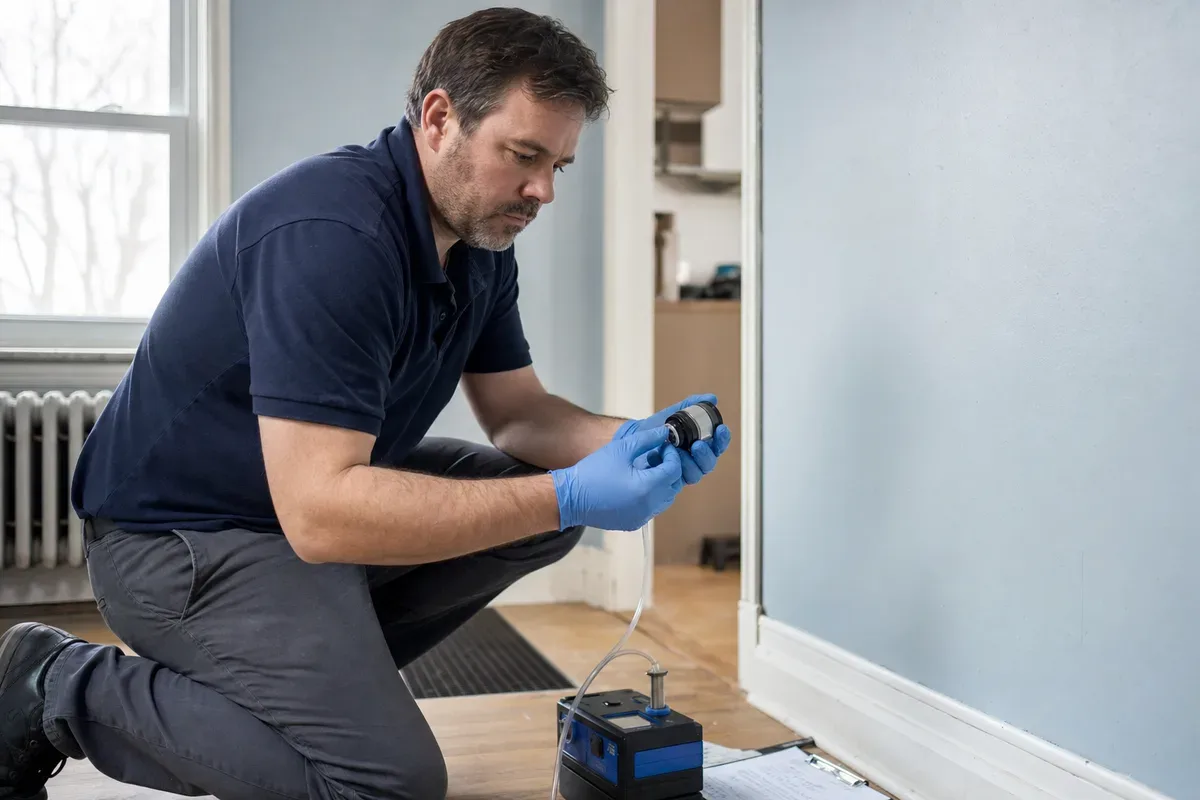
Most companies that test your air also want to sell you the fix. That’s the conflict nobody mentions until the quote arrives. We built this business the other way round: we sample, the lab analyses, you get a written report, and what you do next is your call. If the air is fine, the report says so, and we’ve still done our job.
We’ve been doing it across Ontario and Quebec since 2005. More than 15,000 inspections later, the pattern that keeps repeating is that the thing people are worried about is rarely the thing we find. Someone calls about a smell and we trace it to a slow leak behind a shower wall. Someone calls about mould and the real story is a humidifier running too hard all winter.
Last updated: 31 July 2026
The short version: Air Quality Testing is an independent indoor air quality testing company serving Ontario and Quebec since 2005. Our inspectors are IICRC certified and we belong to the Indoor Air Quality Association. We test for mould and asbestos, run samples through accredited Canadian labs, and deliver a written report you can hand to a contractor, insurer, or buyer. We do not perform remediation, so we have no financial reason to find a problem that isn’t there.
Company Snapshot
| Detail | Air Quality Testing |
|---|---|
| Testing since | 2005 (20+ years) |
| Inspections completed | 15,000+ |
| What we test for | Mould and asbestos |
| Service area | Ontario and Quebec |
| Lab analysis | Independent accredited Canadian laboratories |
| Report turnaround | Typically about 48 hours |
| Do we also do removal? | No. Testing and reporting only |
| Hours | Monday to Friday, 8:00 AM to 3:00 PM |
Why We Don’t Do the Remediation
It’s the question we get asked most, usually phrased as “so who fixes it?” The answer is: someone else, and that’s deliberate. When the same company diagnoses the problem and quotes the repair, every finding doubles as a sales opportunity. We’ve seen enough reports written that way to know how they read.
Keeping the two apart costs us revenue and we think it’s worth it. It also means the report holds up better. An insurer or a buyer’s lawyer reading a mould assessment wants to know the person who wrote it wasn’t about to bid on the teardown. If you want the detail on how we actually run a visit, our air quality inspection process walks through it step by step.
What this means for you: the number in your report is the number the lab produced. There is no upsell attached to it, and no version of the result that earns us more money.
Our Certifications
Indoor air quality testing isn’t a licensed trade in most of Canada. Anyone can buy a pump and call themselves an inspector, which is exactly why credentials are worth checking rather than assuming. Below is what our inspection team actually holds, what each one covers, and where to read about it yourself.
A note on honesty: we link each credential to the organization that issues it, not to a marketing page. Three of the four come from InterNACHI and IAC2, which are related bodies, so we’ve named the issuer on each rather than letting four logos imply four separate authorities. If you want the current qualifications of the specific inspector assigned to your property, ask us before the visit and we’ll tell you.
IICRC Certified
The Institute of Inspection, Cleaning and Restoration Certification is the body that writes the S520 standard for mould assessment and remediation, which is the document our fieldwork follows. About the IICRC
IAC2 Certified
The International Association of Certified Indoor Air Consultants certifies inspectors in indoor air quality assessment. Earning it means holding InterNACHI membership in good standing and completing the approved coursework. About IAC2
Certified Indoor Air Quality Inspector
An InterNACHI credential covering the diagnostic side of the job: reading building conditions, choosing sampling locations that actually mean something, and interpreting lab results against an outdoor control. About this credential
Certified Professional Inspector (CPI)
InterNACHI’s general property inspection credential, which is what lets our inspectors read a building’s construction, age and moisture history instead of only reading a sample result. It requires ongoing coursework and re-examination every three years. About the CPI
Certifications sit across the inspection team rather than with one person, and they get renewed as standards change. The IICRC S520 document we work to has been revised more than once since 2005, and following a standard means following the current version of it.
Professional Memberships
A membership is not a certification, and we’d rather draw that line ourselves than let it blur. Certifications mean training and testing against a standard. Membership means we belong to an industry body, keep up with what it publishes, and are reachable through it.
Indoor Air Quality Association, Corporate Member
The IAQA is the main professional association for indoor air quality practitioners in North America. It sets expectations for member conduct and publishes the guidance our field practice tracks. We hold corporate membership, which is a different thing from a certification and we list it that way on purpose. About the IAQA
How to Check Any of This
Trust is fine, checking is better. Three ways to do it:
Read the issuing body
Every certification above links to the organization behind it, so you can read what the program requires instead of taking our word for the badge.
Ask about your inspector
Call before the visit and ask what the assigned inspector holds. We’ll tell you. If a company won’t answer that question, that itself is an answer.
Read the report
A defensible report names the method, the lab, and the outdoor control taken the same day. Ours does. Vague reports are the ones that fall apart when someone pushes back.
Worth knowing: the IICRC and the IAQA don’t run public lookups where you can type a company name and get a verified record, so any testing company implying you can click straight through to a registry entry is overselling what those directories do. InterNACHI does list certified inspectors publicly, and for anything else, asking us directly is the reliable route.
What We Actually Test For
Two contaminants make up nearly all of our work, and we’d rather be good at those than advertise a list we can’t stand behind.
Mould
Air and surface sampling, always against an outdoor control taken the same day, because an indoor spore count on its own tells you very little. Mould testing
Asbestos
Material and air sampling in buildings old enough to have it, usually before a renovation disturbs something nobody knew was there. Asbestos testing
Odour investigation
When something smells wrong and nothing visible explains it, we sample to find what’s producing it and where it’s coming from. Odour inspection
Homes and businesses
Same methods either way, different scale and reporting. Residential and commercial testing.
Where We Work
We cover Ontario and Quebec, with the bulk of our work along the Ottawa and St. Lawrence river corridors. Montreal, Ottawa, Gatineau, Kingston, Carleton Place, Brockville, Belleville, Cornwall, Kemptville and Orleans all have their own pages with local detail on housing stock and the moisture problems that come with it.
Older limestone and frame housing behaves differently from a 2015 build, and freeze-thaw along the rivers creates condensation patterns you don’t see further inland. Our service areas page lists every city we cover.
How We Handle What We Publish
Everything on this site is reviewed by a certified inspector before it goes live, and we correct things when we get them wrong rather than quietly editing the page. Our editorial policy sets out how we research, review and correct our content, including who signs off and what happens when a reader flags an error.
“In 15,000-plus inspections, the homes that stay healthy are the ones where we found the moisture source, not just the mould. Fix the leak and the air takes care of itself.”
Questions About Who We Are
Yes. Our inspection team holds IICRC certification, which is the body that writes the S520 standard for mould assessment, plus three InterNACHI and IAC2 credentials: IAC2 Certified, Certified Indoor Air Quality Inspector, and Certified Professional Inspector (CPI). We are also a corporate member of the Indoor Air Quality Association. Every certification is listed above with a link to the organization that issues it, and you can ask us what the inspector assigned to your property holds before they arrive.
A certification means someone was trained and tested against an independent standard. A membership means a company belongs to an industry association. They’re often listed together as if they’re the same thing, and they aren’t. We separate them on this page so you can see exactly which is which. The IICRC, InterNACHI and IAC2 certify. The IAQA is an association we hold corporate membership in.
Because a company that both diagnoses and repairs has a reason to find problems. We test, we report, and you take that report wherever you like. It costs us the bigger job and it’s the reason our reports hold up with insurers and buyers. If you need remediation afterwards, we’ll tell you what to look for in a contractor without steering you to one.
Since 2005, so more than 20 years, and over 15,000 inspections across Ontario and Quebec in that time. The practical value of that isn’t the number, it’s pattern recognition. After enough basements you stop guessing where the moisture is coming from and start knowing which three places to look first.
Yes. The sampling methods are the same, but commercial work usually means more sample points, coordination with a property manager or tenant, and a report written for people who need it for compliance or a lease dispute. Our commercial air quality testing page covers how that differs.
Independent accredited Canadian laboratories, never an in-house bench. That separation matters for the same reason we don’t do remediation: the people producing the numbers have no stake in what the numbers say. Results usually come back to you in about 48 hours.
Talk to an Inspector
If something in your home or building has been nagging at you, a short phone call usually sorts out whether it’s worth testing. We’ll tell you if we don’t think you need us.
Monday to Friday, 8:00 AM to 3:00 PM. Or book a callback and we’ll get back to you with available times.