Frequently asked questions.
Frequently asked questions.
Air quality testing is an important topic for many people. Whether you are a landlord, a business owner, or a resident – there are many aspects to consider when it comes to this type of testing. In most cases, it is best to hire a professional to come out and perform the inspection, but there are also some things that you can do on your own. To help you understand the basics of air quality testing, we have compiled some frequently asked questions and answers below:
There are a few factors that determine the price of professional air quality testing. Depending of air quality testing type, how fast you need the results and location of your property you may have a different final quote.
Contacting professionally trained, certified, and experienced air quality consultants will make sure you will identify the exact sources of potential health risks in your home or office.
Air quality testing is a procedure of taking air samples from an indoor environment. The results of air quality testing give you an overview of elevated air pollutant levels in your home or office space.
Air quality testing is done by taking a sample of air and analyzing it for concentrations of certain chemical compounds. This will be done in a laboratory to ensure accuracy, and the sample is analyzed using gas-chromatography or mass spectrometry.
There is no specific, regulated schedule for checking air quality. It is recommended that you check the air quality in your home every 2-3 months.
The signs of poor air quality are many, but the most common ones are increased breathing difficulty, coughing, respiratory infections, and asthma symptoms. In addition to those symptoms, exposure to fine particulates from smoke or dust can lead to elevated risk for chronic lung diseases such as emphysema and bronchitis.
Mold is a type of fungus that requires warm, moist environments to grow. Mold spores can spread via air and may enter your home through open windows and doors as well as leaky pipes. A musty or earthy odor may also be an indication that mold is present; if you detect this smell, you should take care not to walk inside the area until the problem has been remedied.
If you find mold in your home, you should contact a professional. Mold is often found in kitchens and basements, but it can also grow in other areas like bathrooms or any room with high humidity. Mold can be very dangerous for people who are sensitive to spores, so professionals need to identify the species of mold before starting any treatments. Once you have identified the type of mold, the professional will come up with an appropriate course of action that’s best for that particular species.
The signs of asbestos exposure typically include:
- Difficulty breathing
- Coughing up blood
- Chest pain or tightness
- Nausea and vomiting
- Frequent lung infections
- Loss of appetite and weight loss
If an individual is exposed to asbestos, they should immediately exit the area where they were exposed. They should not touch their mouth or eyes, so health care professionals can properly dress the area. An individual should also wash their hands thoroughly after being exposed to asbestos.
The purpose of an odour inspection is to find the source of a persistent smell in a building, most often a musty or earthy odour caused by mold and the moisture feeding it. A certified inspector samples the air using a spore trap, collects an outdoor control sample for comparison, and checks humidity and moisture conditions in the affected area. Samples go to an accredited laboratory, and the report identifies what is producing the smell and where it is coming from. Learn more about our odour inspection service.
The most common indoor odour we are called about is a musty or earthy smell, which usually points to mold growing somewhere out of sight. That smell comes from microbial volatile organic compounds, gases mold releases while it is actively growing, and the human nose detects them at very low concentrations. Damp or stale odours can also come from moisture in materials without active growth, a dried-out floor drain, or a stagnant sump. Air sampling is what separates these, since a smell on its own cannot tell you which one you have.
Yes. We regularly inspect homes and commercial buildings in Almonte, Pakenham, Blakeney, Clayton, Cedar Hill, and the surrounding Mississippi Mills and Beckwith Township areas. Same-day and next-day service is usually available for urgent situations (flooding, real-estate deadlines, clearance testing).
Yes, and more often than most homeowners realize. Spring freshet along the Mississippi River, summer humidity off Mississippi Lake, and winter condensation in poorly ventilated basements create ideal conditions for Stachybotrys (black mold), Aspergillus, Penicillium, and Cladosporium. Even newer builds in Mississippi Mills see mold when bath fans vent into attics, sump pumps fail, or spring rain saturates foundation drainage. An air quality test identifies which species are present and whether levels exceed outdoor baselines, the only comparison that matters for health decisions.
Yes. Many homes in Carleton Place, Almonte, and Mississippi Mills built between 1945 and 1985 contain asbestos in popcorn ceilings, vinyl floor tiles, pipe insulation, drywall joint compound, and cement-board siding. Vermiculite attic insulation (Zonolite) sold during that era was often contaminated with amphibole asbestos. We collect bulk samples, send them to an accredited Canadian lab, and return a written report identifying which materials contain asbestos, the type, and the percentage, so you know exactly what needs professional abatement before any renovation or demolition.
Most residential inspections in Carleton Place take 1.5 to 3 hours on site, longer for larger homes or when both mold and asbestos are being tested.
Pricing depends on the number of samples and contaminants tested. Industry-standard indoor air quality inspections in Ontario range from about $300 to $800 for a typical residential home. Asbestos bulk sampling, vermiculite testing, and post-remediation clearance work are priced separately. These are industry ranges, not our published rates, call 1-866-528-2897 for a flat-rate quote tailored to your Carleton Place or Almonte property.
Yes, we cover the entire SDG region including Long Sault, Ingleside, Morrisburg, Lancaster, Williamstown, Akwesasne, and as far west as Brockville and as far north as Alexandria. If you’re not sure if we cover your address, just call.
The most common triggers are: visible mold or staining, a musty smell that won’t go away, after any water leak or basement flooding (especially after spring snowmelt), unexplained allergy or asthma symptoms, before buying or selling a home, and after a remediation job to confirm it was done correctly.
Yes. We test offices, retail spaces, schools, daycares, healthcare facilities, and industrial buildings across Cornwall and the SDG region. Commercial inspections include written reports suitable for property managers, insurers, and Ministry of Labour compliance.
Lab-analyzed results are typically delivered within 24 to 48 hours of the inspection. For urgent real estate transactions, we can usually expedite. You’ll receive a written PDF report with sample results, photos, and clear recommendations.
A standard residential indoor air quality test in Cornwall starts around $300 to $500 depending on the number of samples and pollutants tested. Mold inspections including air sampling typically range $400 to $700. We provide a flat-rate quote on the phone before booking, no surprise charges. Commercial pricing is quoted per project.
Yes. We regularly inspect homes and commercial buildings across the Kingston area, including Amherstview, Bath, Odessa, Gananoque, Napanee, Inverary, Sydenham, Verona, and the Thousand Islands corridor. Same-day and next-day service is usually available for urgent situations (flooding, real-estate deadlines, clearance testing).
Yes, and more often than most homeowners realize. Year-round humidity off Lake Ontario, spring freshet flooding along the Cataraqui River, summer condensation in older limestone basements, and winter ice dams on 19th-century rooflines create ideal conditions for Stachybotrys (black mold), Aspergillus, Penicillium, and Cladosporium. Even newer builds in Cataraqui North, Westbrook, and Amherstview see mold when bath fans vent into attics, sump pumps fail, or the spring melt saturates foundation drainage. An air quality test identifies which species are present and whether levels exceed outdoor baselines, the only comparison that matters for health decisions.
Yes. Many Kingston homes built between 1945 and 1985, including the limestone-era downtown housing stock and the post-war neighborhoods of Kingscourt, Rideau Heights, and Williamsville, contain asbestos in popcorn ceilings, 9×9 vinyl floor tiles, pipe insulation, drywall joint compound, and cement-board siding. Vermiculite attic insulation (Zonolite) sold during that era was often contaminated with amphibole asbestos. We collect bulk samples, send them to an accredited Canadian lab, and return a written report identifying which materials contain asbestos, the type, and the percentage, so you know exactly what needs professional abatement before any renovation or demolition.
Most residential inspections in Kingston take 1.5 to 3 hours on site, longer for larger homes or when both mold and asbestos are being tested. A standard mold test collects one outdoor control sample plus two to four indoor spore-trap samples, typically basement, main floor and any specific room of concern. Bulk asbestos samples add roughly 15 minutes each. Lab analysis at our accredited Canadian partner takes 2 business days, so you usually have the full CFU/m3 spore-count report and any asbestos results within 48 hours of the site visit.
Pricing depends on how many samples the building needs and how many separate materials require lab confirmation. Air quality testing generally runs CAD 300 to 1,500 and asbestos testing CAD 299 to 1,300. Call 1-866-528-2897 for a flat-rate quote tailored to your Kingston, Amherstview or Gananoque property.
Some people claim that air quality tests are not worth the effort. Air quality tests help people to avoid health problems and keep their environment clean. Air quality testing is a low-cost and low-effort way to make sure the air we breathe is healthy.
Air quality testing in the home is not a standard home maintenance item. Prices for this service vary depending on the number of samples necessary, the type of sample, and the type of test performed.
We are all well aware of the environmental issues our world faces. It is becoming more apparent that even though these issues are getting worse, they are not being addressed properly. We need to do something about this problem, but what? One way is to measure the quality of air in our homes or neighborhoods for ourselves. The EPA provides recommendations on what you should be measuring and how often it should be done. They recommend that you perform measurements at least once a month.
When an individual is exposed to poor indoor air quality, they may experience one or more of the following: increased respiratory problems such as asthma, throat irritation, and chronic cough, impaired lung function and general health issues such as reduced quality of life.
Air quality testing is beneficial because it is an efficient way to manage the air people are breathing. Air quality testing can identify harmful substances that are present in the atmosphere. The most important benefit of air quality testing is that it helps prevent harm to people’s health.
Indoor air quality testing uses state of the art equipment and laboratory analysis to detect mold spores, bacteria, asbestos, and other contaminants in the air.
Industry-standard pricing for professional indoor air quality testing in the Gatineau region typically ranges from $300 to $800, depending on the type of test, number of samples, and the size of the space. Residential mold air sampling usually falls at the lower end; commercial assessments, asbestos testing, or multi-contaminant investigations sit higher.
Please note: these are general industry ranges, not our specific rates. Every Gatineau property is different, call 1-866-528-2897 for a free quote tailored to your situation.
Our inspectors and laboratories are certified to detect mold, bacteria like legionella asbestos, metals, and hazardous waste in the air.
Indoor air quality testing is testing the air for any number of allergens, irritants or gasses. The test is performed by a trained professional using various pieces of specialized equipment and devices to detect the various contaminants.
This is a difficult question to answer as every testing situation is different depending on what is needed. The best thing to do is contact the Air Quality Testing Belleville professional in your area and have a free quote provided to you on exactly what would be performed on your premises.
Air quality testing detects elevated levels of airborne mold spores and identifies which types are present, measured against an outdoor control sample so the indoor number can be interpreted. Asbestos testing confirms whether a suspect material in an older building contains asbestos fibres. Both are analyzed by an accredited laboratory.
To discuss what your building needs, contact our trained professionals in your area and we will scope the work to your situation.
As each situation is different, the time it takes to complete the testing is different. A simple one room test would be much shorter than a full building sampling that needs every room tested for contaminants.
In much the same way that it is hard to tell a customer how long it will take to provide the testing services, it is equally or more difficult to provide a cost to the customer without having a visual inspection completed. As each situation is different the methods used will be different. From simple surface samples to air sampling of every space will change the cost of the testing dramatically. If we need to use infrared cameras to locate the problem, the cost will rise again. However, using every piece of equipment may not be necessary to locate the issue. That is where our years of experience and training come in to play an important part of the cost process. We do what is necessary to remedy your mold issues.
Seeing that every DIY test kit is different, using them is not an ideal way for you to find out if you have a hidden mold issue. The only reliable and accurate way to know what is happening inside your dwelling is to have a professional properly test for mold using proven methods and equipment. The professionals at Air Quality Testing are fully trained and have years of experience to provide you with the best service, knowledge and results.
If you think you have a mold issue inside your dwelling, whether it is in your home or workplace, having your testing done as soon as possible is essential in stopping the spread of mold. Waiting will cause more spread and damage to the premises and in turn create more expense in testing and remediation. Contacting Air Quality Testing right away will be the most cost-effective way to remediate the mold issues if there are any.
The 3-5-7 rule comes from US AHERA regulations (the Asbestos Hazard Emergency Response Act) and is widely used as a best practice in Canada too. For any homogeneous area of suspect surfacing material (sprayed-on, troweled-on, or otherwise applied to a surface), the minimum number of bulk samples is: 3 samples for an area smaller than 1,000 ft², 5 samples for 1,000 to 5,000 ft², and 7 samples for anything over 5,000 ft². Thermal system insulation (pipe and boiler wrap) requires at least 3 samples per homogeneous run. Miscellaneous materials need 1 sample minimum, often more. We follow this rule on every survey, which is why a basement-only project might be 3 samples and a full-house survey might be 12.
An on-site visit for a typical residential project runs 45 minutes to 2 hours depending on the number of samples. Lab analysis is the bottleneck: 24-hour rush if you absolutely need it (most labs offer this for a 75 to 100% premium), 3 to 5 business days standard, or 7 to 10 days economy. TEM analysis (for clearance air samples or borderline bulk results) is typically 3 to 5 business days minimum. Plan backward from your renovation start date and add a few days of buffer.
Three rough tiers: a DIY mail-in kit covers one material for $30 to $120 including the lab fee; a single-room professional test (1 to 3 bulk samples, certified inspector, accredited lab, written report) is $299 to $500; a whole-home or designated substance survey for pre-demolition or commercial projects runs $600 to $1,300+. Price drivers are the number of samples, lab turnaround speed (24-hour rush is roughly double the 3 to 5 day standard), and travel distance from our Ottawa or Montreal base. Air sampling for post-abatement clearance is typically $200 to $400 per area on top of bulk testing. Flat-rate quotes are available by phone. Call 1-866-528-2897.
You can, but for most situations it’s not the right move. DIY mail-in kits work fine if you have one accessible, low-friability material to sample (one vinyl floor tile, one piece of joint compound from inside a closet). They fall short when (a) the material is friable (pipe wrap, popcorn ceiling, vermiculite) because disturbing it releases fibres into the air you’re breathing, (b) you need a defensible report for a real-estate transaction, insurance claim, or workplace project, or (c) the sample is in a hard-to-reach location. A certified inspector samples under controlled conditions with proper PPE, documents chain-of-custody, and produces a report a lawyer, insurer, or buyer will accept. The cost difference is often only $200 once you factor in the actual lab fee on a DIY kit.
Mold is a fungus that grows wherever there is moisture and an organic surface to feed on. Drywall, wood framing, carpet backing and insulation all qualify. In Canadian homes the usual triggers are spring meltwater against a foundation, a slow plumbing leak, condensation on cold surfaces in winter, or anything that stayed wet longer than about 48 hours. Mold releases spores into the air, which is what an air quality test measures.
You should schedule air quality testing in Montreal if you notice any of the following:
- Strange odours in your home or building
- Respiratory symptoms that last longer than two weeks
In addition, you should schedule air quality testing for asbestos and mould if you plan to purchase or sell a new home, break a lease, or need to settle a legal dispute involving health conditions in the workplace.
Yes, summer humidity off the Bay of Quinte, combined with Belleville’s freeze-thaw cycle and older housing stock, creates ideal conditions for mold in basements, crawl spaces, bathrooms, and around poorly sealed windows. Even newer homes in Quinte West and Trenton see mold when bath fans vent into attics or sump pumps fail during spring melt. An indoor air quality test identifies the species present and whether levels exceed outdoor baselines, which is what actually matters for health decisions.
Yes. Many Belleville, Quinte West, and Trenton homes built between 1945 and 1985 contain asbestos in popcorn ceilings, vinyl floor tiles, pipe insulation, drywall joint compound, and cement board siding. Vermiculite attic insulation (Zonolite) sold during that era was often contaminated with amphibole asbestos. We collect bulk samples, send them to an accredited Canadian lab, and return a written report identifying which materials contain asbestos, the type, and the percentage, so you know exactly what needs professional abatement before any renovation, demolition, or drilling.
A mold inspection is a visual walk-through to identify visible mold, moisture sources, and conditions that could support hidden growth. An air quality test quantifies what’s actually airborne, spore counts, mold species, and airborne particle concentrations, using laboratory analysis. For most Carleton Place homes with a suspected mold problem, we recommend both: the inspection identifies where to sample, and the lab test confirms what’s there. If you’d prefer an inspection-only service, see mold inspection in Carleton Place.
A mold inspection is a visual walk-through to identify visible mold, moisture sources, and conditions that could support hidden growth. An air quality test quantifies what is actually airborne, spore counts and species, using laboratory analysis. For most Kingston homes with a suspected mold problem we recommend both: the inspection identifies where to sample, and the lab test confirms what is there. If you would prefer an inspection-only service, see mold inspection in Kingston.
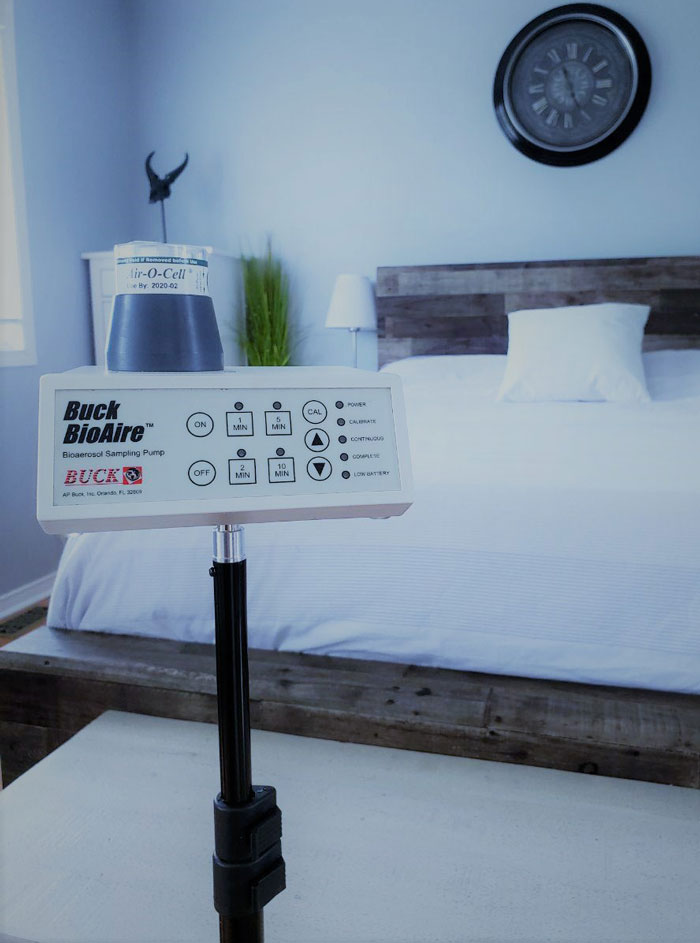
You have two options. A DIY consumer monitor gives you ongoing background readings, or a professional inspection where a certified inspector collects air samples with a calibrated pump and sends them to an accredited Canadian laboratory. DIY monitors are fine for daily awareness. Professional testing is what you want when you suspect mold, need asbestos confirmed before a renovation, or have unexplained symptoms, because the lab can identify and quantify exactly what is in your air and the report stands up with an insurer or a lawyer.
A professional air quality test identifies mold spores by genus (Stachybotrys, Aspergillus, Penicillium, Cladosporium) and quantifies how many are in the air compared with an outdoor control sample. Asbestos testing is a separate service that confirms whether a suspect building material contains asbestos fibres. The exact scope depends on what you have noticed, and our inspector scopes the test to your situation during the on-site visit.
For a one-time consumer monitor used to track daily CO2 and PM levels, usually yes, they cost $200 to $400 and give you ongoing peace of mind. For diagnosing a specific issue (suspected mold, persistent headaches, post-renovation off-gassing, real-estate due diligence, post-flood remediation), a professional test is worth several DIY kits because it produces a lab-certified report you can act on with a remediation contractor, an insurer, or in a real estate transaction.
The most common signs reported in Health Canada’s IAQ guidance are headaches, fatigue, irritated eyes/nose/throat, congestion, worsening asthma or allergy symptoms indoors that improve when you leave the house, persistent musty or chemical odours, visible mold growth, and recurring condensation on windows. If symptoms cluster around a specific room or worsen seasonally, that room is the place to start sampling.
The on-site visit takes 60 to 90 minutes for a typical Canadian home (longer for multi-storey or commercial buildings). Samples ship to the lab the same day. Most contaminant panels return results in 3 to 5 business days; rush turnaround is usually available for an additional fee. You receive a written report with raw lab data, a plain-English interpretation, and recommended next steps.
For most Canadian homeowners a one-time test is enough unless something changes: new symptoms, a renovation, a flood or pipe burst, or a real estate transaction. Any home with a history of moisture problems should re-test for mold spores annually until the source is fully resolved. If you are renovating a building put up before 1990, test for asbestos before the work starts rather than after.
The honest answer is: there is no recognized safe level of asbestos exposure, and risk is cumulative. Every fibre inhaled adds to lifetime risk. A single 30-minute exposure to disturbed asbestos is unlikely to cause acute symptoms, but it does meaningfully increase your statistical risk of mesothelioma and lung cancer 20 to 50 years later. The point of testing before disturbance is to avoid the exposure entirely. If you’ve already had a short accidental exposure (you cut into popcorn ceiling, broke a tile, or disturbed pipe wrap), don’t panic, but do leave the area, ventilate it, double-bag your clothing, and call a professional before doing any cleanup. Vacuuming with a standard household vacuum makes it worse by re-aerosolizing fibres.
A positive result isn’t an emergency on its own. It’s a planning event. The action depends on three factors: (1) the type of asbestos (chrysotile is less hazardous than amphibole varieties like amosite or crocidolite, though all are regulated), (2) the friability, meaning whether the material is crumbling or easily disturbed (high risk) or bound into intact tile/cement (lower risk while undisturbed), and (3) what you were planning to do. If you’re not disturbing the material, the safest action is often to leave it alone, label it, and disclose it on any future sale. If you need to renovate, the next step is to hire a licensed asbestos abatement contractor. We don’t do abatement ourselves, which means our recommendation is unbiased. After abatement is finished, we come back to do clearance air testing (PCM screening plus TEM if clearance fails) to confirm the area is safe to re-occupy. That clearance report is what insurers and inspectors will ask for.
Three rough tiers in 2026 dollars: $300 to $500 for a single-room professional test (one or two spore traps or one bulk asbestos sample, accredited Quebec lab, written report); $500 to $900 for a multi-room mold panel with hygro-thermometer mapping and optional bulk samples; $900 to $1,300+ for a comprehensive whole-home assessment with full spore-trap mapping and a multi-area asbestos survey. Price drivers are the number of samples, the lab turnaround speed (24-hour rush is roughly double the 3 to 5 day standard) and travel distance. Routine residential consultations are no-charge, and we give flat-rate quotes by phone at 1-866-528-2897.
For most Montreal homeowners the answer is yes when there is a specific trigger: a musty smell that comes back after cleaning, visible water damage from a basement flood, recent renovation in a pre-1990 triplex (asbestos and vermiculite era), unexplained allergy or asthma symptoms that worsen indoors, or a real-estate transaction where you need a defensible third-party report. Buying or selling without one is a gamble in a city where 1950s to 1980s housing stock dominates and basement moisture is common. If your home is newer, has no symptoms and no renovation planned, an annual hygro-thermometer check is usually enough, see our guide on signs your home needs testing.
Four species account for the majority of positive results in Greater Montreal: Stachybotrys (the so-called “black mold”, almost always tied to long-term water damage in basements), Aspergillus (very common after summer humidity in poorly ventilated areas), Penicillium (often found alongside Aspergillus and on damp drywall), and Cladosporium (common on cold surfaces like window frames and around plumbing). Plateau and NDG triplexes with old plumbing, basement bedrooms, and West Island bungalows after spring melt are the situations where we see elevated counts most often.
Anytime you’re planning to disturb a suspect material in a home built before 1990. The big four in Montreal housing stock are vermiculite attic insulation (very common in Plateau, NDG and Outremont), popcorn ceilings (1960s to 1980s residential), vinyl floor tile and the black mastic underneath, and pipe wrap in basements and boiler rooms. Buying a pre-1990 home is the other clear trigger, get the testing done before condition removal so a positive result becomes negotiating leverage rather than a surprise mid-renovation. We refer remediation to licensed Quebec abatement contractors after a positive result, and return for clearance air testing once the work is done. Asbestos testing service details. For a full Montreal-specific guide to materials, the testing process, cost and Quebec regulations, see our asbestos testing in Montreal page.
The on-site visit typically takes 45 minutes to 2 hours for a residential assessment, depending on the number of samples. Lab analysis is the bottleneck: 24-hour rush for spore traps and bulk samples (75 to 100 % premium), 3 to 5 business days standard, or 7 to 10 days economy. We email a plain-English PDF report the day the lab results arrive, and we follow up by phone to walk you through any positive findings. See how to choose an air quality testing service for what a good report should include.
Yes. Our Montreal service area covers Montreal Island (Plateau-Mont-Royal, Notre-Dame-de-Grâce, Verdun, Outremont, Westmount, Côte-des-Neiges, Rosemont, Ahuntsic), the West Island (Beaconsfield, Pointe-Claire, Dollard-des-Ormeaux, Kirkland), Laval, Longueuil, Brossard and the South Shore (St-Hubert, Boucherville). Same-week scheduling is the norm for Greater Montreal. Travel beyond a 50 km radius from Downtown Montreal may include a small mileage charge, confirmed in writing before the visit. After a positive mold result we refer to mold removal in Montreal; after positive asbestos to a licensed Quebec abatement contractor.
Our certifications