
Asbestos Testing in Ontario & Quebec: Bulk and Air Sampling, Lab-Certified Results
If your home, rental property, or workplace was built or last renovated before 1990, there is a real chance some of the building materials contain asbestos. Air Quality Testing has been performing independent, lab-certified asbestos testing across Ontario and Quebec for 20+ years, with more than 15,000 inspections completed. Our inspectors are IICRC and IAQA certified, samples go to accredited labs (AIHA-LAP, NVLAP, or CALA), and we deliver written reports in 24 hours to 10 business days depending on the rush level you need.
We don’t do abatement, which is the point. Our role is to give you an unbiased answer about whether asbestos is present, where, and at what concentration. If your samples come back positive, we’ll refer you to a licensed asbestos abatement contractor and come back later for clearance air testing once they’re done.
Why asbestos testing matters before you renovate or sell
Asbestos is a Group 1 human carcinogen, classified by the Health Canada alongside tobacco smoke and benzene. Long-term exposure to airborne asbestos fibres is linked to four serious diseases: mesothelioma (a rare cancer of the lung lining), lung cancer (with risk multiplying for smokers), asbestosis (irreversible scarring of the lungs), and pleural plaques. There is no recognized safe level of exposure. Even brief disturbances of asbestos-containing material during a renovation can release millions of fibres into the air, and those fibres can stay airborne for days.
Canada banned the manufacture, import, and use of asbestos in 2018 under the Prohibition of Asbestos and Products Containing Asbestos Regulations. The catch: that ban is forward-looking. It doesn’t remove the asbestos that’s already in the millions of pre-1990 Canadian homes, schools, hospitals, and commercial buildings. If your property predates 1990 (or if it was last renovated before 1990) any plaster, drywall joint compound, popcorn ceiling, vinyl floor tile, vermiculite insulation, pipe wrap, or HVAC duct insulation is a candidate for testing before you cut, drill, sand, or demolish.
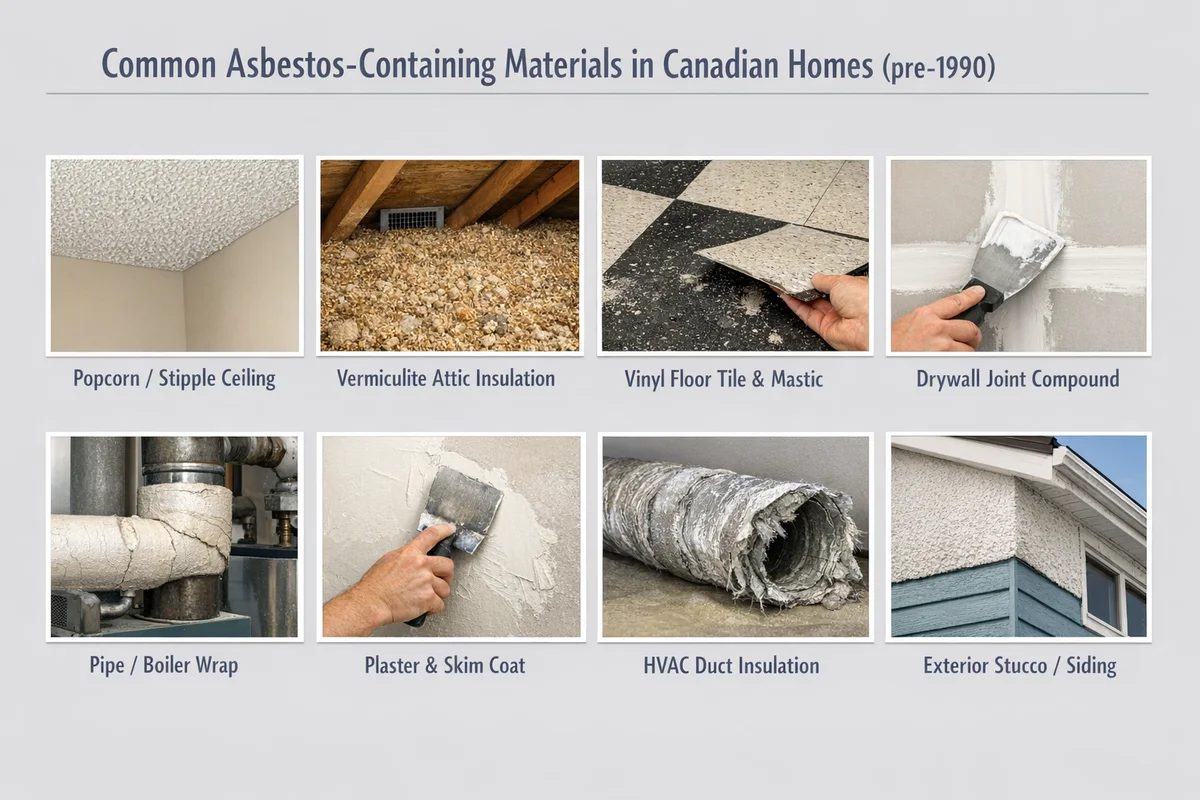
Common asbestos-containing materials in Canadian homes
You cannot identify asbestos by sight. That’s the whole point of laboratory testing. Here’s what to expect during an air quality inspection, from sampling to your report. But these are the materials our Ontario and Quebec inspectors sample most often:
- Drywall joint compound and tape (1940s to 1980s): small amounts of chrysotile asbestos were routinely added for fire resistance. Often missed because the drywall itself is fine.
- Popcorn / stipple / textured ceilings (1950s to 1980s): among the most commonly tested materials in renovations. Tends to crumble (friable), which makes it higher-risk.
- Vermiculite attic insulation (especially “Zonolite” brand, 1940s to 1990): the gold-brown granular insulation in older attic bays. Often contaminated with amphibole asbestos from the Libby, Montana mine.
- Vinyl floor tile and the black mastic underneath (1920s to 1980s): both the 9×9-inch tile and the cutback adhesive can contain asbestos. Sample both layers.
- Vinyl sheet flooring with paper backing (1950s to 1980s): the paper backing under the linoleum is usually where the asbestos is.
- Plaster and skim coats (1940s to 1980s): particularly common in pre-war Ottawa and Montreal homes.
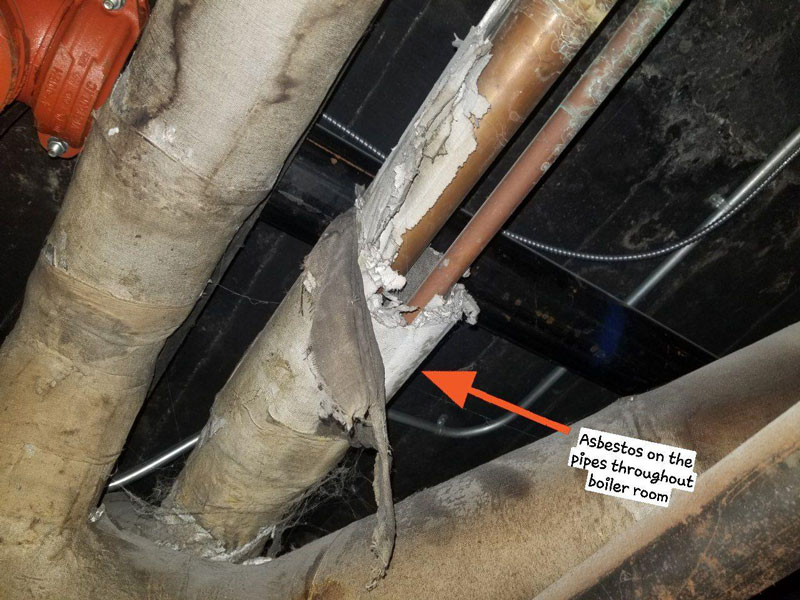
- Pipe and boiler wrap insulation: the white fabric-wrapped insulation around basement pipes and boilers. Highly friable, very high-risk if disturbed.
- HVAC duct insulation and connector wraps: silver-faced duct wrap and the canvas connectors at register transitions.
- Exterior stucco, siding, and shingles (1920s to 1980s): asbestos-cement siding, transite roofing shingles, and stuccoed walls.
- Fire-rated drywall and door cores: used in apartment building common-area walls, between garages and living spaces, and in commercial fire separations.
- Caulking and window glazing compound: exterior window perimeters in mid-century homes.
- Gaskets, paper liners, and insulation board behind woodstoves, furnaces, and electrical panels.
- Heat shields, mortar, and chimney flue liners: easy to overlook because they’re not visible.
If you can see any of the items above and you don’t know when they were last installed, the right call is to leave them alone and have a sample taken before any work starts.
How our asbestos testing works
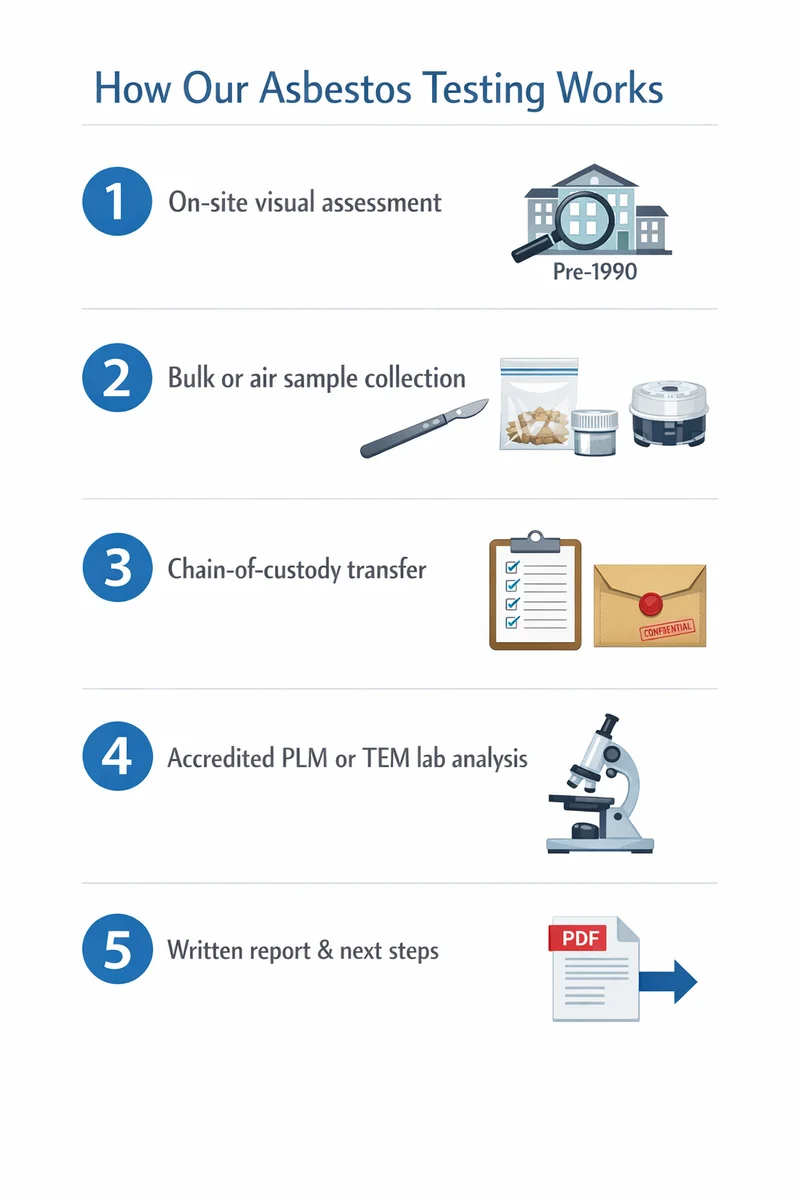
- On-site visual assessment. An IICRC-certified inspector walks the property, identifies suspect materials, and recommends a sampling plan. For routine residential inquiries we don’t charge for this assessment.
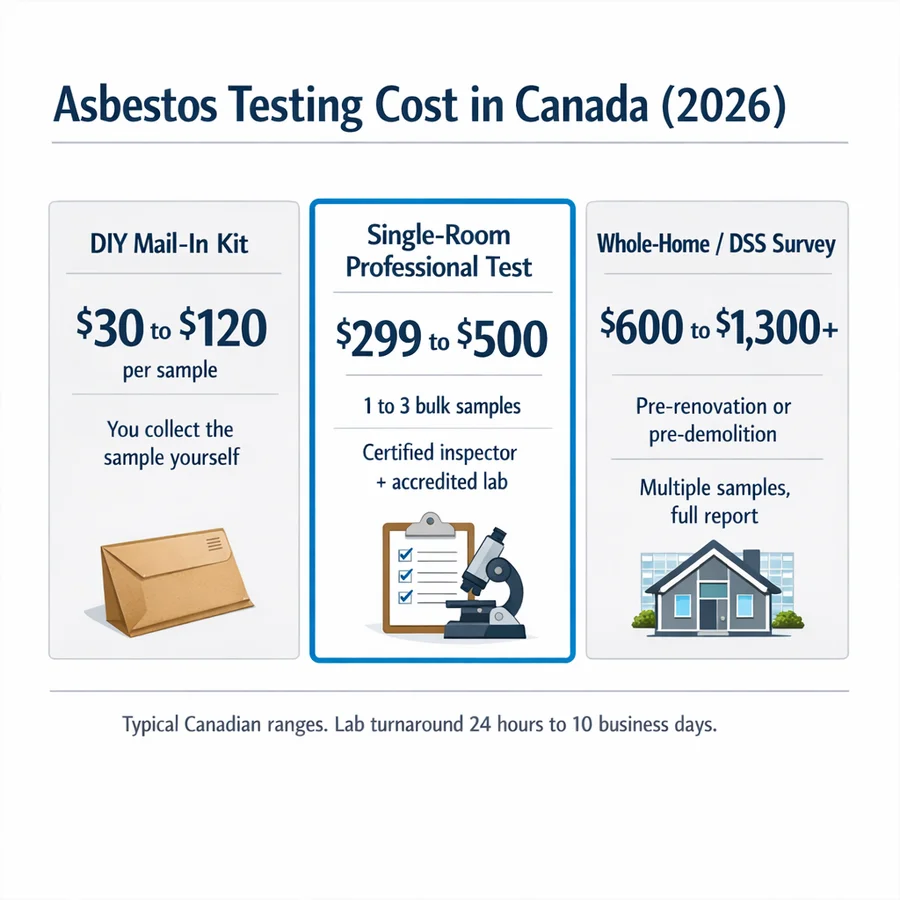
- Bulk and/or air sample collection. Bulk samples are physically cut or scraped from suspect material using clean tools, then sealed in labelled containers. Air samples are collected with calibrated pumps drawing air through 25 mm cassettes for a measured number of minutes. Every sample is photographed and logged with location, material type, and quantity.
- Chain-of-custody transfer. Samples leave your property under a signed chain-of-custody form and go to an accredited third-party lab (AIHA-LAP, NVLAP, or CALA). We don’t analyze samples in-house, so there’s no incentive to bias the result.
- Accredited PLM or TEM lab analysis. Bulk samples are analyzed by Polarized Light Microscopy (PLM, EPA Method 600/R-93/116). Borderline results below 1% trigger Transmission Electron Microscopy (TEM) for confirmation. Air samples are analyzed by Phase Contrast Microscopy (PCM, NIOSH 7400) for screening, or TEM (NIOSH 7402) for clearance and disputes.
- Written report and next steps. You get a PDF report identifying the asbestos type (chrysotile, amosite, crocidolite, or other amphibole), concentration as a percentage, and recommended next actions. If positive, we’ll refer you to a licensed abatement contractor and schedule clearance air testing for after the work is finished.
We provide affordable, fast and professional asbestos testing services.
Bulk samples vs. air samples: which do you need?
Two different questions get two different sample types:
| When you need… | Use a bulk sample | Use an air sample |
|---|---|---|
| Question being answered | Does this material contain asbestos? | Are asbestos fibres in the air I’m breathing? |
| Typical use case | Pre-renovation, pre-demolition, vermiculite check | Post-abatement clearance, accidental disturbance, occupied workplace |
| Lab method | PLM (Polarized Light Microscopy); TEM if <1% | PCM for screening; TEM for clearance / disputes |
| Result expressed as | % asbestos by weight in the material | Fibres per cubic centimetre (f/cc) of air |
| Reference threshold | ≥0.5% triggers asbestos-handling rules (Ontario Reg. 278/05) | ≤0.01 f/cc for clearance (industry standard, applied in Quebec) |
| Turnaround | 24 h rush, 3 to 5 day standard, 10-day economy | 24 h rush (PCM), 3 to 5 days standard, 5 to 7 days for TEM clearance |
If you’re not sure which one applies to your situation, call us before you take any action and we’ll work it out in five minutes. The wrong sample type is a waste of money.
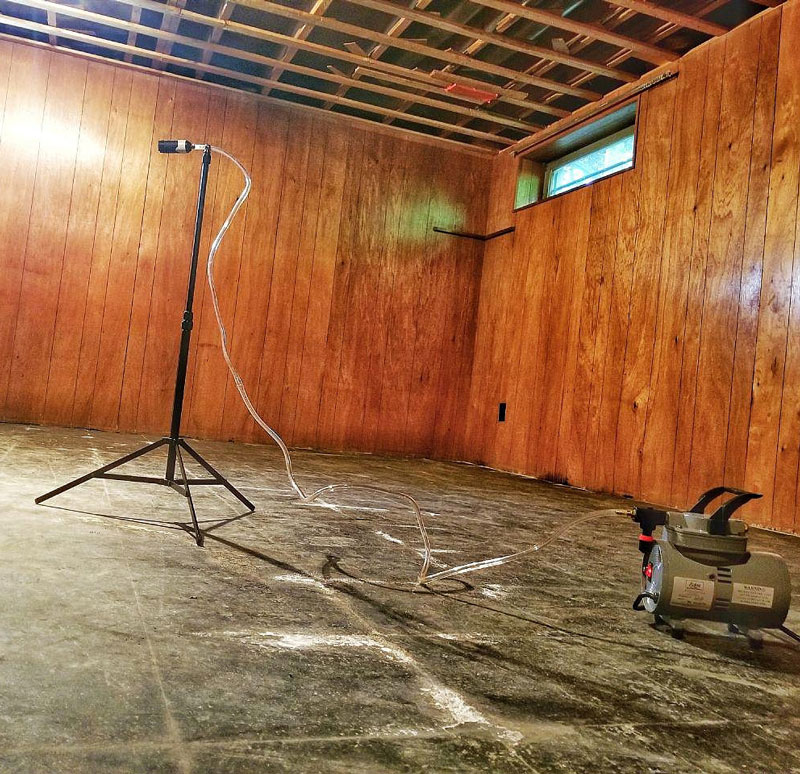
When is asbestos testing required?
Required by law before you start work:
- Demolition of any pre-1990 building: both Ontario Regulation 278/05 and the Quebec Safety Code for Construction Work (S-2.1) require an asbestos survey before demolition or major renovation.
- Major renovation that disturbs more than 1 m² of suspect material: drywall removal, tile lift-up, plaster demolition, ceiling scraping, exterior siding removal.
- Any workplace construction project: under Ontario Reg. 278/05 the project owner must provide contractors with a list of designated substances (including asbestos) before tenders are issued. This applies even to small office build-outs.
- Real-estate disclosure on older homes: Ontario’s Property Disclosure form asks sellers about known asbestos. Testing in advance lets you answer truthfully and avoid a deal-killing late-stage discovery.
Strongly recommended (not strictly required by law):
- Any home built or last renovated before 1990, before you cut, drill, or sand suspect material.
- Properties with vermiculite attic insulation: the federal government estimates 60 to 70% of Zonolite vermiculite contains amphibole asbestos.
- After water or fire damage to plaster, drywall, or pipe insulation. Disturbance can release fibres.
- Unexpected dust during a minor renovation that’s already underway. Stop the work, ventilate the area, and test before resuming.
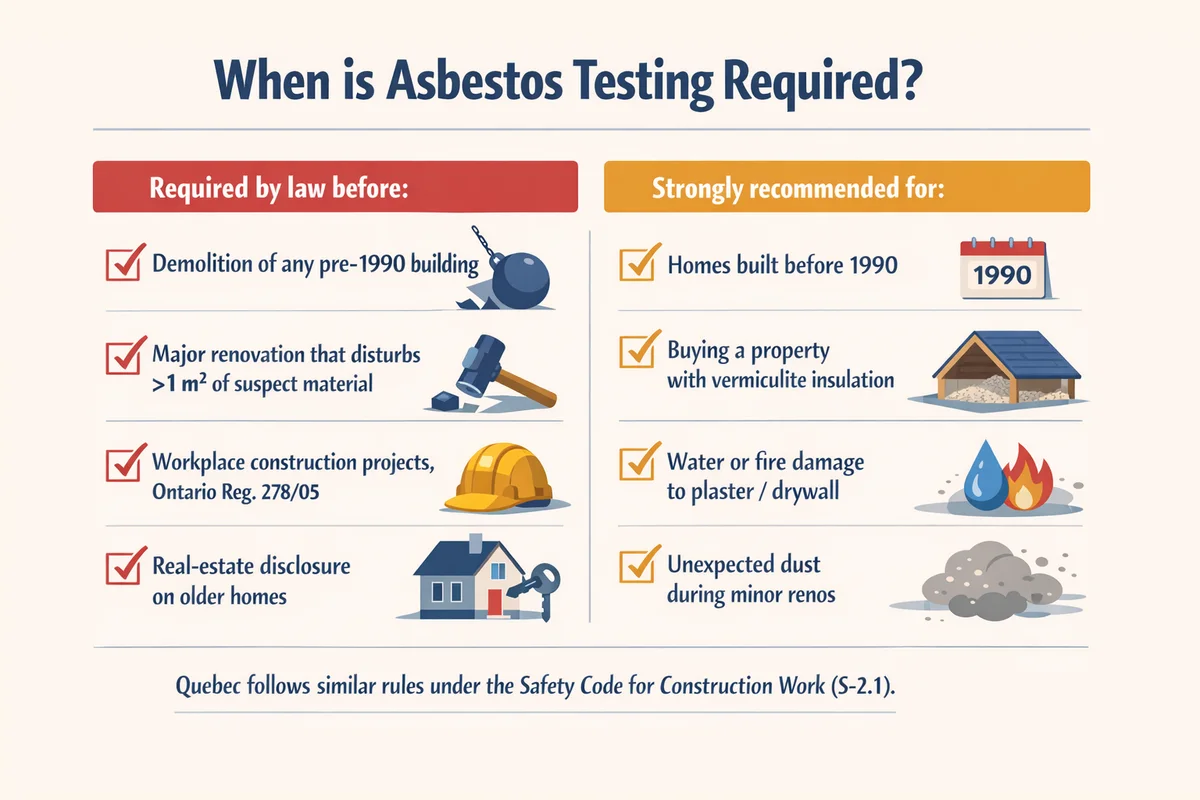
How much does asbestos testing cost in Canada?
Asbestos testing in Canada in 2026 runs from about $30 per sample for a DIY mail-in kit to $1,300+ for a full pre-demolition designated substance survey. Three typical tiers:
| Tier | Typical cost (CAD) | What’s included | Best for |
|---|---|---|---|
| DIY mail-in kit | $30 to $120 per sample | Sampling bag, instructions, lab fee. You take the sample yourself. | A single, low-risk material you can safely access (e.g. one floor tile) |
| Single-room professional test | $299 to $500 | Certified inspector site visit, 1 to 3 bulk samples, accredited PLM lab analysis, written report. | Bathroom, kitchen, or basement renovation; pipe wrap; popcorn ceiling check |
| Whole-home or DSS survey | $600 to $1,300+ | Full property walk, multiple bulk samples across homogeneous areas, designated substance survey report meeting Ontario Reg. 278/05 / Quebec S-2.1. | Pre-demolition, full gut renovation, real-estate transactions, workplace projects |
What pushes the price up or down: number of samples (each extra sample is typically $40 to $80 at the lab), turnaround speed (24-hour rush is roughly 2× the standard 3 to 5 day rate), travel distance from our Ottawa or Montreal base, and whether you need air sampling alongside bulk samples. We’re happy to give a flat-rate quote over the phone in five minutes. Call 1-866-528-2897. For a full breakdown of pricing factors, DIY versus professional testing, and how Ontario and Quebec compare, see our guide to asbestos testing cost in Canada.
If you’re considering the DIY route, our guide to home asbestos test kits covers what’s actually accurate, what to avoid, and when you should call a professional instead.
Service areas, where we test in Ontario and Quebec
We’re based in the Ottawa-Gatineau region with technicians available across both provinces. Same-week scheduling for these primary cities:
We also serve nearby Toronto, Hamilton, Quebec City, Sherbrooke, Laval, and Longueuil on a project-by-project basis. For asbestos sampling on the island of Montreal and across the West Island and South Shore, see our asbestos testing in Montreal page.
Outside our same-week zone, lead time is typically 7 to 14 days. Beyond asbestos, we offer related services including residential air quality testing, commercial air quality testing, and mold testing.
For mold inspection specifically in the Ottawa region, see our Ottawa mold inspection and testing service page. Our published guidance is reviewed by certified inspectors before it goes live. See our editorial policy for how we research, review and correct it.
What Our Asbestos Testing Clients Say
Recent asbestos-testing engagements across Ontario and Quebec
"We were about to scrape popcorn ceilings in a 1972 Westboro split-level and our contractor refused to start without a test. AQT had an inspector out two days later, three samples to the lab, and a clear PDF report on Friday morning. Two ceilings came back positive, so we changed plans and saved everyone a lot of trouble."
"Bought a 1958 NDG home with vermiculite in the attic. The AQT inspector explained the Libby mine problem, took two samples from different bays, and the TEM results came back four days later confirming amphibole. Honest, professional, and we got the discount we needed from the seller."
"Needed independent clearance testing after an abatement contractor finished our 1960s Sydenham Ward basement. AQT did PCM the day they finished and a TEM follow-up two days later. Came back well under 0.01 f/cc. The report was exactly what our insurance adjuster wanted to see, with no back-and-forth."
"Our plumber accidentally damaged the pipe wrap insulation in our basement during a water heater swap. AQT showed up same week, took air and bulk samples, confirmed chrysotile in the wrap, and lined us up with an abatement crew. Bilingual technicians made the whole thing easier."
Frequently asked questions
A positive result isn’t an emergency on its own. It’s a planning event. The action depends on three factors: (1) the type of asbestos (chrysotile is less hazardous than amphibole varieties like amosite or crocidolite, though all are regulated), (2) the friability, meaning whether the material is crumbling or easily disturbed (high risk) or bound into intact tile/cement (lower risk while undisturbed), and (3) what you were planning to do. If you’re not disturbing the material, the safest action is often to leave it alone, label it, and disclose it on any future sale. If you need to renovate, the next step is to hire a licensed asbestos abatement contractor. We don’t do abatement ourselves, which means our recommendation is unbiased. After abatement is finished, we come back to do clearance air testing (PCM screening plus TEM if clearance fails) to confirm the area is safe to re-occupy. That clearance report is what insurers and inspectors will ask for.
The honest answer is: there is no recognized safe level of asbestos exposure, and risk is cumulative. Every fibre inhaled adds to lifetime risk. A single 30-minute exposure to disturbed asbestos is unlikely to cause acute symptoms, but it does meaningfully increase your statistical risk of mesothelioma and lung cancer 20 to 50 years later. The point of testing before disturbance is to avoid the exposure entirely. If you’ve already had a short accidental exposure (you cut into popcorn ceiling, broke a tile, or disturbed pipe wrap), don’t panic, but do leave the area, ventilate it, double-bag your clothing, and call a professional before doing any cleanup. Vacuuming with a standard household vacuum makes it worse by re-aerosolizing fibres.
You can, but for most situations it’s not the right move. DIY mail-in kits work fine if you have one accessible, low-friability material to sample (one vinyl floor tile, one piece of joint compound from inside a closet). They fall short when (a) the material is friable (pipe wrap, popcorn ceiling, vermiculite) because disturbing it releases fibres into the air you’re breathing, (b) you need a defensible report for a real-estate transaction, insurance claim, or workplace project, or (c) the sample is in a hard-to-reach location. A certified inspector samples under controlled conditions with proper PPE, documents chain-of-custody, and produces a report a lawyer, insurer, or buyer will accept. The cost difference is often only $200 once you factor in the actual lab fee on a DIY kit.
Three rough tiers: a DIY mail-in kit covers one material for $30 to $120 including the lab fee; a single-room professional test (1 to 3 bulk samples, certified inspector, accredited lab, written report) is $299 to $500; a whole-home or designated substance survey for pre-demolition or commercial projects runs $600 to $1,300+. Price drivers are the number of samples, lab turnaround speed (24-hour rush is roughly double the 3 to 5 day standard), and travel distance from our Ottawa or Montreal base. Air sampling for post-abatement clearance is typically $200 to $400 per area on top of bulk testing. Flat-rate quotes are available by phone. Call 1-866-528-2897.
An on-site visit for a typical residential project runs 45 minutes to 2 hours depending on the number of samples. Lab analysis is the bottleneck: 24-hour rush if you absolutely need it (most labs offer this for a 75 to 100% premium), 3 to 5 business days standard, or 7 to 10 days economy. TEM analysis (for clearance air samples or borderline bulk results) is typically 3 to 5 business days minimum. Plan backward from your renovation start date and add a few days of buffer.
The 3-5-7 rule comes from US AHERA regulations (the Asbestos Hazard Emergency Response Act) and is widely used as a best practice in Canada too. For any homogeneous area of suspect surfacing material (sprayed-on, troweled-on, or otherwise applied to a surface), the minimum number of bulk samples is: 3 samples for an area smaller than 1,000 ft², 5 samples for 1,000 to 5,000 ft², and 7 samples for anything over 5,000 ft². Thermal system insulation (pipe and boiler wrap) requires at least 3 samples per homogeneous run. Miscellaneous materials need 1 sample minimum, often more. We follow this rule on every survey, which is why a basement-only project might be 3 samples and a full-house survey might be 12.
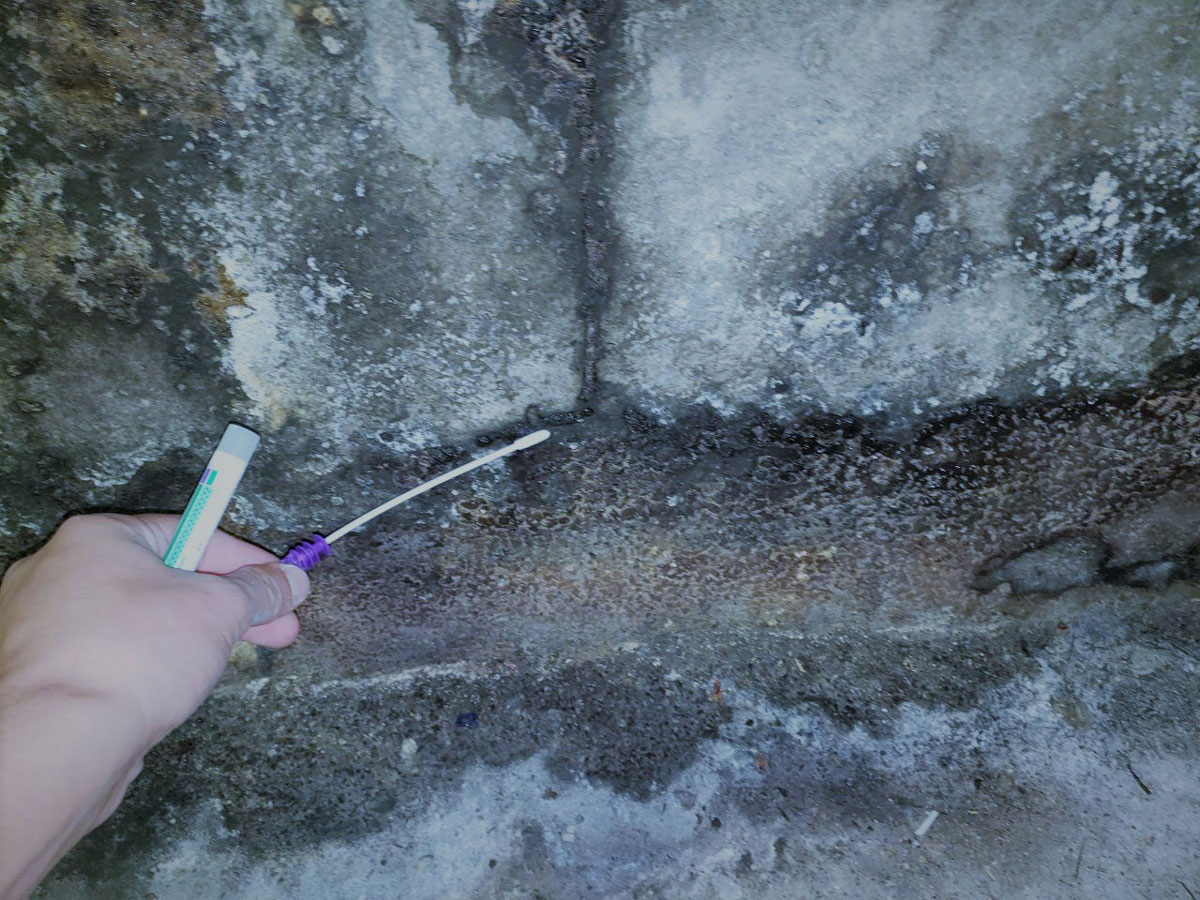
Suspect Asbestos in Your Home or Workplace?
Get a straight answer from an IICRC-certified inspector with samples analyzed at an accredited Canadian lab. No abatement upsell. We test, you decide.
Mon to Fri, 8 AM to 3 PM · Response within 1 business day · Flat-rate quotes, no surprises
Asbestos Testing Near You
Certified asbestos testing in the cities we serve.