July 30, 2025
How to Choose Air Quality Testing Services in Canada
Bottom Line Up Front
When you’re comparing air quality testing services in Canada, three things separate a real provider from a side hustle: industry certifications, accredited lab analysis, and pricing transparency. We’ve completed 15,000+ inspections across Ontario and Quebec since 2005 and built this guide from what our IAQA- and IICRC-certified inspectors see every week. Use the 15-point checklist below to pick the right air quality testing services for your home — without the upsell.
Indoor air can be 5 times more polluted than outdoor air
Families helped by Air Quality Testing since 2005
Years of experience in Canadian air quality testing
Why Professional Air Quality Testing Matters
Most Canadian homeowners try DIY air quality monitors first. These devices give basic readings but miss critical details, which is why professional air quality testing services exist. A certified inspection finds problems that home monitors cannot detect.
Professional testing identifies specific pollutants, measures exact concentration levels, and provides actionable solutions. DIY monitors show general air quality but cannot pinpoint mold spores, asbestos fibers, or volatile organic compounds (VOCs).
When family members develop unexplained respiratory issues, allergies, fatigue, headaches, sinus irritation, or worsening asthma, an indoor air analysis often reveals the cause. Long-term exposure to indoor pollutants has also been linked to cardiovascular symptoms like heart palpitations. A professional IAQ assessment saves money by identifying the real problem instead of treating symptoms.
Understanding Different Types of Air Quality Testing
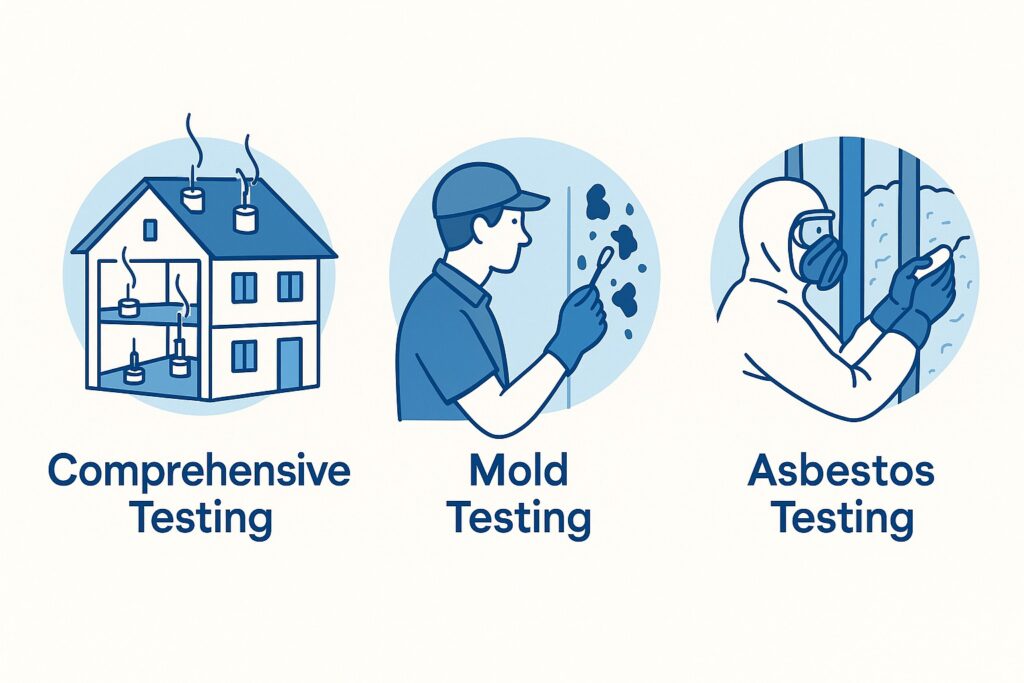
Comprehensive Indoor Air Quality Assessment
A complete residential air quality testing examines multiple pollutants in your home. This test checks for mold spores, VOCs, particulate matter, carbon monoxide, radon, and other common contaminants.
Most comprehensive assessments take 2-4 hours to complete. The technician places calibrated air sampling equipment in different rooms, takes a baseline outdoor sample for comparison, and collects samples for laboratory analysis. Results typically arrive within 3-5 business days.
Targeted Mold Testing
Mold testing focuses specifically on identifying mold spores and moisture problems. This test measures both airborne spores and surface samples from suspected areas.
Mold testing becomes necessary when you see visible mold growth, smell musty odors, or experience allergy symptoms that worsen at home. Professional mold testing identifies the specific mold types — including Stachybotrys, Aspergillus, Penicillium, and Cladosporium — and concentration levels.
Not sure whether mold-specific testing is the right call for your situation? Our explainer on air quality testing for mold and how it differs from other mold tests covers the decision in detail.
Asbestos Detection Services
Asbestos testing requires specialized training and equipment. Only certified professionals should collect asbestos samples due to health risks.
Homes built before 1980 often contain asbestos in insulation, flooring, ceiling tiles, and pipe wrapping. Disturbing these materials releases dangerous fibers into the air.
Air Quality Testing for Real Estate Transactions
Pre-purchase and pre-listing air quality assessments are increasingly common in Ontario and Quebec real estate transactions. Our guide to air quality testing for real estate transactions covers the Ontario vs Quebec disclosure differences. Buyers use a professional inspection for peace of mind on older homes, post-flood properties, or buildings with known renovation history. Sellers use it to disclose air quality proactively and avoid post-sale disputes. See our guide on air quality testing for home buyers for what to expect, and what to look for in air quality testing services that serve real estate transactions.
15-Point Checklist for Choosing Air Quality Testing Services
Essential Qualifications and Certifications
1. Industry Certifications
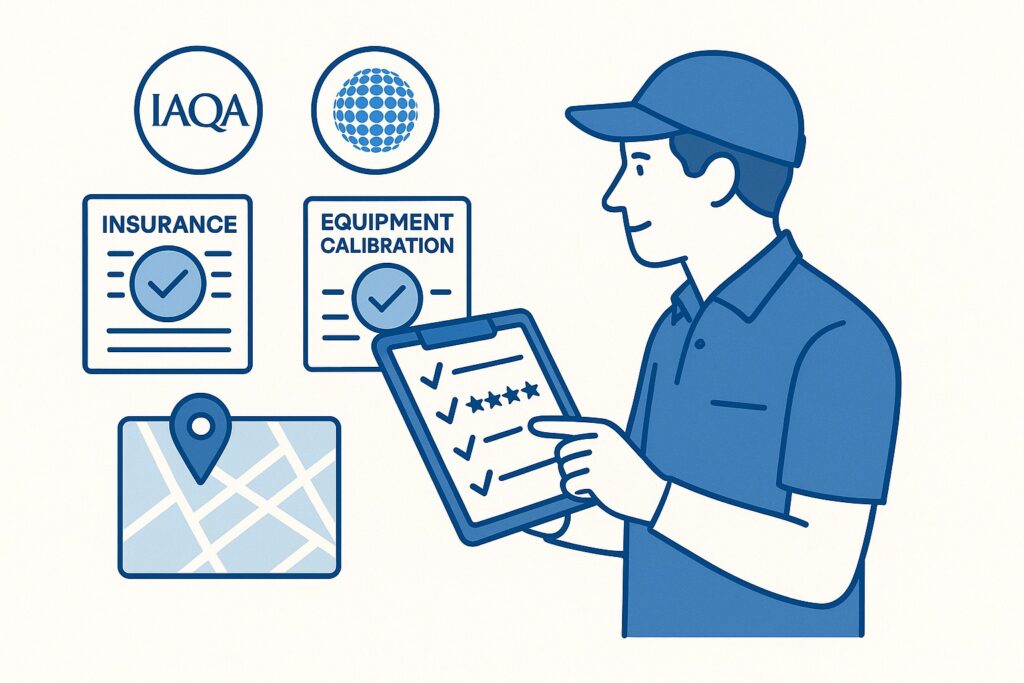
Look for companies certified by the Indoor Air Quality Association (IAQA), the Institute of Inspection, Cleaning and Restoration Certification (IICRC), or with Indoor Air Consultants (IAC2) credentials. These organizations require ongoing education and testing to maintain certification.
2. Licensed and Insured
Verify the company holds proper business licenses and liability insurance. Request to see insurance certificates and confirm coverage amounts meet your needs.
3. Experience in Your Area
Choose companies with local experience. Air quality problems vary by region due to climate, construction methods, and environmental factors. A provider that knows Ontario humidity patterns or Quebec’s older limestone-foundation housing stock will catch issues a general inspector misses.
4. Specialized Equipment
Professional testing requires calibrated equipment for accurate results. Ask about equipment calibration schedules, maintenance records, and what specific instruments will be used (air sampling pumps, particle counters, VOC meters, infrared thermography).
Company Background and Reputation
5. Years in Business
Companies with 5+ years of experience understand common air quality problems and testing challenges. New companies may lack the expertise to handle complex situations.
6. Customer Reviews and References
Read reviews on Google, Better Business Bureau, and company websites. Ask for recent customer references and contact them about their experience.
7. Professional Associations
Membership in professional organizations shows commitment to industry standards. Look for IAQA, IICRC, IAC2, or AIHA association memberships.
8. Local Presence
Companies with local offices provide better service than out-of-town providers. Local presence ensures quick response times and ongoing support.
Pricing and Service Transparency
9. Clear Pricing Structure
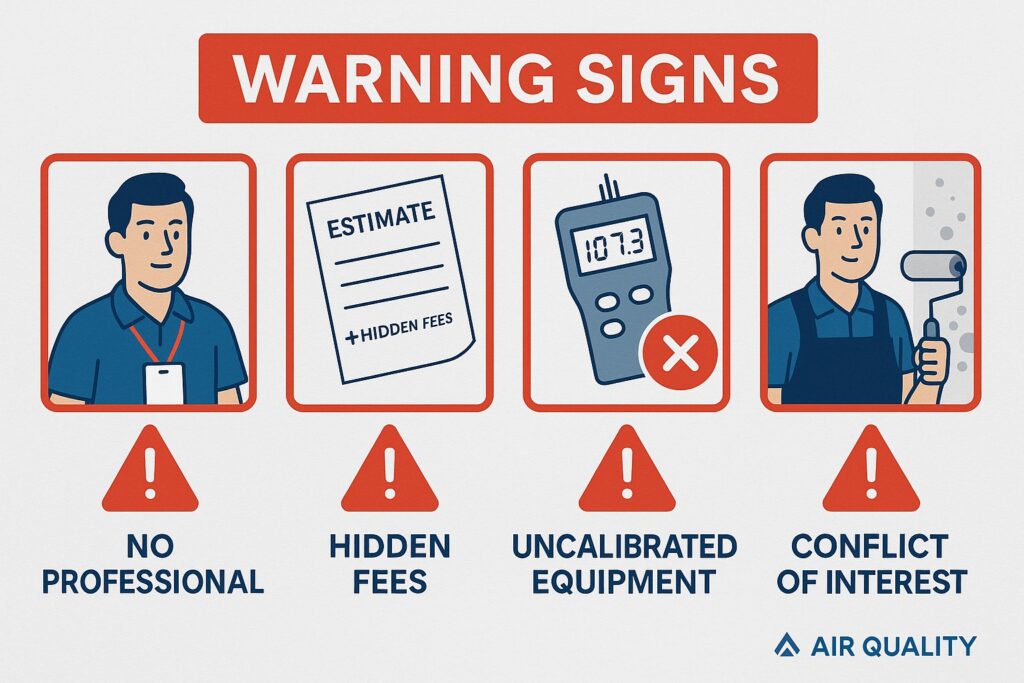
Avoid companies that won’t provide upfront pricing. Professional testing companies should explain costs clearly before starting work. The price should reflect the type of test, the number of samples, and the turnaround for results — not surprise add-ons after the visit.
For a full breakdown of what air quality testing costs in Canada, including price tiers and what moves the number, see our cost guide.
10. Detailed Service Descriptions
The company should explain exactly what tests they perform, how long testing takes, and what the report includes. Vague descriptions often hide limited services.
11. No Hidden Fees
Ask about additional costs for travel time, equipment setup, or rush processing. All fees should be disclosed upfront.
12. Written Estimates
Professional companies provide written estimates that detail all services and costs. Verbal estimates can lead to billing disputes.
Testing Process and Reporting
13. Comprehensive Testing Protocols
The company should follow established testing standards and protocols. Ask about sampling methods, equipment types, and quality control procedures.
14. Independent Laboratory Analysis
Samples should go to independent, accredited laboratories for analysis — ideally a lab accredited by CALA (Canadian Association for Laboratory Accreditation) or NVLAP. Companies that analyze samples in-house may have conflicts of interest.
15. Detailed Reporting
Reports should include specific pollutant levels, health risk assessments, and clear recommendations. Simple pass/fail results provide limited value.
Questions to Ask Before You Hire an Air Quality Testing Company
Before booking an inspection, run through this short list with any provider you’re considering. The answers separate certified professionals from companies that test as a side hustle.
What certifications do your inspectors hold?
Look for IAQA, IICRC, IAC2, or InterNACHI. Generic answers like “we’re certified” without naming the body are a red flag.
Do you also offer remediation, or only testing?
An independent testing company avoids the conflict of interest that comes with selling you the cleanup work too.
Which lab will analyze my samples, and is it accredited?
The lab should be third-party and CALA- or NVLAP-accredited. In-house lab work can introduce bias.
How many samples will be taken, and from where?
Expect at least one indoor sample per problem area plus one outdoor baseline sample for comparison.
What contaminants does the test cover?
A comprehensive test should cover mold spores, VOCs, particulate matter (PM2.5/PM10), carbon monoxide, and on request: asbestos, radon, and formaldehyde.
How long will I wait for results, and what does the report look like?
3-5 business days is standard. Ask to see a sample report — vague reports without specific concentrations or comparisons to Health Canada Residential Indoor Air Quality Guidelines are a warning sign.
What’s your total fixed price for my home, with no add-ons?
A professional should give a written, all-in quote based on property size, sample count, and turnaround.
How long have you been testing in my area, and can you share local references?
Local experience matters because regional building stock and climate change what to look for.
Red Flags to Avoid When Choosing Air Quality Testing Services
Pricing Red Flags
Extremely low prices often indicate poor quality testing or hidden costs. Professional inspections require expensive equipment and laboratory analysis. Companies offering significantly lower prices may cut corners on quality.
High-pressure sales tactics suggest the company prioritizes sales over customer service. Professional testing companies should provide information and let you decide without pressure.
Service Quality Warning Signs
Companies that also perform remediation work may have conflicts of interest. Independent testing companies remain unbiased because they don’t profit from finding problems they then sell you the fix for. Ask if the company offers cleaning or removal services.
Lack of written protocols or procedures indicates unprofessional service. Professional companies follow established testing standards and document their procedures.

Understanding Air Quality Testing Costs in Canada
Air quality testing cost in Ontario typically runs $300 to $1,200 depending on scope. Quebec pricing is comparable, with bilingual reporting available on request. Three factors drive the final price: the type of test, the number of samples taken, and the turnaround for results.
| Service Type | Residential Cost Range | What’s Included |
|---|---|---|
| Basic Air Quality Screening | $300 – $500 | Single room testing, basic pollutant analysis |
| Comprehensive Home Assessment | $600 – $1,200 | Whole house testing, detailed laboratory analysis |
| Mold Testing (Additional) | $200 – $400 | Air and surface sampling, species identification |
| Asbestos Testing | $300 – $600 | Professional sampling, laboratory analysis |
Geographic location impacts the final cost due to travel time and local market rates. Urban areas often have higher rates but more service options than rural locations. Same-day or next-day result turnaround usually carries a rush fee on top of the base price.
What to Expect During a Professional Air Quality Test
Knowing the testing process helps you prepare and spot a provider cutting corners. A standard residential visit follows these steps:
1. Pre-test preparation (24 hours before)
Maintain normal living conditions. Don’t deep-clean, don’t open windows for extended periods, and don’t run air purifiers on high. The goal is to capture your home’s typical air, not a freshly aired-out version.
2. Visual assessment and walkthrough
The inspector tours the home, notes moisture issues, ventilation patterns, and visible problem areas, and decides where to place sampling equipment.
3. Calibrated equipment setup
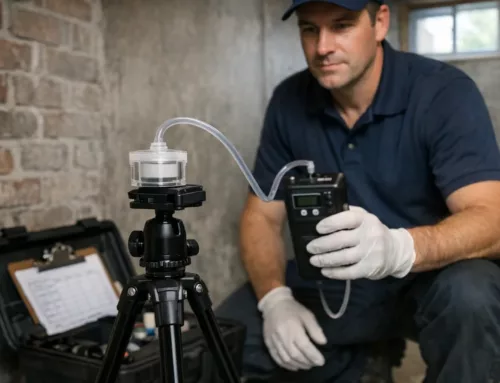
Air sampling pumps go on tripods at breathing height. The inspector documents location, time, and conditions for each sample.
4. Sample collection (about 5 minutes per sample)
A typical air sample pulls 75 litres of air through a sterile cassette over roughly 5 minutes. Multiple indoor samples are taken, plus a baseline outdoor sample for comparison.
5. Third-party laboratory analysis
Samples are couriered to an accredited lab (CALA in Canada, NVLAP in the U.S.) for spore counting, species identification, or chemical analysis depending on the test.
6. Detailed report (3-5 business days)
You receive a written report with each sample’s results, comparison to outdoor baseline, comparison to Health Canada guidelines where applicable, and a plain-English explanation of what to do next. A good report tells you whether you have a problem, where it is, and how serious it is — without pushing you toward remediation services.
Canadian-Specific Air Quality Testing Considerations
Canada’s diverse climate creates unique air quality challenges. Cold winters require sealed buildings that can trap pollutants. Humid summers in eastern regions increase mold growth risks.
Regional construction materials and methods affect indoor air quality. Older homes in Ontario and Quebec may contain asbestos or lead-based materials requiring specialized testing.
Canadian Regulations and Standards
Canadian air quality standards differ from US guidelines. Testing companies should understand Health Canada’s Residential Indoor Air Quality Guidelines and provincial regulations affecting indoor air quality. Health Canada publishes specific exposure limits for radon, formaldehyde, carbon monoxide, mould, and other indoor contaminants — your inspector’s report should reference these where relevant.
Provincial differences in building codes and environmental regulations affect testing requirements. Quebec, for example, follows the Quebec Construction Code and has specific provincial guidance on asbestos disclosure during real estate transactions. Companies should know local standards for their service areas.
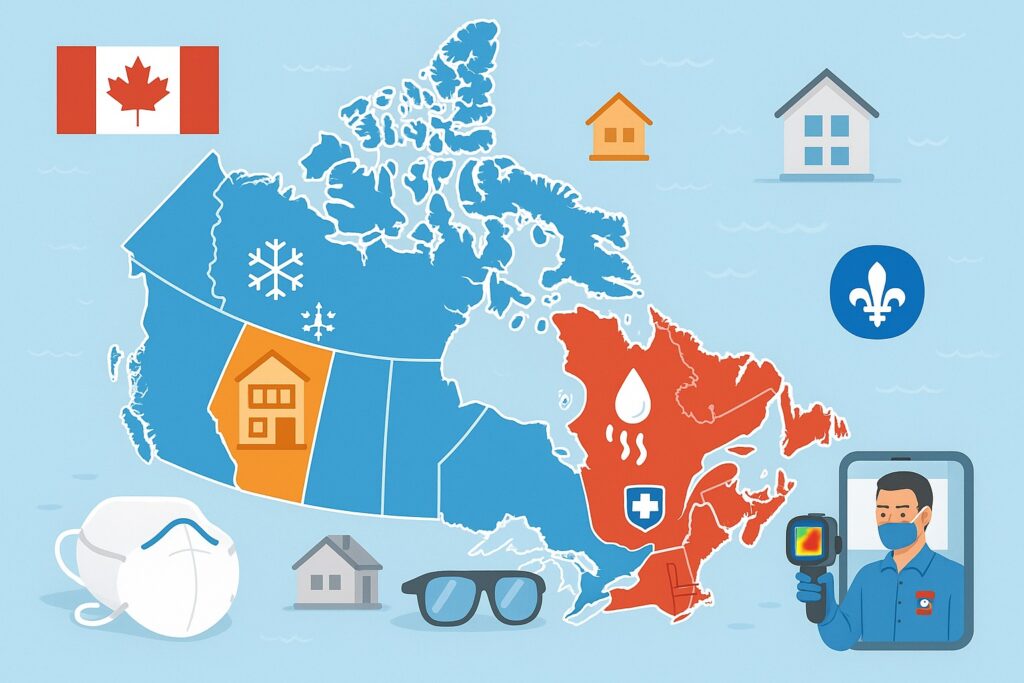
Professional Air Quality Testing Across Ontario and Quebec
Air Quality Testing provides professional services across major cities and surrounding areas:
Montreal
Comprehensive testing for Greater Montreal area homes and businesses
Ottawa
Professional air quality services for the National Capital Region
Gatineau
Expert testing services for Gatineau and surrounding communities
Kingston
Reliable air quality testing for Kingston area residents
We also serve Carleton Place, Brockville, Belleville, and Cornwall.
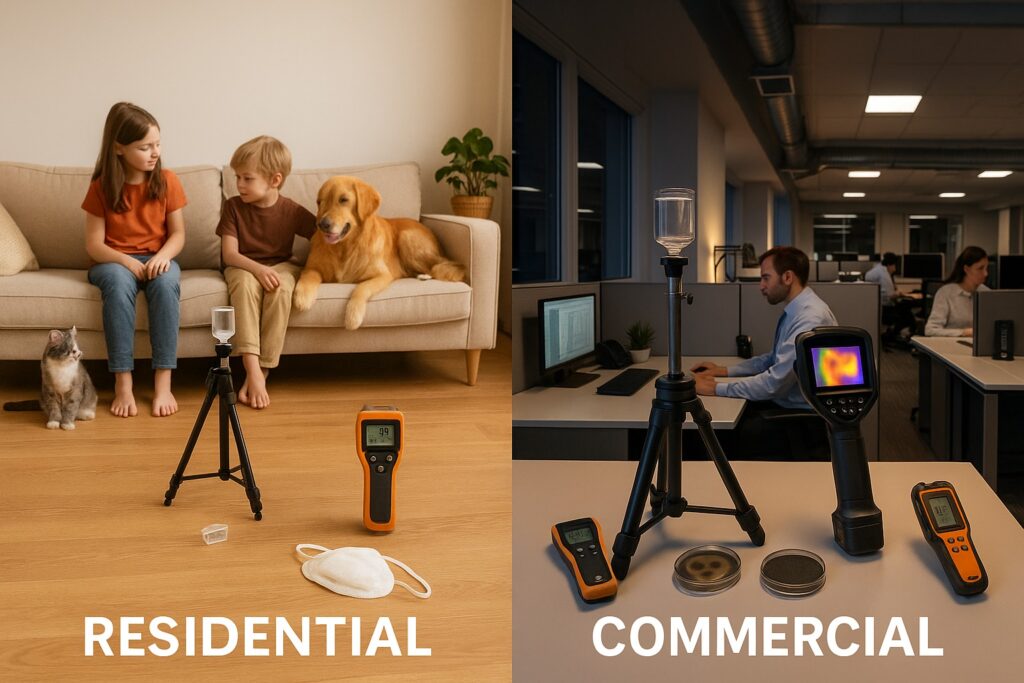
Different Testing Needs for Residential vs Commercial Properties
Residential Testing Focus
Residential testing focuses on family health and comfort. Common concerns include mold, VOCs from furniture and cleaning products, and poor ventilation. Testing schedules work around family routines to minimize disruption.
Commercial Testing Requirements
Commercial air quality testing addresses workplace safety and regulatory compliance. Commercial properties face different challenges including higher occupancy, industrial processes, and complex HVAC systems.
Frequently Asked Questions
Air Quality Testing Canada
With over 20 years of experience and 15,000+ inspections completed, Air Quality Testing Canada provides reliable, professional air quality testing services across Ontario and Quebec. Our IAQA- and IICRC-certified experts help families breathe easier through accurate testing and clear recommendations.
🌟 Ready to Improve Your Home’s Air Quality?
Air Quality Testing brings over 20 years of experience to every project. Our certified professionals understand Canadian air quality challenges and provide comprehensive solutions for homes across Ontario and Quebec.
Monday – Friday: 8:00 AM – 3:00 PM