Ontario & Quebec · since 2005
Home Air Quality Testing for Mold & Asbestos
Something feels off, a musty basement, a cough that clears when you leave the house, a place that never smelled right. We find what’s actually in your air, and the worst contaminant is rarely the one you were worried about.
15,000+ inspections
Accredited lab analysis
IICRC & IAQA certified
Why test the air in your home?
The air inside a typical Canadian home is two to five times more polluted than the air outside, according to Health Canada, and most of what’s in it is invisible. You can’t see mold spores drifting from a damp wall cavity. You can’t smell asbestos fibres released when someone disturbs an old popcorn ceiling. They sit at levels you won’t notice until they start affecting someone’s health.
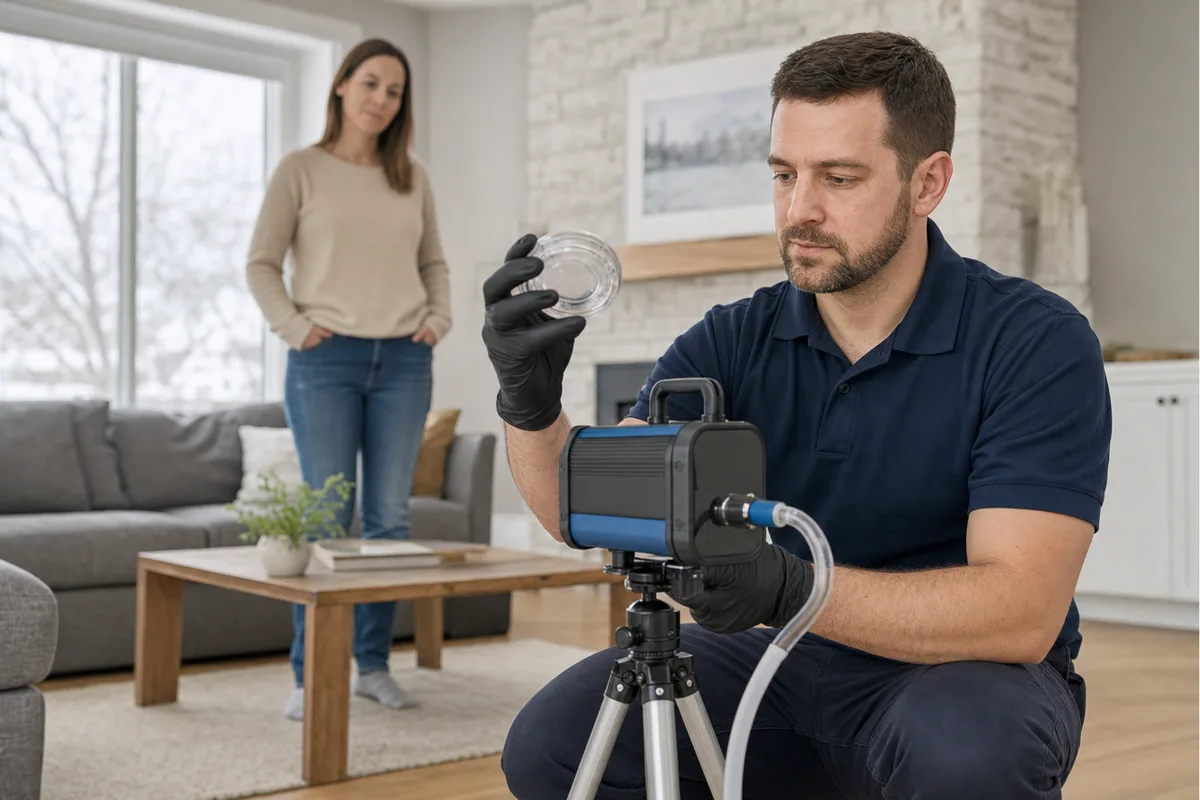
A professional test gives you data instead of guesses. We collect air samples, send them to an accredited Canadian lab, and hand you a plain-English report comparing your home against published Canadian guidelines. Then you know whether to act, and on what.
The part most homeowners aren’t told: a clean visual doesn’t mean clean air. We’ve walked into spotless homes that tested high for mold spores behind a finished basement wall, and we’ve cleared houses that looked rough but were perfectly fine. The air is the evidence. The rest is decoration.
Signs you need a home air quality test
You probably need a test if the air in your home keeps giving you reasons to wonder about it. The most common triggers we get called for:
- A persistent musty or “off” odour that ventilation doesn’t fix
- Visible mold spots, water staining, or windows that fog up again and again
- Allergy or breathing symptoms that ease when you leave the house and return when you come back
- A recent flood, pipe burst, or roof leak, even a small one that “dried out”
- An older home (built before 1990) where you’re about to renovate, sand, or tear out old flooring, popcorn ceilings, or vermiculite insulation
- A home purchase or sale where you want a baseline before closing (see our guide to testing during a real estate transaction)
If two or more of those sound like your house, testing is worth a call. One sign on its own is usually worth a conversation first, which is free.
What we test for in your home’s air
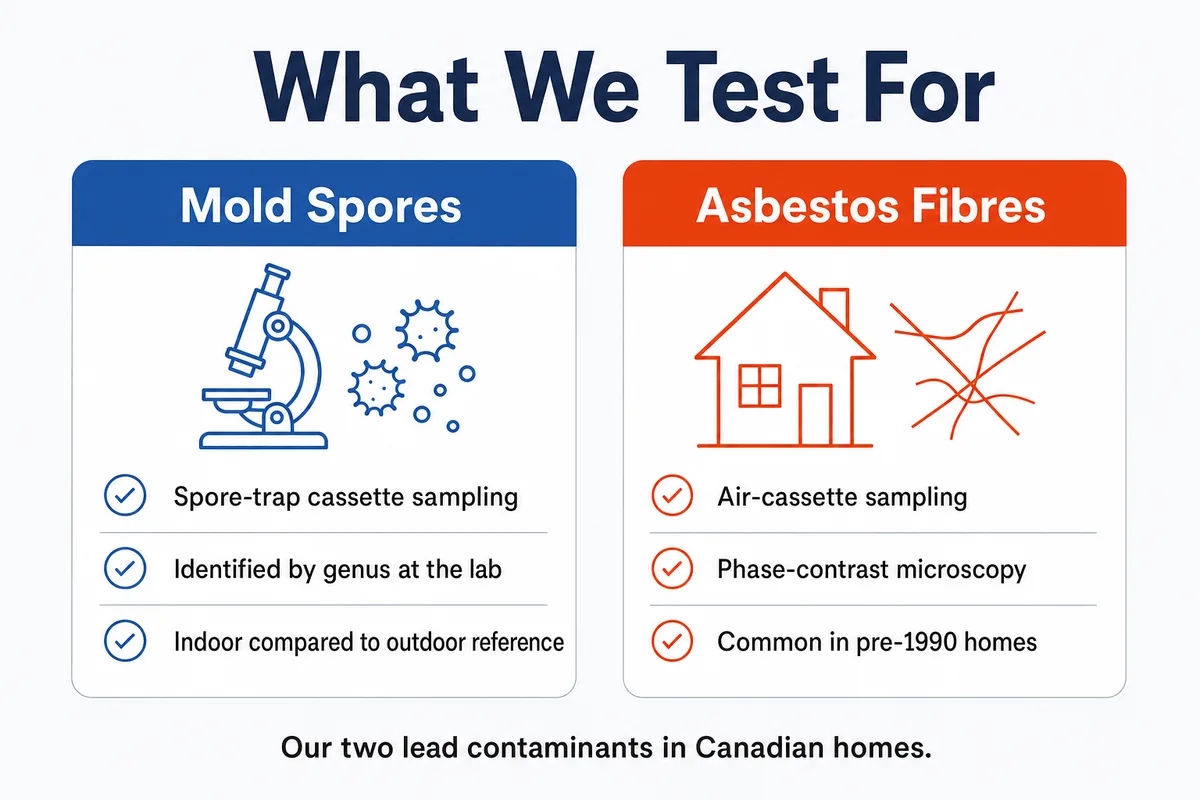
We focus on the two contaminants that drive the most calls and carry the most risk in Canadian homes: mold and asbestos. Our inspectors also take ambient readings of common indoor pollutants during the visit, but mold and asbestos are where lab-grade testing earns its keep.
🧫 Mold spores
We collect spore-trap cassettes with a calibrated bioaerosol pump and identify mold by genus at the lab, usually Stachybotrys, Aspergillus, Penicillium, Cladosporium, or Alternaria. The indoor sample gets compared against a same-day outdoor reference, which is how we tell whether your home has an active mold source or is just breathing normal outdoor background. Counts alone don’t mean much without that comparison, and a lot of cheaper “mold tests” skip it. For a deeper look, see our air quality testing for mold page.
🏚️ Asbestos fibres
For homes built before 1990, or any home where vermiculite insulation, popcorn ceilings, or old vinyl flooring is being disturbed, we collect air samples on cassettes and analyze them by phase-contrast microscopy. If the count needs confirming, the lab runs transmission electron microscopy, which can actually identify asbestos fibre type. Asbestos is the one contaminant where DIY isn’t an option. You need a microscope and a trained reader, full stop.
Beyond those two, our equipment picks up the usual background of indoor air during the walk-through, and anything unusual gets flagged in your report and discussed before you commit to a fuller panel. We’d rather tell you that you don’t need extra sampling than sell you a test you won’t use.
How home air quality testing works
A professional residential air quality test in Canada runs in four stages, and the whole on-site visit takes 60 to 90 minutes for a typical home.
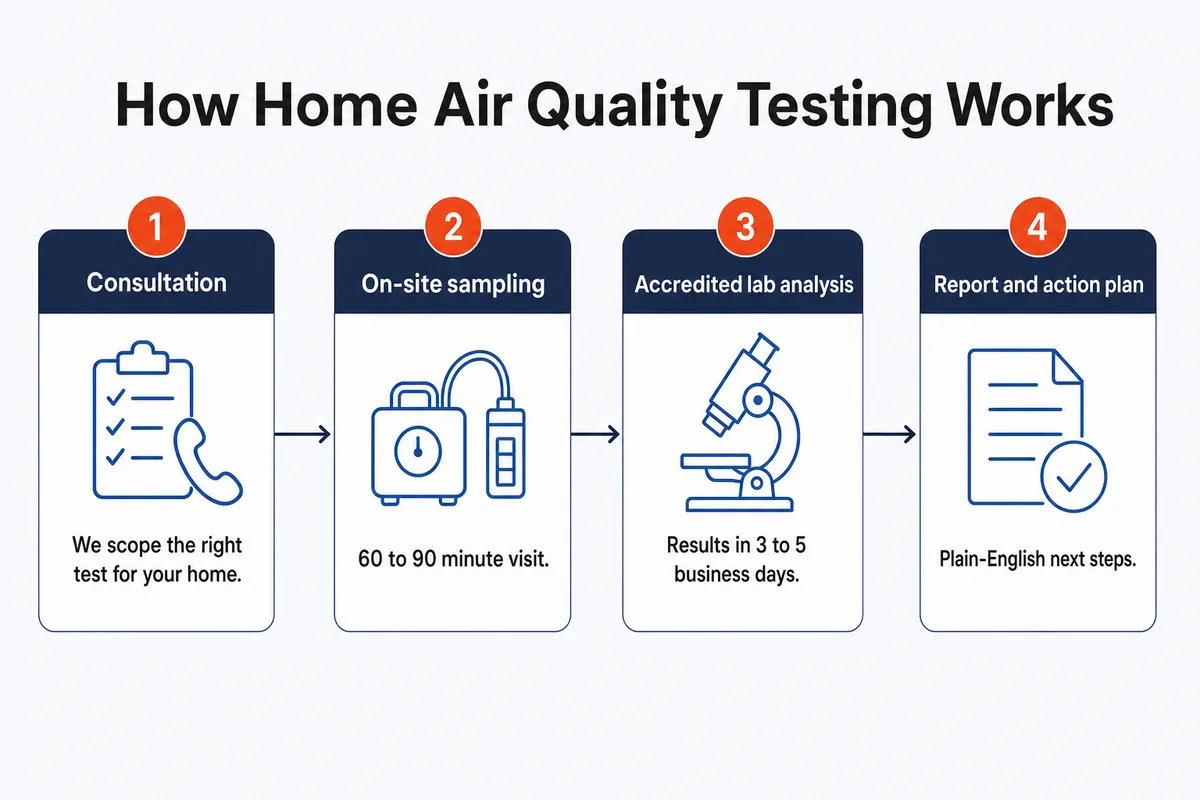
1. Consultation
A certified technician reviews your concerns by phone or in person and scopes the test. There’s no point sampling for asbestos in a 2015 build, so we tailor the panel to your actual situation instead of charging for boxes you don’t need.
2. On-site sampling
The technician arrives with calibrated equipment and collects what your home calls for, mold spore traps, asbestos cassettes, and ambient readings. Clean work, no mess left behind.
3. Accredited lab analysis
Samples ship the same day to an accredited Canadian laboratory. Mold cassettes are read by a microbiologist, asbestos by microscopy. Most results come back in 3 to 5 business days, and rush turnaround is usually available if you’re up against a closing date.
4. Report and action plan
You get a written report with the raw lab data, a plain-English interpretation, a comparison against Canadian guidelines (Health Canada, ASHRAE 62.2), and clear next steps. Sometimes that’s remediation. Sometimes it’s a ventilation tweak. Sometimes it’s “you’re fine, don’t spend the money.”
Professional test vs DIY home monitor
A consumer monitor is good for daily awareness. A professional test is what you want when you need to know exactly what’s wrong and prove it. They solve different problems.
Consumer monitors (Airthings, uHoo, Awair, Atmotube) have genuinely improved, and at $200 to $400 they’re a fair buy for tracking humidity and general air trends in one room. What they can’t do is identify a mold species, confirm asbestos, or produce a result an insurer or a real estate lawyer will accept. A monitor can tell you “something changed.” Only a lab can tell you what.
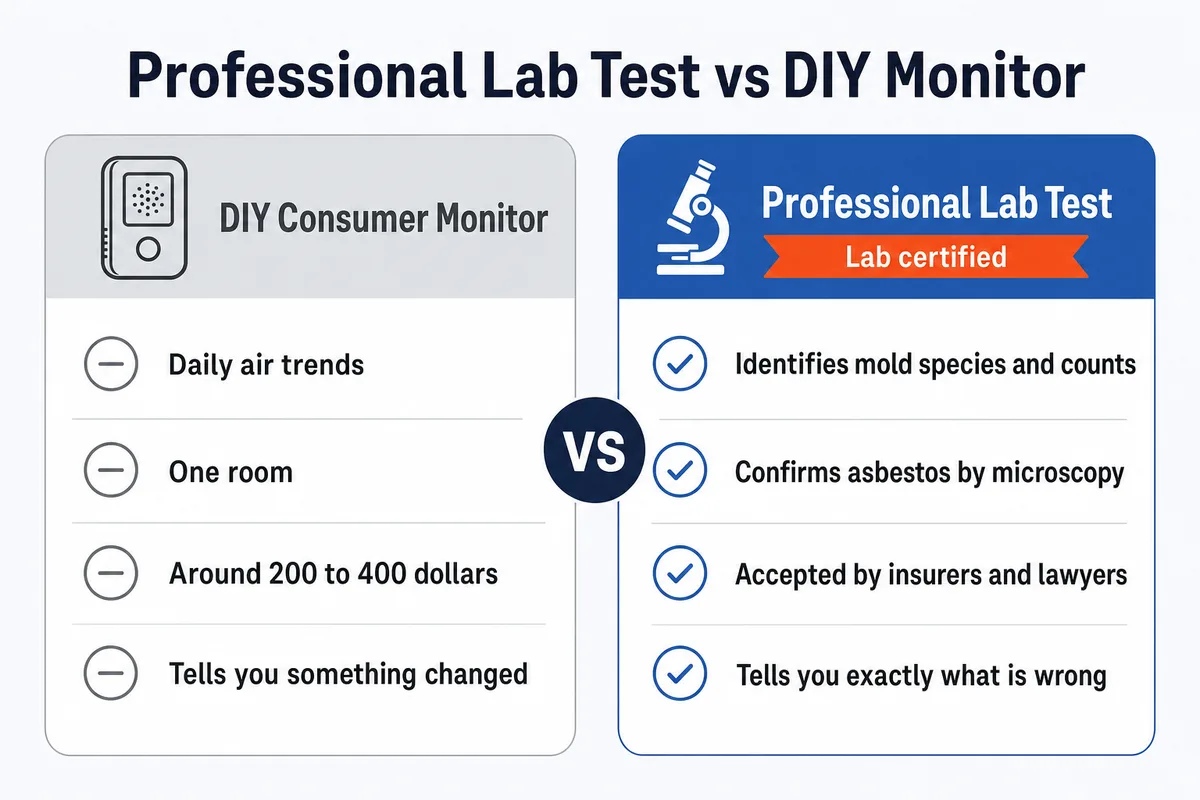
| Situation | DIY consumer monitor | Professional lab test |
|---|---|---|
| Daily awareness of general air trends | Best fit | Overkill |
| Suspected mold problem | Flags “something’s off” at best | Identifies species and counts |
| Real estate transaction | Not certified | Accepted by lawyers and lenders |
| Asbestos suspicion | Cannot detect it | Microscopy confirms it |
| Insurance claim documentation | Not accepted | Accredited report |
Plenty of our clients run a monitor between professional tests. The monitor flags a change, the lab test finds the cause. If you’d rather start with a DIY kit, we keep a buying guide of the best air quality testing kits for Canadian homes, and a guide on how to choose air quality testing services when you’re ready for the real thing.
Where we test: Ontario & Quebec service areas
Our technicians cover homes across Ontario and Quebec from our Montreal and Ottawa hubs, with same-week appointments available in most areas. Pick your city for local detail, or call us if you’re just outside the lines.
🏙️ Montreal, QC
Mold and asbestos testing across the Island and South Shore. View Montreal page
🏛️ Ottawa, ON
Air quality and mold testing across the National Capital region. View Ottawa page
🌉 Gatineau, QC
Hull, Aylmer, and the Outaouais, where older homes and freshet flooding drive a lot of our calls. View Gatineau page
🏰 Kingston, ON
Limestone-foundation mold and lakeside humidity. View Kingston page
🌲 Carleton Place, ON
Almonte, Pakenham, and rural well-water homes. View Carleton Place page
⚓ Brockville, ON
Thousand Islands waterfront homes with moisture and basement concerns. View Brockville page
🌊 Belleville, ON
Bay of Quinte humidity, plus Trenton and Quinte West vermiculite checks. View Belleville page
🌅 Cornwall, ON
St. Lawrence-area mold and post-flood testing. View Cornwall page
Outside these areas? Call 1-866-528-2897. We offer remote-collection kits and partner referrals across Ontario and Quebec.
How much does home air quality testing cost?
Residential air quality testing in Canada usually runs in the $300 to $700 range. What moves the number is how many spots you sample (most homes are one or two rooms), whether you’re testing mold, asbestos, or both, and whether the lab fees are bundled or billed separately. Mold-only is the cheapest starting point. Add asbestos or multiple rooms and it climbs from there.
We don’t quote a flat price online because it would be wrong for half the people reading it. Quotes are free, so call 1-866-528-2897 or book a callback, and we’ll scope a real number for your home before anything gets booked. Curious what an appointment involves? Here’s what to expect during an air quality inspection, step by step.
Customer stories & reviews
Real feedback from recent residential inspections across Ontario and Quebec.
★★★★★
“We just moved into a 1970s house and wanted to be sure the air was safe before unpacking the kids’ rooms. The technician walked us through every sample, what he was collecting and why. Got the full report in four days, and the recommendations were genuinely actionable.”
★★★★★
“My doctor recommended a professional air quality test to help manage my asthma. Three years on, it’s paid for itself in fewer flare-ups. We found a hidden mold issue behind a basement vanity that no DIY monitor would have caught. Polite, thorough technicians who answer every question.”
★★★★★
“Skeptical going in. The price was fair but I half-expected a sales pitch, and got the opposite. The technician spent an hour, packed up, and said ‘we’ll see what the lab finds, you may not need anything done.’ Recommended a small ventilation fix, no remediation, no upsell. Recommend without reservation.”
★★★★★
“Persistent odours in the basement that wouldn’t clear. The team came out within the week, tested for mold, and explained the lab report in plain English so I could share it with my insurer. They traced it to an old foundation crack letting moisture in. Five stars.”
Mold assessment: how to tell if you have a mold problem
Alongside air testing, we also offer a mold assessment, which is a hands-on visual inspection of the area you think is affected. Because mold spores are microscopic, the point of the assessment isn’t to spot every colony. It’s to map how far the contamination reaches and find the source, almost always a moisture problem: an intrusion, a condensation point, or a hidden plumbing leak.
We use the assessment two ways. It tells us how to plan the mold remediation and the prep it’ll need, and it lets us give you an accurate quote instead of a guess. If you’ve got visible mold and want eyes on it before you commit to lab work, this is usually where we start.
Frequently asked questions
For most Canadian homeowners, a one-time test does the job, unless something changes. New symptoms, a renovation, a flood or pipe burst, or a real estate transaction are all good reasons to retest. Any home with a history of moisture problems should retest for mold spores annually until the source is fully resolved, since spores come back as long as the moisture does.
The on-site visit runs 60 to 90 minutes for a typical home, longer for multi-storey houses. Samples ship to the lab the same day, and most results come back in 3 to 5 business days. Rush turnaround is usually available for an added fee if you’re working against a deadline. You’ll get a written report with the raw lab data, a plain-English read, and clear next steps.
The signs Health Canada flags most often are headaches, fatigue, irritated eyes, nose, or throat, congestion, and asthma or allergy symptoms that get worse indoors and ease when you leave. Add persistent musty or chemical odours (a smell you cannot place is worth an odour inspection on its own), visible mold, and recurring window condensation. If the symptoms cluster in one room or get worse in a certain season, that room is where we’d start sampling.
For ongoing daily readings, a $200 to $400 consumer monitor is usually worth it for peace of mind. For diagnosing a real problem, suspected mold, post-renovation concerns, a possible asbestos issue, post-flood damage, or real estate due diligence, a professional test is worth several DIY kits, because it produces a lab-certified report you can actually act on with a remediation contractor, an insurer, or a lawyer.
Our testing focuses on mold spores, identified by genus at an accredited lab, and asbestos fibres, confirmed by microscopy. Our inspectors also take ambient readings of common indoor pollutants during the visit and flag anything unusual in your report. The exact panel depends on your concern, and the technician scopes it with you during the consultation so you’re not paying for sampling you don’t need.
You’ve got two paths. A DIY consumer monitor (Airthings, uHoo, Awair) gives you ongoing readings for general daily awareness. A one-time professional inspection sends air samples to an accredited Canadian lab for analysis. Monitors are fine for tracking trends. Professional testing is what you want when you suspect a specific contaminant like mold or asbestos, or when symptoms have no obvious cause, because the lab can identify and quantify exactly what’s there. To get started, call 1-866-528-2897 and we’ll book your inspection.
Every page on this site is reviewed by our certified inspectors before it goes live. Read our editorial policy to see how we research, review and correct our content.