May 13, 2026
Air Quality Testing for Mold: When You Need It and What to Expect
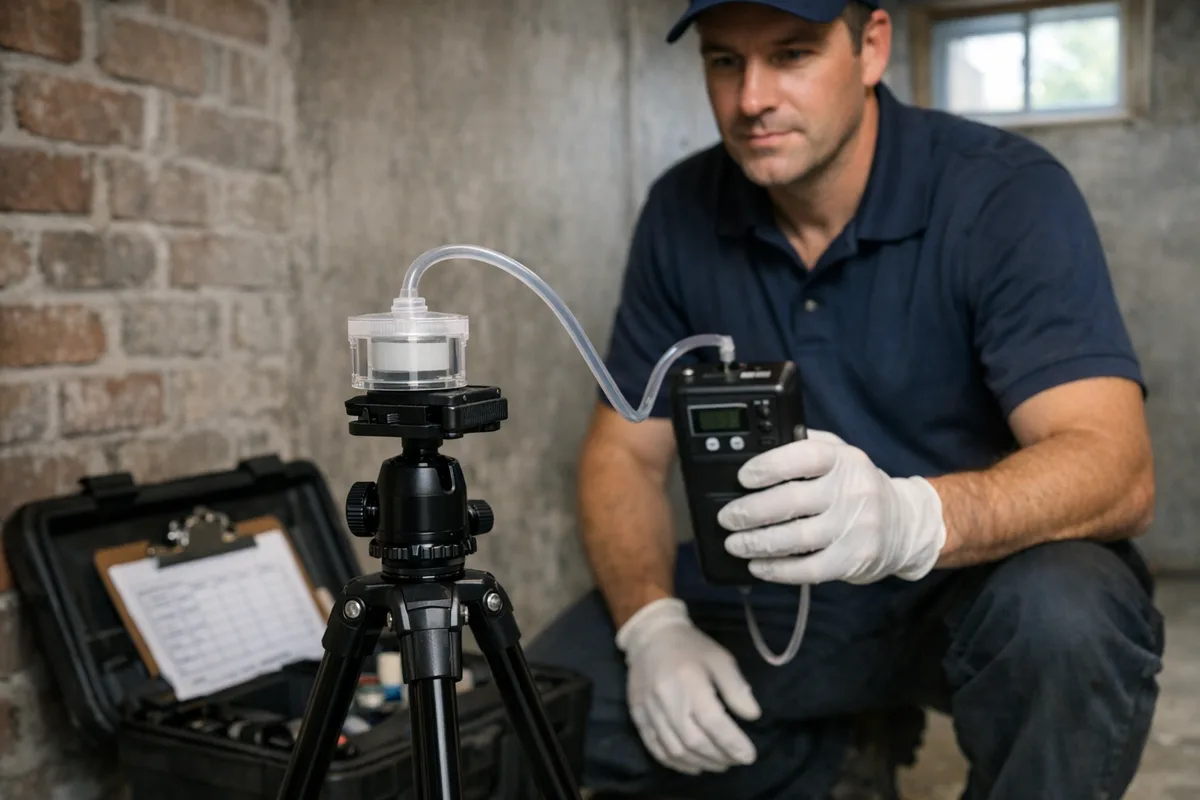
A good air quality test for mold answers two questions that a visual inspection cannot: how many mold spores are actually in the air your family is breathing, and which species are present. Visible mold on a bathroom ceiling is easy to diagnose; the harder cases are a musty smell after a basement leak, asthma that gets worse only at home, or a real-estate purchase where the seller insists “there’s no mold.” For those situations, indoor air sampling with a spore trap, analyzed by an accredited Canadian laboratory, is the test that gives you defensible numbers. Professional mold testing in a Canadian home should always combine a spore-trap sample with an outdoor control sample — it’s the only way to put the indoor numbers in context. We’ve performed over 15,000 inspections across Ontario and Quebec since 2005, all by IICRC- and IAQA-credentialed inspectors, and this guide explains exactly when an air quality test for mold is the right call, what the process looks like, what the results mean, and what it costs.
When you need an air quality test for mold (vs other mold tests)
An air test for mold is the right choice when you suspect a mold problem but can’t see one, or when you can see one and need to know how far the spores have spread through your indoor air. Mold testing this way is built around a spore-trap cassette: a small sealed device that captures every airborne spore for the lab to count. It is not the right test for every situation. Use this checklist as a starting point.
- A musty or earthy smell persists in a room even after cleaning, with no visible mold to clean off.
- You had water damage, a roof leak, a sump-pump failure, a basement flood, or an ice-dam leak more than 48 hours ago, and you want to know whether the drying-out worked.
- Family members get respiratory symptoms (cough, wheeze, headache, sinus congestion) only at home, and symptoms ease when they leave the house.
- You can see mold in one location and want to know whether airborne spores have reached other rooms or the HVAC.
- You are buying or selling a home and need a defensible third-party document for the transaction.
- You finished mold remediation and need clearance testing to confirm spore counts are back to normal.
Choose a different mold test if:
- The mold is visible on a hard surface and you just want it identified — a surface tape lift or swab is cheaper and tells you the species directly.
- You suspect mold inside a wall cavity — a wall-cavity air sample is more sensitive than a room-air sample for hidden growth.
- You’re a researcher or have very specific medical reasons to fingerprint species at the DNA level — an ERMI dust sample is the academic standard, but it is not designed for routine residential diagnosis.
If you’re still not sure which test fits your situation, the signs your home needs air quality testing guide walks through the symptoms that point to each test type. You can also call us at 1-866-528-2897 — we’ll match the right method to your problem before any work begins, or schedule a mold inspection for a combined visual and sampling visit. For most homeowners, what you actually want is a short combination of a visual inspection of suspect rooms plus indoor and outdoor air sampling — that’s the standard scope of residential air quality testing when mold is the concern.
What an air quality test actually measures for mold
An air quality test for mold measures the concentration of mold spores in your indoor air, expressed in colony-forming units per cubic metre of air, written CFU/m³ (or sometimes spores/m³ for non-viable methods). It does not test for the volatile compounds mold gives off, and it does not test for live mold colonies behind walls. What it gives you is a snapshot of how many airborne spores are floating where you breathe.
There are two sampling methods. Most Canadian inspectors use the first.
Non-viable air sampling (the industry standard). A calibrated air pump pulls a measured volume of air through a sealed spore trap cassette — typically an Air-O-Cell or Allergenco-D — for five minutes per location. The spore trap captures every spore on an adhesive strip. An accredited lab examines the strip under a microscope and counts every spore by genus (Stachybotrys, Aspergillus, Penicillium, Cladosporium, and so on). Non-viable mold testing counts both living and dead spores, which is exactly what you want for human exposure — your immune system reacts to dead spores too. Results take 5–7 business days. This is the spore-trap method we use on most residential visits.
Viable air sampling (specialty use). A different cassette traps living spores onto a culture medium. The lab grows the spores into colonies over 7–14 days, then counts and identifies them at the species level. Viable mold testing answers questions non-viable can’t — for example, “is the Stachybotrys we found chartarum or echinulata?” — but it misses dead spores entirely and takes twice as long. For routine residential mold testing of indoor air, non-viable spore-trap sampling is the better tool. We use viable testing for forensic or medical-litigation cases.
Outdoor control sample. Every indoor air sample is paired with an outdoor air sample taken the same day, at the same time. Mold spores are normal in outdoor air everywhere in Canada — the question is whether indoor counts are consistent with outdoor counts (normal indoor fungal ecology) or significantly higher (a problem). Without the outdoor baseline, an indoor spore count is just a number with no context. CCOHS and the IICRC S520 standard for mould remediation both build their interpretation around this indoor-vs-outdoor comparison.
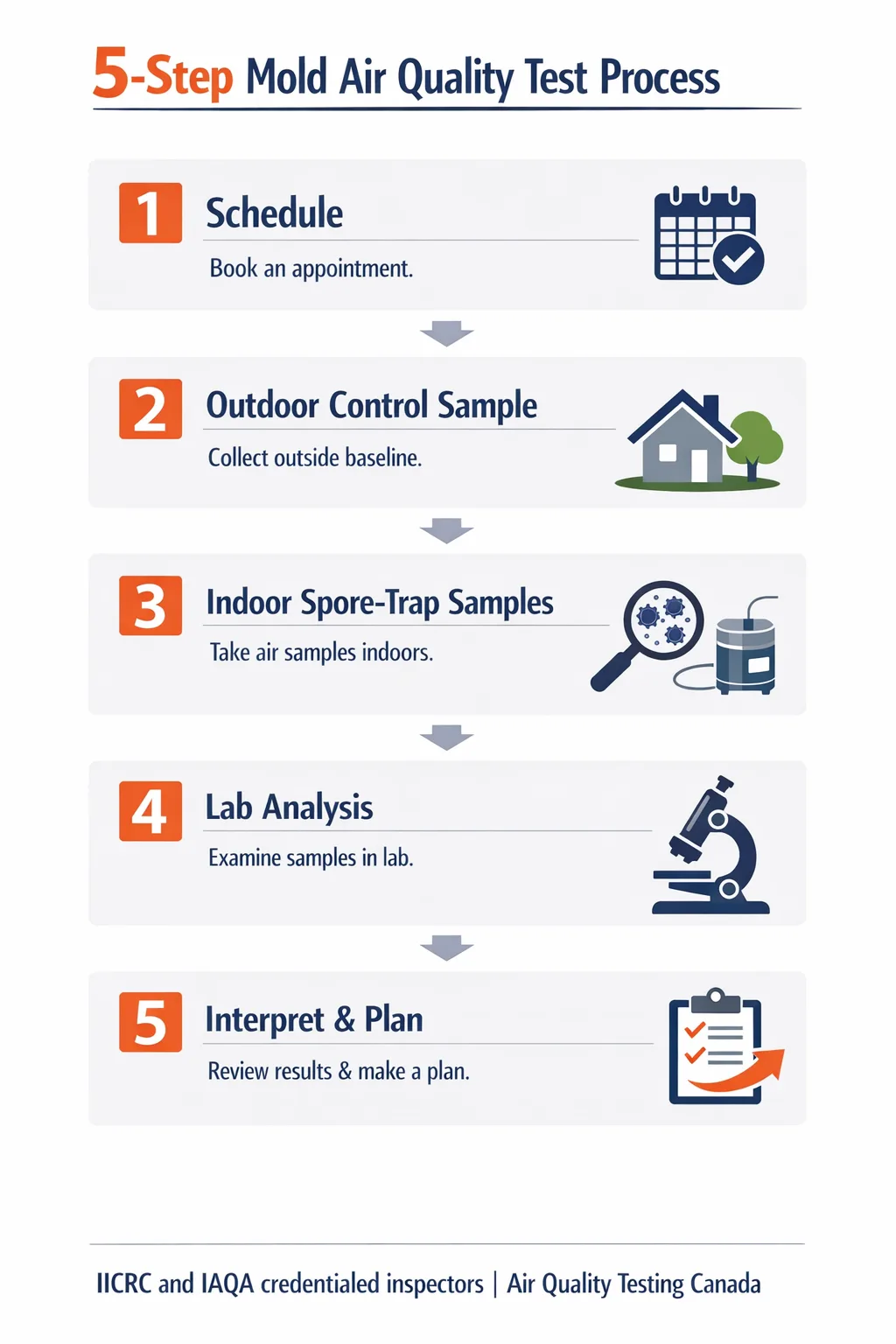
A typical residential air quality test for mold takes 60–90 minutes on site — about 15 minutes for setup and walk-through, 5 minutes per sample location, and 10 minutes to brief you and pack out. Inspectors holding IICRC and IAQA credentials follow a defined sample protocol so the lab can compare your data against industry baselines. Our IICRC-trained inspector visit and spore-trap process covers the full protocol for residential and commercial buildings.
Air quality test vs surface mold test vs ERMI: which do you need?
This is the single most common question we get. The right method depends on what you can see, what you suspect, and what you’ll do with the result. Here’s the comparison.
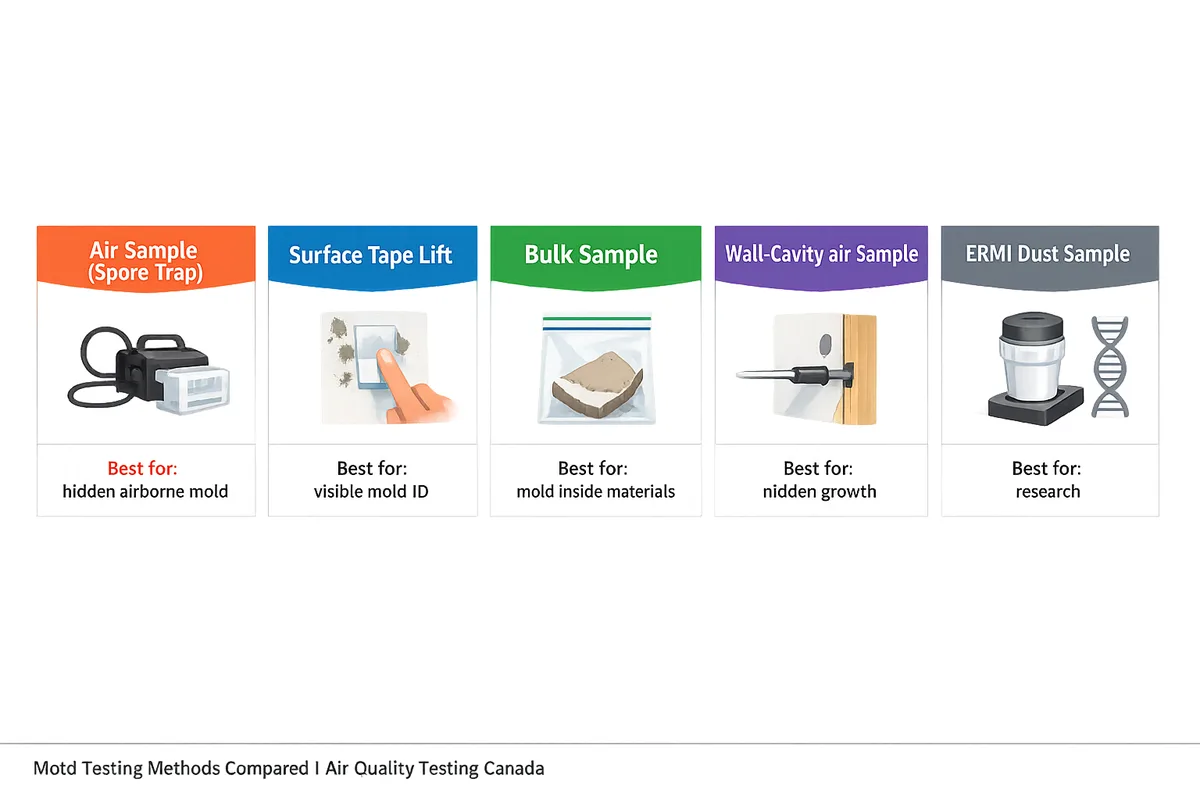
| Method | What it detects | When to use | Lab turnaround | Cost CAD |
|---|---|---|---|---|
| Indoor air sample (spore trap) | Airborne mold spores by genus, indoor vs outdoor concentration | Musty smell with no visible source; post-water-damage; symptoms only at home; clearance after remediation | 5–7 business days | $299–$450 per zone |
| Surface tape lift / swab | Mold species growing on a specific surface | Visible mold on drywall, tile, wood, fabric — you want a species ID | 3–5 business days | $80–$150 per sample |
| Bulk sample | Mold inside a physical chunk of building material (drywall, insulation, vermiculite) | Suspect mold inside a removed sample of building material | 5–7 business days | $100–$180 per sample |
| Wall-cavity air sample | Hidden mold growing inside wall, floor, or ceiling cavities | Persistent musty odour with no visible growth; pre-renovation moisture survey | 5–7 business days | $200–$300 per cavity |
| ERMI dust sample | DNA of 36 mold species in settled house dust | Research or clinical applications; very specific medical questions | 10–14 business days | $250–$400 per sample |
A surface tape lift cannot tell you whether spores from that mold colony have reached the rest of the house — only an air test for mold can. An air sample cannot tell you exactly which surface the mold is growing on — only a visual inspection plus a tape lift can. Most professional residential mold testing visits combine both: a visual inspection of suspect rooms, a tape lift if visible mold is found, and indoor + outdoor spore-trap air samples to measure spore concentration. ERMI is a powerful tool for researchers, but for a homeowner deciding whether to remediate a basement, it is overkill and the results are notoriously hard to interpret without an environmental medicine specialist. For most Canadian households, residential mold testing built around a non-viable spore trap plus an outdoor control sample is the right scope.
The other category worth naming is the DIY mold air kit you can buy at a hardware store. We cover those further down — short version: a $30 settle-plate kit is not a real air test for mold, and even good mail-in spore-trap kits leave the most important variable (interpretation against an outdoor baseline) up to you.
Air quality test vs mold test: how to choose
People search “air quality test vs mold test” when they know they have a problem but can’t tell which test to book. The short answer: when most people say “mold test” they mean one of four things — an air quality test (the spore-trap method we run by default), a surface tape lift, a bulk material sample, or an ERMI dust test. An “air quality test” is the single most useful of the four for the situation most homeowners are actually in: a musty smell with no obvious source, a recent water event, or symptoms that ease when you leave the house. The table above breaks down which method fits which problem.
- You can’t see mold but you can smell it, or you got sick after a water event → book an air quality test for mold. Spore-trap air sampling is the method designed for this scenario.
- You can see mold on a surface and just want to know what it is → a surface mold test (tape lift or swab) is faster and cheaper.
- You can see mold and want to know whether spores have spread to other rooms → do both — a surface tape lift for the species ID and an air quality test for the spread.
- You finished remediation and need defensible clearance documentation → book a post-remediation air quality clearance test with paired indoor and outdoor samples.
The phrase mold test by itself doesn’t name a method — it names a goal. The right method depends on whether you’re trying to detect, identify, or measure spread, and that’s the call we help make on the phone before any inspector is scheduled. If you’re still unsure after reading the comparison table, call 1-866-528-2897 and we’ll match the method to your situation before quoting anything.
How to read your air quality test results for mold (CFU/m³)
Your air quality testing for mold report will list every mold genus found in each sample with its concentration in CFU/m³. The hardest part for most homeowners is knowing whether those numbers are normal, elevated, or alarming. Health Canada deliberately does not publish a single safe number for airborne mold — individual sensitivity varies, and what’s healthy for a 35-year-old is not necessarily healthy for an asthmatic child. The accepted industry interpretation, drawn from the IICRC S520 standard, the CCOHS workplace mould fact sheet, and Health Canada’s guide to mould in the home, uses three bands.
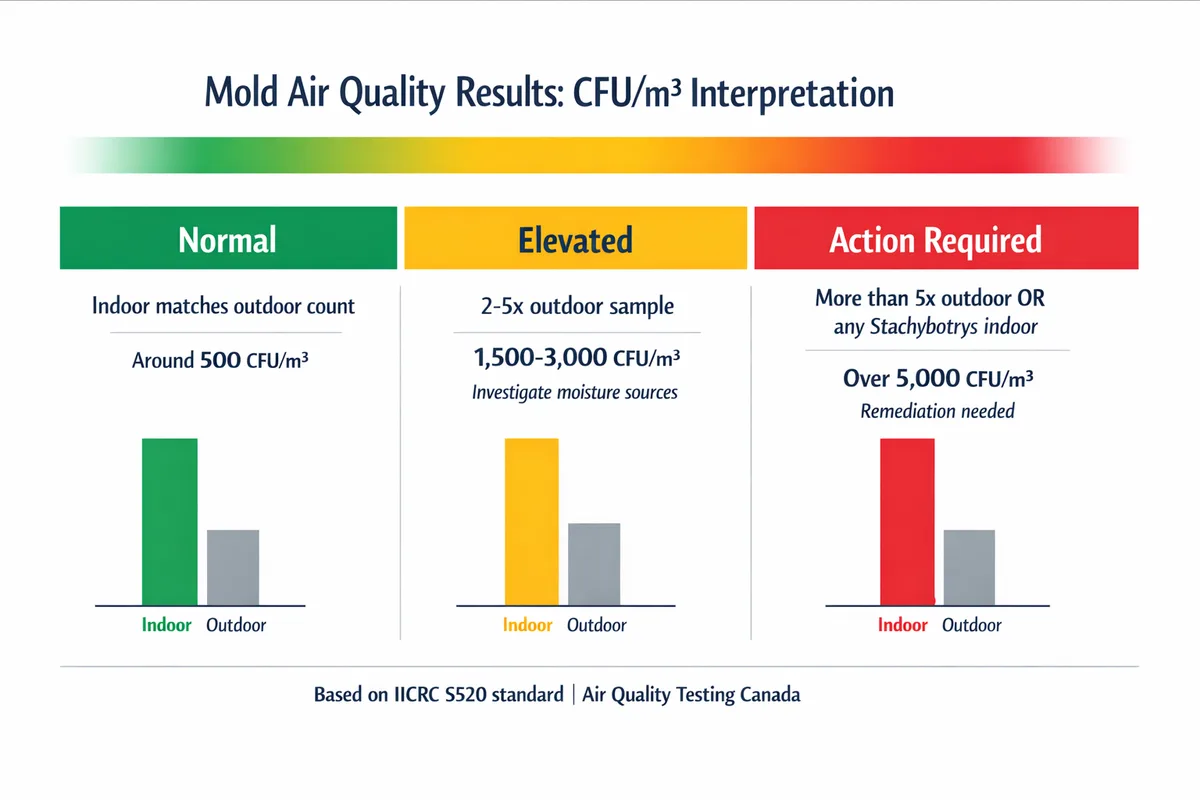
Indoor spore counts are similar to outdoor counts and the same species mix dominates indoors as outdoors. This is normal indoor fungal ecology — mold spores are part of the outdoor air everywhere in Canada, and they drift inside on shoes, pets, and ventilation. Typical normal indoor totals run a few hundred to a couple of thousand CFU/m³, but only the comparison to your same-day outdoor sample matters, not the absolute number.
Indoor totals are roughly 2× to 5× the outdoor sample, or a genus that’s rare outdoors is dominant indoors. This usually means there’s an active moisture source somewhere — a leaky pipe, a basement humidity problem, condensation behind drywall, a wet crawlspace. An elevated result by itself is not proof of a health emergency, but it is a clear signal to find and fix the moisture source. We typically recommend a follow-up moisture inspection and, if a source is found, a remediation plan.
Indoor totals are more than 5× outdoor counts, OR any Stachybotrys (black mold) is detected indoors when none is present outdoors, OR a single dominant genus reaches several thousand CFU/m³. Stachybotrys spores are heavy and rarely become airborne unless they are disturbed or unless there is an active wet colony — finding even a few of them in a non-disturbed sample is significant. Toxigenic species at high concentrations need professional mold removal following IICRC S520 containment and removal protocols, not surface cleaning.
The four genera you’ll see most often in Canadian homes are Aspergillus (the most common indoor mold — allergenic, sometimes infectious in immunocompromised people), Penicillium (often found on water-damaged materials, causes sinus inflammation), Cladosporium (grows on cold surfaces like AC drip pans, triggers asthma), and Stachybotrys (the so-called black mold, produces mycotoxins, requires immediate remediation when found indoors). A few hundred Cladosporium spores after a wet weekend is not the same problem as a few hundred Stachybotrys spores in a closed basement. The species mix matters as much as the count.
For a deeper interpretation guide with sample report walkthroughs, see our companion article on what your CFU/m³ counts and species ID mean. If your report is in the action-required band, call us at 1-866-528-2897 and we’ll walk you through the next steps the same day.
When an air quality test won’t find mold (and what to do instead)
Honest answer: indoor air sampling has real limits. It is the right tool for many situations and the wrong tool for several. Knowing the limits before you test prevents the most common mistake we see — a $400 air quality test that comes back “normal” while a colony is quietly growing inside a wall cavity.
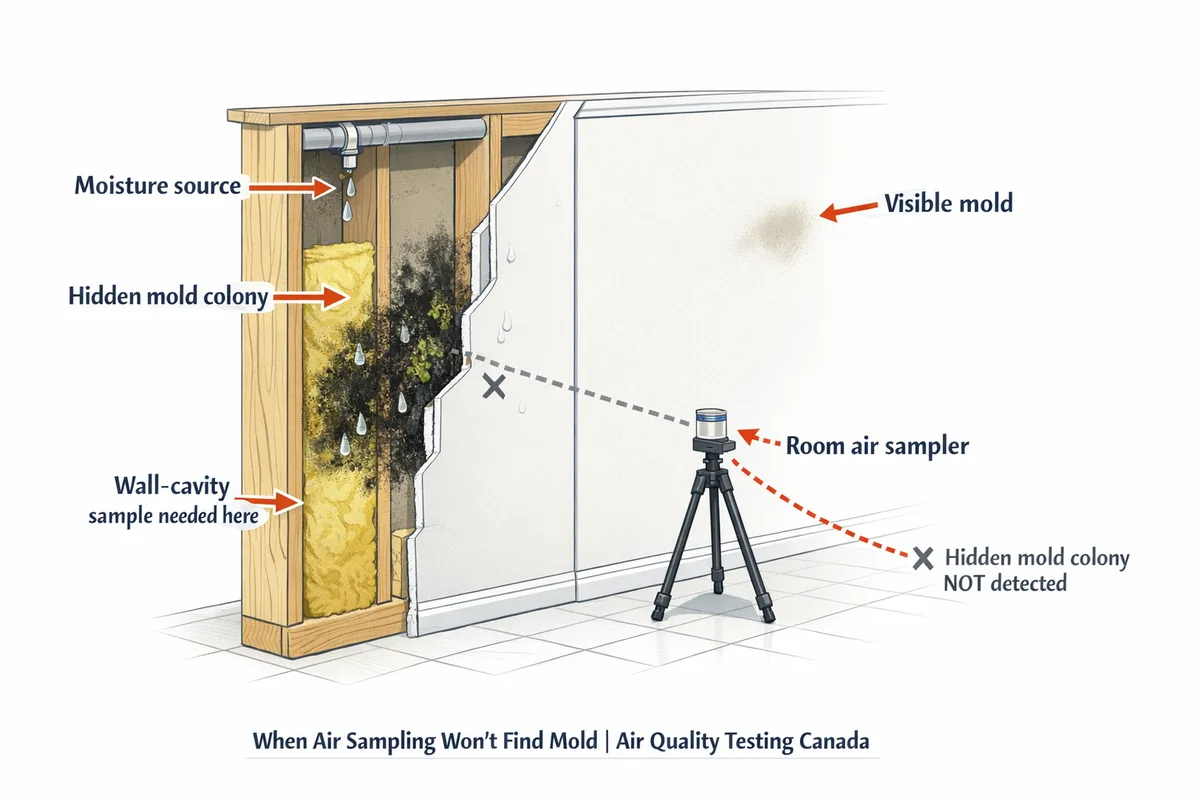
Air sampling misses mold that isn’t shedding spores. A colony behind sealed drywall, inside subfloor, in a closed crawlspace, or sealed inside HVAC ductwork may produce a strong musty odour without releasing spores into the breathing zone. A standard room-air sample taken in the middle of the room can come back normal even when there is significant hidden growth nearby. If you smell mold but the room-air result is clean, the next step is a wall-cavity air sample (low-flow pump with a needle probe through a small hole in the drywall) plus thermal imaging to find the wet spot driving the growth.
Air sampling misses mold that’s been suppressed by HVAC. Running an air conditioner heavily before testing can drop airborne spore counts temporarily by filtering them out. We always ask homeowners to leave the HVAC at normal operating conditions for at least 24 hours before testing, and we record the HVAC state in the report.
Air sampling misses mold that’s not yet sporulating. Brand-new mold growth (under a week, in cool weather) may not be releasing spores yet. A “normal” result on a fresh leak does not rule out a future problem if the leak isn’t fixed.
Air sampling won’t tell you where the mold is. Even when an air sample is positive, it tells you spores are in the air — not which wall, ceiling, or appliance they came from. You still need a visual moisture inspection, thermal imaging, and (sometimes) bulk or wall-cavity sampling to localize the source.
DIY mold air quality test kits: why they mislead
Hardware stores and Amazon.ca sell at-home mold test kits ranging from $20 settle-plate dishes to $80 spore-trap cassettes you mail to a lab. The mail-in spore-trap kits use the same cassette technology a professional uses, and if you collect the sample correctly, the lab analysis is real. The catch is that almost nobody collects the sample correctly.
Settle plates are not an air quality test for mold. A petri-style settle plate left open in a room for 30 minutes catches whatever drifts down by gravity. It cannot measure air concentration because it doesn’t move a known volume of air through a known filter. Mold spores exist in all indoor air everywhere, so a settle-plate test almost always grows something. A “positive” settle-plate result confirms what’s already true: mold spores are everywhere. It does not tell you whether your home has a problem.
At-home spore-trap kits are better but lack a baseline. A mail-in spore-trap kit ($60–$120) gives you a real spore count, but most DIY users skip the outdoor control sample. Without it, the indoor number is meaningless — you don’t know whether 800 CFU/m³ is normal for that neighbourhood that day or three times higher than normal. The lab can identify mold by genus, but it can’t interpret your home’s situation without context the kit doesn’t capture.
The interpretation problem is the real problem. Even when a homeowner uses a good kit, takes both indoor and outdoor samples, and gets a clean lab analysis back, the report is a list of species and counts with no recommendation. Is 2,400 CFU/m³ of Penicillium in your basement a problem? It depends on the outdoor reading, the moisture sources you have, the type of building, and your family’s health profile. That’s the part a $120 DIY kit can’t deliver.
For homeowners who want to check the air themselves before committing to a professional visit, our guide to consumer air quality test kits walks through the kits that actually work in Canadian homes. For everything past initial screening, we recommend booking a professional air quality test for mold with same-day outdoor controls, IICRC-trained sample collection, accredited lab analysis, and a written interpretation you can hand to a doctor, an insurer, or a real estate buyer.
How much does an air quality test for mold cost in Canada?
Pricing depends on how many rooms you sample, whether the lab fee is bundled, and whether a moisture inspection is included. Here is what professional air quality testing for mold typically costs across Ontario and Quebec in 2026. Ottawa-specific pricing, the spring-freshet timing, and local service areas are detailed on our mold inspection in Ottawa page.
| Test scope | What’s included | Typical cost |
|---|---|---|
| Single-room screening | 1 indoor air sample + 1 outdoor control, lab fee, IICRC inspector visit, written report | $299–$450 |
| Whole-home 3-room panel | 3 indoor air samples + 1 outdoor control, lab fees, moisture-meter inspection, thermal imaging of suspect surfaces, written report | $500–$750 |
| Post-remediation clearance | 2–3 indoor air samples + 1 outdoor control after a remediation job, IICRC clearance protocol, written clearance report for your contractor | $400–$900 |
A DIY mail-in spore-trap kit costs $60–$120 per cassette and excludes interpretation. A wall-cavity air sample (low-flow pump through drywall, used when room-air results are inconclusive) typically adds $200–$300 per cavity. Surface tape lifts to identify visible mold growth run $80–$150 per sample and are often bundled into a mold inspection visit rather than priced separately.
We quote every job up front before any work begins. Call 1-866-528-2897 for a same-week residential booking across Ottawa, Gatineau, Montreal, Kingston, and surrounding Ontario and Quebec service areas.
Frequently asked questions
Yes — a professional air quality test for mold uses a calibrated pump to draw indoor air through a spore-trap cassette, which an accredited lab examines under a microscope to count and identify mold spores by genus. It detects airborne spores from any active mold growth that is shedding into the air. It will not detect mold sealed inside a wall cavity, mold that has not yet started releasing spores, or mold that the home’s HVAC has been filtering for several days. For hidden growth, a wall-cavity air sample is the better tool.
“Mold test” is an umbrella term. An air quality test for mold measures spores in the air. A surface mold test (tape lift or swab) identifies a species growing on a visible surface. A bulk mold test analyzes a physical sample of a building material. An ERMI dust test measures mold DNA in settled dust. The right method depends on what you suspect. If you have a musty smell and no visible mold, you want an air quality test. If you can see mold on a wall, a surface tape lift identifies it. Most professional visits combine air sampling with a visual inspection.
A single-room professional air quality test for mold runs $299–$450 and includes one indoor sample, one outdoor control sample, lab fees, an IICRC-trained inspector, and a written report. A whole-home three-room panel runs $500–$750 and adds a moisture-meter inspection and thermal imaging. Post-remediation clearance testing runs $400–$900 depending on the size of the job. DIY mail-in kits cost $60–$120 per cassette but exclude interpretation and rarely include an outdoor control sample.
Yes, with caveats. Mail-in spore-trap kits use the same cassette technology a professional uses, and the lab analysis is real if you collect the sample correctly. The two problems are sampling technique (most DIY users skip the outdoor control sample) and interpretation (the lab report lists species and counts but does not interpret your home’s situation). For initial screening, a $60–$120 mail-in kit is reasonable. For situations where the result matters — a real estate transaction, a health complaint, a clearance after remediation — book a professional air quality test for mold with same-day outdoor controls and a written interpretation.
Health Canada deliberately does not publish a single safe number for airborne mold. The industry standard, drawn from the IICRC S520 standard, compares indoor counts to a same-day outdoor control sample. Normal indoor counts are roughly equal to outdoor counts with the same species mix. Elevated counts (2× to 5× outdoor) usually mean an active moisture source. Action-required counts (above 5× outdoor, or any Stachybotrys indoors when there’s none outdoors) usually mean remediation is needed. Typical normal indoor totals run a few hundred to a couple of thousand CFU/m³, but the outdoor comparison matters far more than the absolute number.
The on-site sampling visit takes 60–90 minutes — about 15 minutes for setup and walk-through, 5 minutes per sample location, and 10 minutes to brief you and pack out. Non-viable spore-trap analysis at an accredited Canadian lab takes 5–7 business days. Viable culture-based analysis takes 7–14 days. We email the written report when lab results come back. For urgent situations such as a real estate closing, ask about same-week scheduling and rush lab turnaround.
It depends on what you mean by “accurate.” For confirming whether airborne mold spores are at problem levels in your living space, the most accurate method is non-viable spore-trap air sampling with a paired outdoor control, analyzed by an accredited lab against the IICRC S520 standard. It captures every airborne spore (living or dead, since your immune system reacts to both) and benchmarks the count against same-day outdoor air. For identifying a specific visible patch of mold down to the species, a surface tape lift is more accurate — it samples the colony directly. For finding hidden mold inside a wall cavity, a wall-cavity air sample beats a room-air sample because it pulls air from where the mold actually is. There is no single “most accurate” mold test — there is a most accurate method for each specific question. The professional answer combines a visual inspection (to find the obvious) with one or two air samples (to measure what the eye can’t see).
For most Canadian homeowners, no — you need one well-designed visit. A professional air quality test for mold is already a mold test: it uses a spore-trap cassette to count and identify mold spores in your indoor air, with a paired outdoor control. That is the “mold test” people picture when they search the phrase. You only need a second test if the air sample comes back elevated and you want a surface tape lift to identify the species growing on a specific visible patch, or if the inspector finds evidence of hidden mold in a wall cavity and wants a follow-up wall-cavity air sample. We sort that out on the same visit — one inspector, one report, one bill. If you’re being quoted “mold test plus air quality test” as two separate services, ask the provider what each test would tell you that the other wouldn’t.
What homeowners and inspectors say about our air quality test for mold
“After our basement flooded I needed proof for our insurance that we’d cleared the mold problem. The IICRC inspector took indoor and outdoor samples, the lab report came back in five days, and I had a clearance document the same week. Worth every dollar.”
“Bought a 1950s home and the seller swore there was no mold issue. The air quality test caught elevated Stachybotrys in the basement that a visual inspection missed. Saved us from a $40,000 surprise after closing.”
“My son’s asthma was getting worse at home and our family doctor recommended an air quality test for mold. The report identified Aspergillus levels three times outdoor. After remediation his symptoms cleared up within weeks.”
“We had a musty smell in the spare bedroom for months. Air sample came back normal but the inspector recommended a wall-cavity sample, which found hidden Penicillium behind the drywall from an old window leak. Honest professional work.”
Book your air quality test for mold
Air Quality Testing Canada serves Ottawa, Gatineau, Montreal, Kingston, Belleville, Brockville, Cornwall, Carleton Place, and surrounding Ontario and Quebec communities with same-week residential and commercial bookings. Every visit is performed by an IICRC- and IAQA-credentialed inspector, samples are analyzed by accredited Canadian laboratories, and you receive a written report you can hand to a doctor, an insurer, a contractor, or a real estate buyer. We also offer asbestos testing if a related question comes up during the inspection.
📞 Call 1-866-528-2897 Request a callback
Monday to Friday, 8:00 AM to 3:00 PM ET · Quotes are always free