May 5, 2026
Mold Testing in Montreal: Air & Surface Sampling for Homes Across Greater Montreal
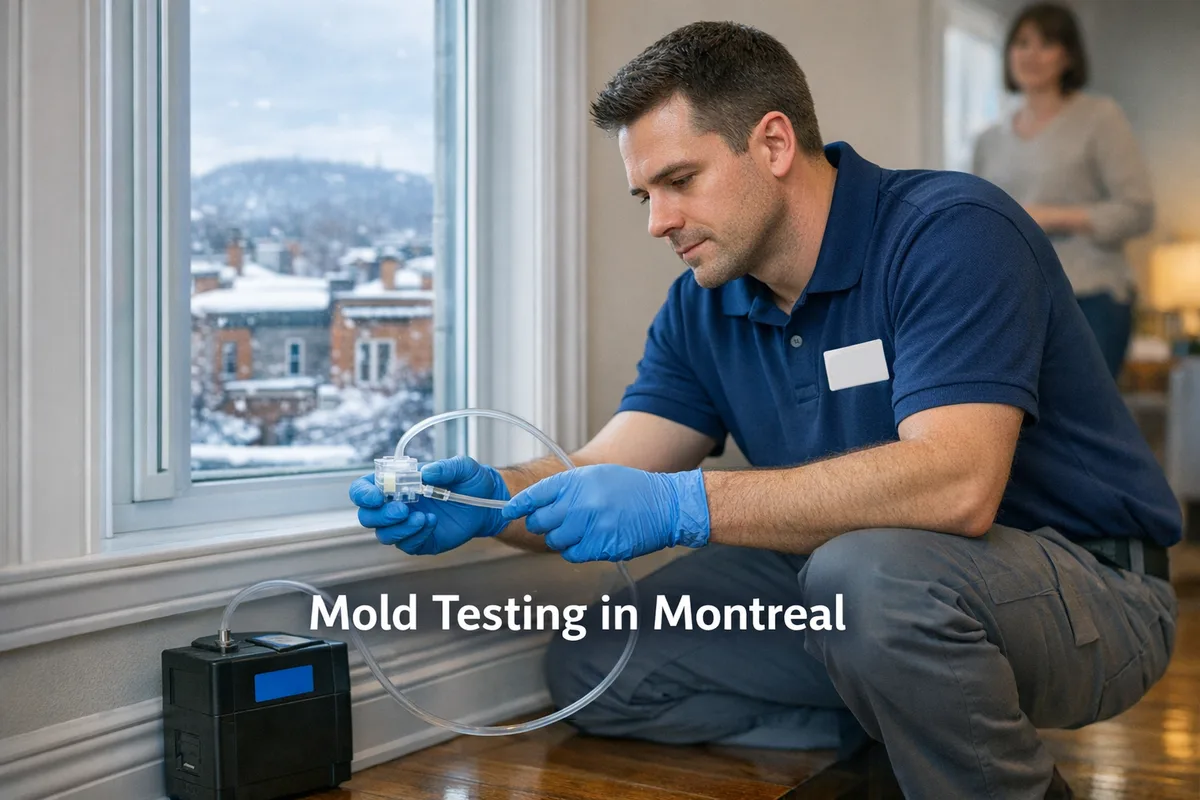
Mold doesn’t behave the same way in Montreal as it does in the rest of Canada. Long humid summers, tightly sealed-up winters, century-old triplex and duplex foundations, and the basement-heavy housing stock across the Plateau, Verdun, NDG, and Outremont give mold spores year-round opportunities to colonize behind drywall, under flooring, in cold rooms, and around bathroom vents.
If you can smell a musty odour, you see staining on a wall or ceiling, someone in the home is reacting with new allergy or asthma symptoms, or you’ve just had a water intrusion event, you need professional mold testing in Montreal — not a hardware-store test kit, and not a guess.
Our professional mold testing team has been working across the Island of Montreal, Laval, Longueuil, the West Island, and the South Shore for more than 20 years and has completed more than 15,000 indoor air and mold inspections. Our inspectors hold IICRC and IAQA certifications, our lab work is processed through accredited Canadian labs, and we offer bilingual (English and French) appointments — typically within the same week.
- What you’ll get: a visual survey, air sampling with calibrated spore-trap cassettes, surface samples where needed, accredited lab analysis, and a written report with photos, lab data, and a remediation plan.
- What it costs: $300–$900 for most residential mold inspections in Montreal, depending on home size and number of samples.
- How fast: on-site sampling typically takes 60–90 minutes; lab results in 3–5 business days.
How our Montreal mold testing process works
Every mold testing in Montreal appointment we run follows the same five-step process. It exists to make sure the data you get is defensible — if you ever need to show it to a buyer, a landlord, your insurer, or a Régie du logement adjudicator, the chain of custody and methodology hold up.
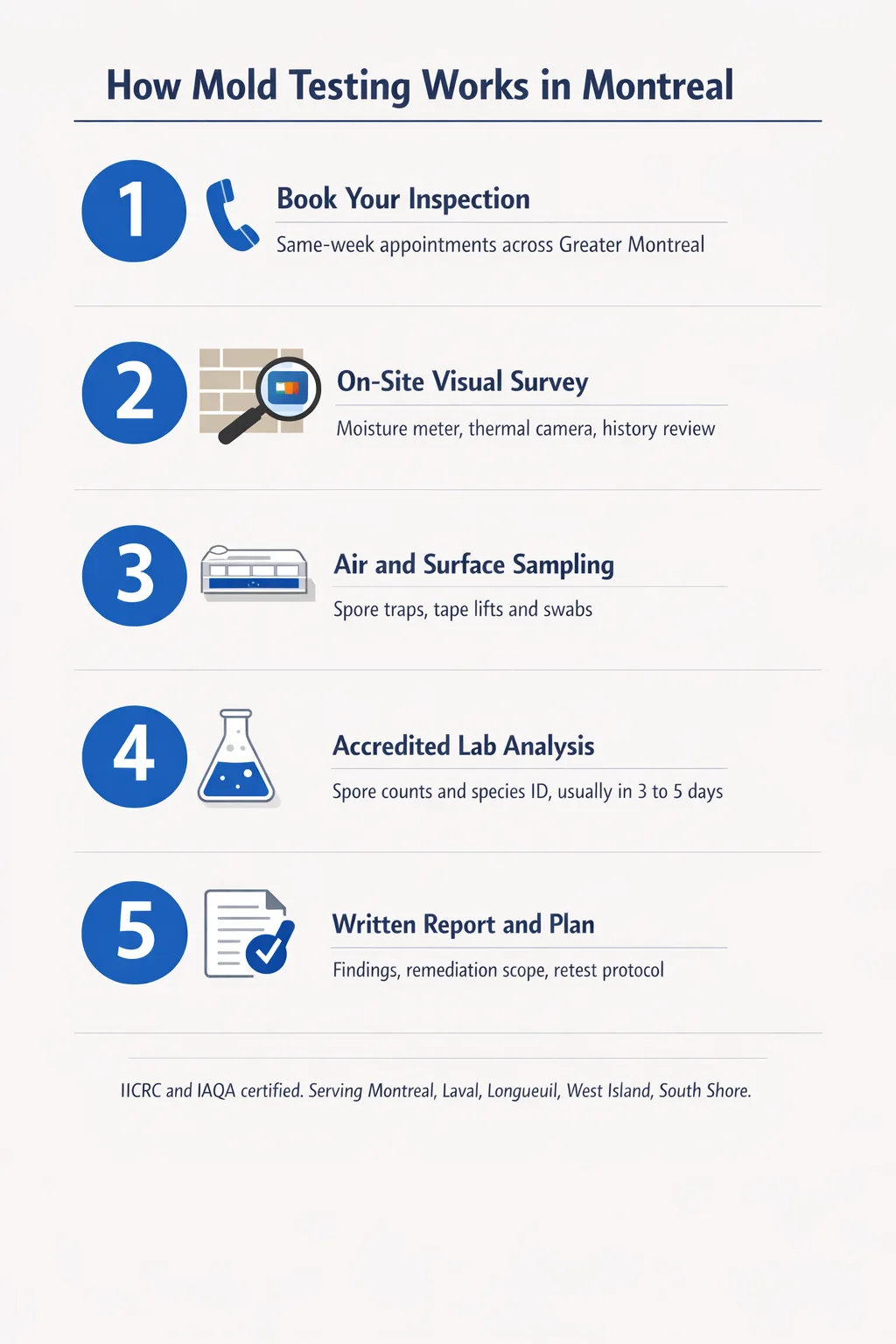
- Book your inspection. Call or book online. We confirm a same-week slot for most Greater Montreal addresses and email you a short intake form (history of leaks, symptoms, areas of concern).
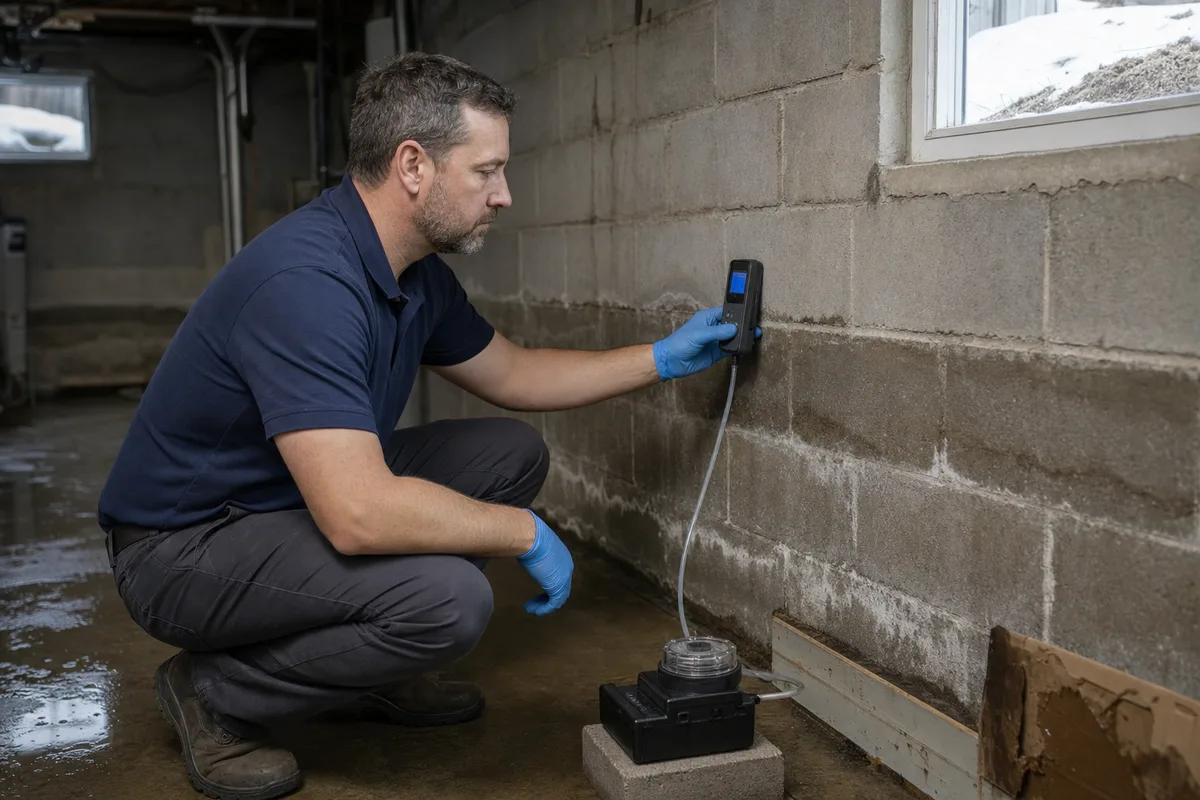
- On-site visual survey. Your inspector walks the property with a moisture meter and an infrared thermal camera, checking basements, bathrooms, attics, behind appliances, and around windows for visible mold and hidden moisture.
- Air and surface sampling. We collect air samples using calibrated spore-trap cassettes (typically one outdoor control + 2–4 indoor samples) and surface samples (tape lifts or swabs) on any suspect growth.
- Accredited lab analysis. Samples ship the same day. The lab counts and identifies spore types — including Stachybotrys (the “black mold”), Aspergillus, Penicillium, and Cladosporium — and compares indoor vs. outdoor levels.
- Written report and plan. Within 3–5 business days you receive a full PDF report with photos, lab data, indoor-vs-outdoor comparisons, and a clear recommendation: no action, monitor, or remediate (with scope).
For homeowners outside our standard service window or anyone evaluating providers across the city, our team can also coordinate with mold testing services in Montreal from our affiliated network.
What mold are we finding in Montreal homes?
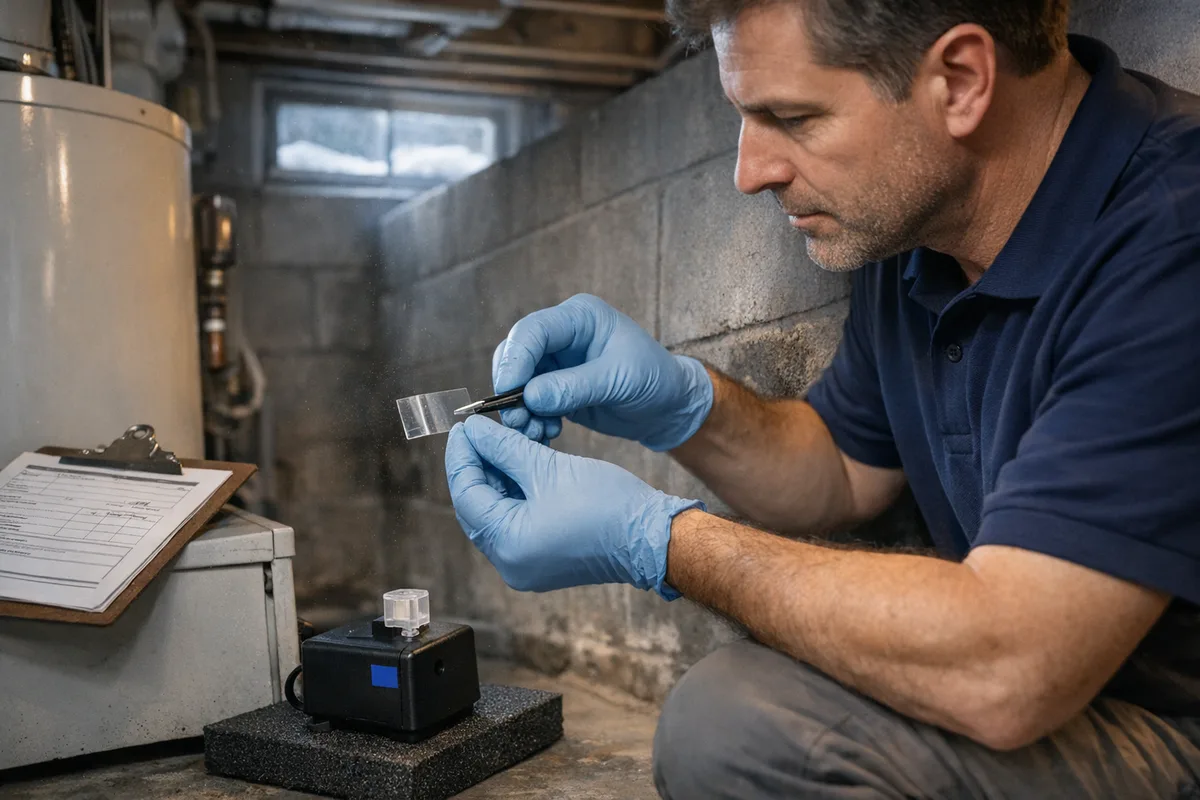
Across thousands of Montreal-area inspections, four mold genera show up over and over again. Each one tells us something different about what’s happening in the building.
- Stachybotrys chartarum (toxic black mold) — almost always tied to long-term water damage. We find it behind drywall in basement rec rooms, under bathroom vinyl after slow toilet leaks, and around foundation cracks in older Plateau and Hochelaga triplexes. It does not become airborne easily, which is why surface sampling matters — air samples alone can miss it.
- Aspergillus and Penicillium (Asp/Pen) — the most common indoor mold pair in Quebec homes. Drives allergy and asthma flare-ups. Common after a humid summer where the HVAC has run hard and condensation has built up in ducts or around cold-water lines.
- Cladosporium — frequently found around windows, on bathroom ceilings, and on caulking. A signal that humidity control or ventilation is failing in that micro-area.
Three Montreal-specific drivers make these especially common here:
- Cold winters + warm interiors. Sealed-up homes from November to April trap humidity from cooking, showering, and breathing. With outdoor temperatures below −15 °C, condensation forms on cold exterior walls, window frames, and unheated cold rooms (chambre froide).
- Old foundations + spring thaw. A century of stone and concrete foundations across the Plateau, Mile End, Verdun, and Pointe-Saint-Charles take on water during the spring snowmelt and heavier April rain events. Basements that “smell musty every spring” are leaking, not just damp.
- Plex housing. Triplexes and duplexes share moisture between units. A leak on the third floor that nobody noticed shows up as mold in the second-floor bathroom ceiling six months later.
If any of these match what you’re seeing — or you’re noticing the kinds of signs your home needs testing like a persistent musty smell, water stains, or new respiratory symptoms — book an inspection before the next humid season.
Water damage and air quality: when to test after a Montreal flood or leak
Water damage is the single most common reason a healthy Montreal home turns into a mold problem. The moment building materials get wet — drywall, framing, subfloor, insulation, carpet underlay — the clock starts. Mold can begin colonizing damp material within 24 to 48 hours, long before you see a stain or smell anything musty. By the time the visible signs appear, spore counts in the air you breathe are often already elevated.
This matters in Montreal more than almost anywhere else in Canada, because our housing stock and our climate stack the odds against you:
- Spring freshet and snowmelt. When the snowpack melts and the ground is still frozen, water has nowhere to go but sideways — into stone and concrete foundations across the Plateau, Verdun, Pointe-Saint-Charles, and along the rivers. A basement that takes on even a few centimetres of water in late March can be feeding mold by early April.
- Heavy April and summer rain events. Short, intense storms overwhelm older drainage and can back up municipal sewers into basements — a sewage-contaminated water intrusion that needs both mold and bacterial assessment, not just a mop.
- Plex shared-moisture. In triplexes and duplexes, a slow leak in an upstairs unit can saturate the wall cavity of the unit below for weeks before anyone notices. The downstairs tenant is breathing the result long before the landlord sees it.
- Frozen and burst pipes. A pipe that bursts during a −25 °C cold snap can release hundreds of litres behind a wall. The water dries from the surface but stays trapped in the cavity, where it quietly feeds Stachybotrys all winter.
When should you test the air after water damage?
There are two moments that matter, and most homeowners only think about one of them:
- Right away, if the water sat for more than 24–48 hours — or if it came from a sewer backup, a flood, or grey water (dishwasher, washing machine). Testing now establishes what you’re dealing with, guides the drying and remediation scope, and gives you documented baseline data for an insurance claim.
- After drying and remediation, before you move furniture and people back in — this is the step almost everyone skips. A “clearance” air test confirms the work actually returned indoor spore counts to normal versus outdoor levels. Without it, you’re trusting that the problem is gone instead of knowing it is. This is especially important for anyone in the home with asthma, allergies, or a compromised immune system.
If your water damage is tied to a real estate transaction, a tenant dispute, or a Régie du logement case, the dated, lab-backed report from a clearance test is the document that holds up — a contractor’s “looks dry to me” does not.
Why air sampling specifically, after water damage? You can dry and clean a visible water stain and still have a contaminated room. Disturbing wet material during cleanup releases spores into the air, and the spores that matter most after a flood — including Stachybotrys, the so-called black mold — don’t always settle where you can see them. Air sampling measures what’s actually airborne in the spaces you live in, and compares it against an outdoor control sample, which is the only way to confirm whether hidden growth is affecting your breathing air.
If you’ve had any water intrusion event — a flooded basement, a slow roof or plumbing leak, an ice dam, or a sewer backup — and especially if anyone in the home has developed new respiratory symptoms, book an air quality and mold test. Our residential air quality testing covers exactly this scenario, and we coordinate same-week — or same-day where the schedule allows — for active water-damage situations across Greater Montreal.
How much does mold testing cost in Montreal?
Most professional mold inspection in Montreal appointments fall into three price bands. The right one for your home depends on size, number of suspect areas, and whether you need an air-only test or air plus surface sampling.
| Scope | Typical CAD range | What’s included |
|---|---|---|
| Targeted single-area test Bathroom, one bedroom, one suspect spot |
$300–$450 | Visual survey + 1 outdoor control + 1 indoor air sample + lab analysis + report |
| Full home inspection Most condos, single-family homes, plex units |
$450–$700 | Visual survey + 1 outdoor control + 2–4 indoor air samples + 1–2 surface samples + lab analysis + full report |
| Large or commercial-grade home 3,000+ sq ft, multi-floor, or post-water-damage |
$700–$900+ | Visual + thermal imaging + 5+ air samples + multiple surface samples + lab + report + remediation scope |
If you also need to check for asbestos (common in pre-1980s Montreal duplexes, especially around vermiculite insulation and old vinyl flooring), we can bundle asbestos testing into the same visit — that typically adds $250–$500 depending on materials sampled. If you also need to rule out asbestos in an older Montreal home, see our asbestos testing in Montreal page.
For commercial or large multi-unit buildings, please see our commercial air quality testing page.
Areas we serve around Montreal
We dispatch from the Island of Montreal and reach most of Greater Montreal within the same week. Our service area covers:
- ✓ Plateau-Mont-Royal
- ✓ Outremont
- ✓ Verdun
- ✓ Westmount
- ✓ NDG (Notre-Dame-de-Grâce)
- ✓ Côte-des-Neiges
- ✓ Rosemont-La Petite-Patrie
- ✓ Hochelaga-Maisonneuve
- ✓ Saint-Laurent
- ✓ LaSalle
- ✓ Pointe-Saint-Charles
- ✓ Ahuntsic-Cartierville
- ✓ Laval (Chomedey, Sainte-Rose, Laval-des-Rapides)
- ✓ Longueuil & the South Shore
- ✓ West Island (DDO, Pointe-Claire, Kirkland, Beaconsfield)
- ✓ Brossard
- ✓ Vaudreuil-Dorion
- ✓ Saint-Bruno-de-Montarville
For full service area details and same-day options, see our Montreal air quality testing page. For a second opinion or independent Montreal mold inspection, see our partner network.
How to keep mold out of your Montreal home
Once we’ve confirmed your indoor air is clear, three habits keep it that way through Montreal’s swing from −20 °C winters to 30 °C humid summers:
- Hold relative humidity at 30–50%. Use a dehumidifier in basements May through September. In winter, watch for condensation on window frames — that’s the warning sign that humidity is too high for the outdoor temperature.
- Run bathroom and kitchen exhaust fans for 20+ minutes after use. Vent them outside, not into the attic. In duplexes and triplexes, check that your downstairs neighbours’ vents aren’t terminating inside a shared wall cavity.
- Inspect the foundation each spring. Walk the basement perimeter after the spring thaw and again after the first heavy April rain. Efflorescence (white powder on concrete) and discoloured baseboards are early signals of water intrusion that will become mold within 48–72 hours.
For broader guidance on managing indoor air, see Quebec.ca’s finding and eliminating mould reference and the Health Canada mould fact sheet.
Frequently asked questions
How much does mold testing cost in Montreal?
Most residential mold testing in Montreal falls between $300 and $900. A targeted single-area test starts around $300–$450. A full-home inspection with 2–4 air samples plus surface sampling typically runs $450–$700. Larger homes (3,000+ sq ft) or post-water-damage assessments range $700–$900+. The price covers visual survey, sampling, accredited lab analysis, and a written report.
How long does a mold inspection take?
On-site work usually takes 60–90 minutes for a single-family home or condo. Larger homes or buildings with multiple suspect areas can take 2–3 hours. Lab analysis adds 3–5 business days; you’ll get your written report by email within a week of the inspection.
Is testing for mold worth it, or should I just clean what I can see?
Visible mold is only part of the picture. Air sampling tells you whether spore counts indoors are elevated compared to outdoor air — that’s how you know whether hidden growth is contaminating the rooms you live in. Surface sampling identifies the species, which determines how aggressively the area needs to be remediated. If you can smell mold but can’t see it, or you have respiratory symptoms with no visible source, testing is almost always worth it.
Do you offer same-day mold testing in Montreal?
We offer same-week appointments for most Greater Montreal addresses and same-day or next-day appointments when our schedule allows — particularly for water-damage emergencies and real estate transactions on tight timelines. Call us to confirm availability for your address.
Do you provide bilingual (English and French) service?
Yes. All inspectors and reports are available in English and French. Reports for insurance, real estate, or Régie du logement disputes can be issued in either language.
What’s the difference between a mold inspection and a mold test?
A mold inspection is the visual survey plus moisture and thermal investigation — it tells you where mold is likely growing. A mold test is the laboratory sampling component (air samples, tape lifts, swabs) that confirms what species is present and at what concentration. A complete professional appointment includes both, which is what we deliver as standard.
How soon should I test the air after water damage?
Mold can begin growing on wet building materials within 24 to 48 hours, so timing matters. If water sat for more than a day, or came from a sewer backup or flood, test right away — it documents the situation for your insurer and guides the drying scope. Just as important, schedule a clearance air test after drying and remediation, before people and furniture return, to confirm indoor spore counts are back to normal versus outdoor levels. In Montreal, spring snowmelt and heavy April rain make this a seasonal concern for basements across the city.
Does water damage always lead to mold and air quality problems?
Not always — but the risk is high whenever materials stay wet beyond 48 hours, when water reaches hidden cavities behind walls or under floors, or when the water was contaminated (sewer backup, river flooding). Even after the surface looks and feels dry, moisture trapped in wall cavities can quietly feed mold for months. An air quality test with an outdoor control sample is the only reliable way to confirm whether a past water event left elevated spore levels in the air you actually breathe.
Book mold testing in Montreal
IICRC and IAQA certified. Same-week appointments across Greater Montreal, Laval, Longueuil, and the West Island. Bilingual service. Outside Greater Montreal, Ottawa-area homeowners should visit our dedicated Ottawa mold inspection and testing page.