Editorial Policy
Somebody reads a page about black mould at eleven at night, decides the spots above the bathroom fan are harmless, and doesn’t call anyone. That’s the scenario we think about when we publish. Air quality content sits close to health decisions, and getting it wrong has a cost that lands on the reader, not on us.
So this page explains who writes what you read here, who checks it, where the numbers come from, and what happens when we get something wrong. No mystery, no anonymous byline hiding behind a logo.
The short version: Air Quality Testing Canada publishes as a company. Every page is reviewed by a certified indoor air quality inspector before it goes live, built on IICRC S520, ASTM methods, and Health Canada guidance, and reviewed at least once a year. Found an error? Tell us and we’ll correct it in the open.
Air Quality Testing Canada has been inspecting buildings since 2005. Over 20 years and more than 15,000 inspections, our team has developed opinions about what actually matters in indoor air. Those opinions are what you’re reading.
Who Writes and Reviews This Content?
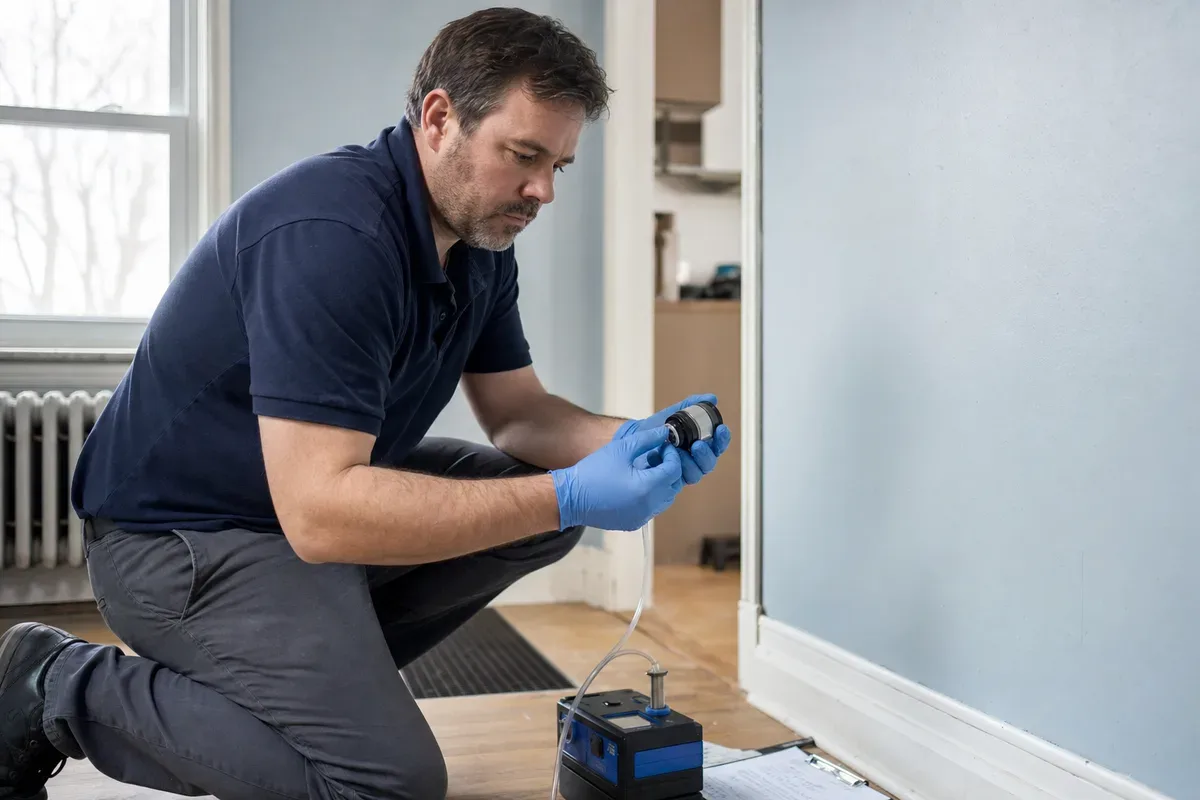
Our content is produced by Air Quality Testing Canada as a company, and reviewed by our certified indoor air quality inspectors before it goes live. We publish under the company name rather than individual bylines because the work behind a page is genuinely collective. The inspector who’s crawled through the attic, the technician who prepared the samples, and the person who read the lab report all shape what ends up on the site.
Every inspector on our review team holds certification through the Institute of Inspection, Cleaning and Restoration Certification (IICRC), and our company holds membership with the Indoor Air Quality Association (IAQA).
IICRC Certified
Industry certification covering inspection, remediation, and restoration practice.
IAQA Member
Membership in the Indoor Air Quality Association, the field’s professional body.
Indoor Air Quality Inspector
Credentialed assessment of airborne contaminants in occupied buildings.
Indoor Air Consultant
Advisory qualification covering diagnosis and remediation planning.
Professional Inspector
General building inspection credential underpinning our field work.
That review requirement is not decorative. A page describing spore trap sampling gets read by somebody who runs spore trap sampling for a living. If a claim doesn’t match what they see in the field, it doesn’t publish. We’ve killed drafts over this, and honestly, the ones we killed were usually the ones that read most smoothly.
The same applies across everything we cover, whether that’s mold testing, asbestos testing, or general indoor air quality work in homes and commercial buildings.
You can read more about our team and credentials on our about us page.
What Standards and Sources Do We Use?
We build our technical content on published industry standards and government guidance, not on what ranks well. The main sources we work from:
IICRC S520
The standard covering professional mould remediation. It informs how we describe containment, remediation scope, and post-remediation verification.
ASTM Methods
Governs sampling and analytical procedures. When we describe how a sample is collected or handled, this is the reference point.
Health Canada
Federal positions on indoor mould and residential air quality. Where Canadian guidance exists, we follow it rather than importing American thresholds.
Accredited Lab Analysis
Spore counts reported in colony-forming units per cubic metre (CFU/m³), always compared against an outdoor control taken the same day.
Where a lot of air quality content quietly goes wrong: you’ll see articles listing a specific spore count as the “safe” threshold. There isn’t one. Health Canada has deliberately not set a numerical indoor limit, because what matters is whether indoor levels materially exceed the outdoor baseline and what species are present. Any page handing you a single magic number is oversimplifying, and we’d rather tell you that than repeat it.
Our resources section covers the underlying concepts in more depth.
How Is Content Reviewed Before Publishing?
Every page passes through three checkpoints before it goes live.
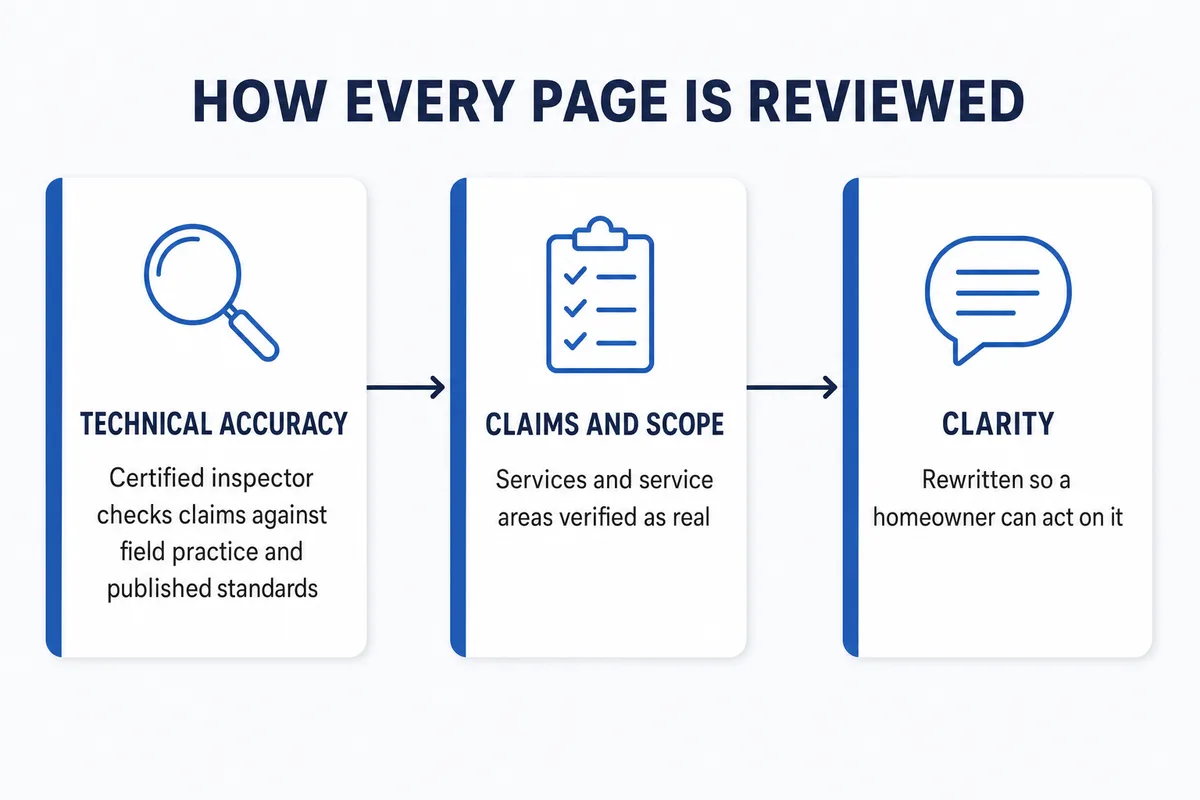
1. Technical Accuracy
A certified inspector reads the draft against field practice and published standards. Sampling descriptions, contaminant behaviour, remediation steps, and any figure with a unit attached all get verified here.
2. Claims and Scope
We confirm that what we’re describing matches what we actually do, in the areas we actually serve. If a page describes a service, that service exists. If it names a city, we work there.
3. Clarity
Technical content is useless if the reader can’t act on it. We rewrite anything that requires industry knowledge to decode, and we cut anything that pads length without adding information.
Pages that make cost claims get additional scrutiny, because pricing varies with building size, sample count, and lab turnaround. We publish ranges rather than fixed prices, and we say what moves a project within that range. Our air quality testing cost guide shows how those factors work in practice.
How Often Is Content Updated?
We review published content at least annually, and sooner when something changes that affects accuracy.
Standards get revised. Health Canada updates positions. Lab methods evolve. When any of that happens, the affected pages get corrected rather than left to age quietly. A page describing a superseded standard is worse than no page at all, because it looks current.
We’re deliberately not promising a faster cycle than that. Plenty of sites advertise quarterly or monthly review schedules, and we’ve never seen convincing evidence that most of them keep to it. An annual commitment we actually meet is worth more than a monthly one we don’t, and you can check us on it: pages carry a visible last-updated date.
Some content needs updating more often than the yearly minimum. Cost guidance, seasonal advice, and anything referencing a specific standard revision gets looked at as circumstances change.
What Do We Do When We Get Something Wrong?
We correct it, and we don’t pretend it didn’t happen.
If a published page contains a factual error, we fix the error and update the last-updated date so the change is visible. For corrections that materially change the meaning of a page (a wrong figure, a mischaracterised standard, an outdated regulatory position), we note what changed rather than silently editing. Quiet edits are how a site loses the ability to be trusted.
Reporting an error
Found something that looks wrong? Tell us through our contact page. Include the page address and what you think is inaccurate, and if you have a source, even better. You can also reach us at airqualitytestingcanada@gmail.com or 1-866-528-2897.
We read every one of these. We don’t promise a turnaround time on corrections, because we’d rather verify a claim properly than rush a change to hit a self-imposed deadline. Anything affecting health guidance moves to the front of the queue.
How Do Experience and Certification Shape What We Publish?
Our content comes out of inspection work, not desk research. That’s the practical difference between what you’ll read here and a generalist article on the same topic.
When we write about what mould looks like behind drywall, it’s because our inspectors have opened those walls. When we describe how asbestos sampling works in a 1960s Montreal duplex, that’s a building type we’ve been inside repeatedly. Over 15,000 inspections since 2005 across Ontario and Quebec produces a large collection of specifics, and specifics are what make content useful.
There are questions we get asked where the honest answer is that it depends on conditions we can’t assess from a web page. We say so instead of manufacturing confidence. An article that tells you it can’t replace an inspection is being more useful than one that implies it can.
Our testing process page walks through what an actual inspection involves, including where lab work fits and how long results take.
Is Your Content Independent of Your Sales Process?
Yes. Our educational content isn’t gated, and it isn’t written to make testing look necessary when it isn’t.
We publish material that tells readers when they probably don’t need a professional inspection. If you can see and reach a small patch of surface mould on a hard surface, and you know where the moisture came from, that’s often a cleaning job rather than a testing job. Saying so costs us bookings. We’d rather be the company you call when it actually matters.
- No payment accepted for editorial placement or coverage
- Product mentions in our equipment guides reflect our own testing experience, not paid placements
- Customer reviews are genuine. We don’t write them, and we don’t filter out critical ones to protect an average
- Educational content stays ungated, whether or not you ever book an inspection
What About Accountability?
Air Quality Testing Canada is responsible for everything published on this site. Not a contractor, not an agency, not an unnamed content team.
Our certified inspectors review published content and stand behind its accuracy. Where a page describes a technical procedure, somebody who performs that procedure has read it and confirmed it matches practice. Where a page makes a health-related claim, it traces back to Health Canada guidance or a published standard rather than to industry folklore.
We handle indoor environments that people live and work in. Sloppy published information is a real problem in this field, and the least we can do is make our own process visible enough that you can judge it.
Questions about this policy, or about how a specific page was produced? Our contact page reaches us directly, or call 1-866-528-2897 Monday through Friday, 8:00 AM to 5:00 PM.
Editorial Policy FAQ
Air Quality Testing Canada, as a company, is responsible for all published content. Pages are produced by our team and reviewed by certified indoor air quality inspectors before publishing. We publish under the company name rather than individual bylines because the work behind each page is collective.
Because a page typically reflects the work of several people: the inspector who did the field work, the technician who handled sampling, and the person who interpreted the lab report. Attributing that to one name would be less accurate than attributing it to the company. Our certifications and review process are documented on this page so you can judge the expertise behind the content.
Primarily IICRC S520 for mould remediation, ASTM methods for sampling and analysis, and Health Canada guidance for residential air quality positions. Laboratory results come from accredited labs and are reported in colony-forming units per cubic metre, compared against a same-day outdoor control sample.
Use our contact page and include the page address plus what you believe is inaccurate. A supporting source helps. We verify before changing anything, so we don’t commit to a fixed turnaround, but corrections affecting health guidance are prioritised. When we correct a substantive error, we note what changed rather than editing silently.
At least once a year, and sooner when a standard is revised, guidance changes, or we identify an error. Every page carries a visible last-updated date so you can see when it was last reviewed. We deliberately avoid promising a monthly or quarterly cycle we couldn’t consistently meet.
Last updated: July 28, 2026