
Odour Inspection: Find the Source of a Musty Smell
A smell you can’t place, and nothing visible to explain it. We sample the air, identify what’s producing the odour, and tell you where it’s coming from. We test and report, we don’t sell the cleanup, so we’ve got no reason to find a problem that isn’t there.
Accredited lab analysis
IICRC & IAQA certified
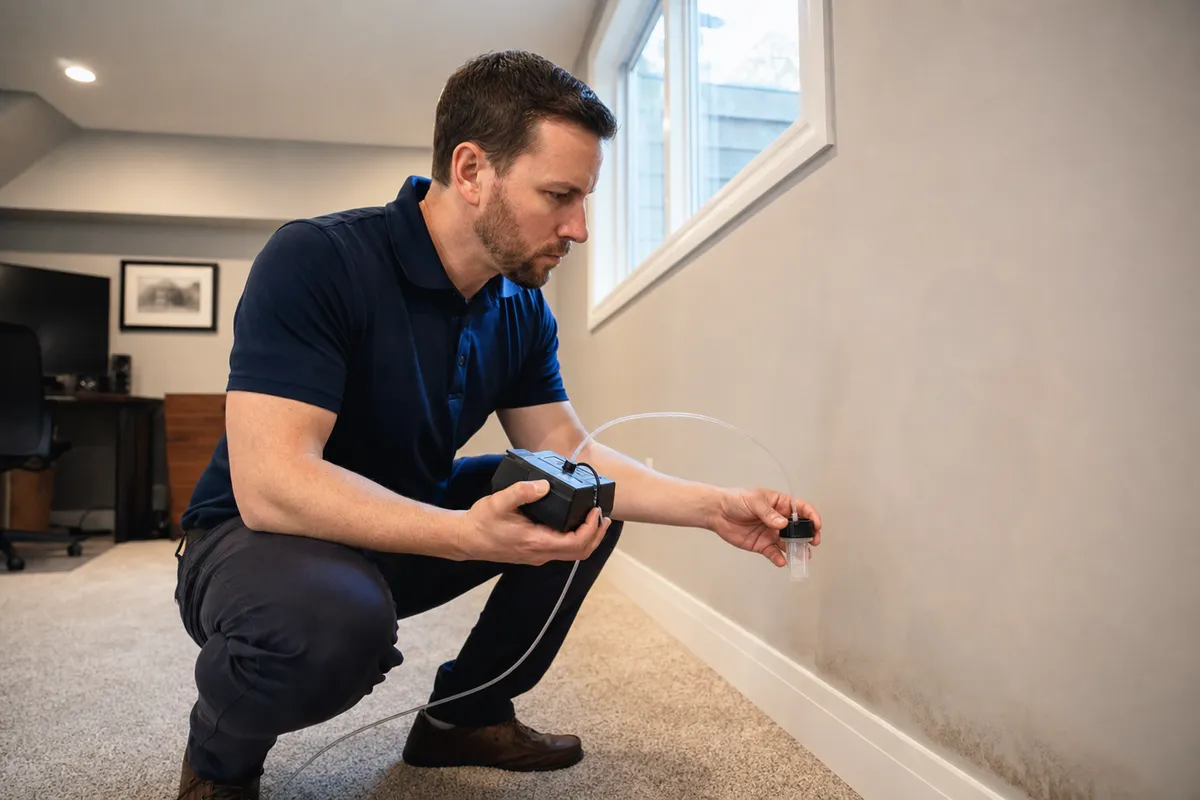
The call usually comes in the same way. Someone walks down into their basement, or opens a closet on an exterior wall, and something smells wrong. Not dramatic. Just persistent, faintly earthy, and it doesn’t go away when they open a window.
Then they look for mold and find nothing. No black spots, no fuzzy patches, no water stain on the ceiling. Just the smell.
That’s the situation an odour inspection is built for. Our inspectors sample the air, identify what’s producing the smell, and tell you where it’s coming from. We don’t clean it up or sell you a treatment, which means we’ve got no reason to find a problem that isn’t there. Sometimes the honest answer is that your air is fine and the smell has a boring explanation.
Last updated: 29 July 2026
What Is an Odour Inspection?
An odour inspection is a diagnostic air quality assessment that identifies the source of a persistent smell in a building. We test the air, look for the moisture conditions that let mold grow, and report what we find with lab-verified results.
The key word is diagnostic. Plenty of companies will deodorise a space, fog it, or run an ozone treatment. That addresses the smell you can perceive. It does nothing about the thing producing it, which is why the smell tends to come back a few weeks later once the masking agent wears off.
Our inspectors approach it the other way around. If there’s a musty odour, something is generating it, and that something almost always involves moisture. Find the moisture, and you’ve found the real problem. The smell is just how the building told you about it.
A typical inspection covers the affected area and a control comparison, uses calibrated sampling equipment, and produces a written report you can act on. If you want the full step-by-step, we’ve documented what to expect during an air quality inspection start to finish.
| Service snapshot | Details |
|---|---|
| What it is | Diagnostic air quality assessment to locate the source of a persistent odour |
| Focus | Mold and the moisture conditions that produce musty odours |
| Method | Spore trap air sampling plus outdoor control, moisture and humidity readings |
| Lab analysis | Accredited laboratory, spores per cubic metre and CFU per cubic metre |
| Time on site | One to two hours for most homes |
| Lab turnaround | Two to three business days, same-day inspection reporting available |
| Typical cost | CAD 300 to CAD 1,500 depending on property size and sample count |
| Service area | Ontario and Quebec |
What Does Mold Actually Smell Like?
Mold smells musty, earthy, or damp. Most people describe it as the smell of an old book, a wet basement, or a forgotten gym bag. Some notice a slightly sweet or sharp edge to it.
Here’s the part most homeowners never get told: you’re not smelling mold itself. You’re smelling microbial volatile organic compounds, or MVOCs. These are gases mold releases while it’s actively growing and metabolising. Your nose picks them up at remarkably low concentrations, often long before there’s anything visible to see.
Why the smell comes and goes. MVOC production rises when mold is active, and mold activity tracks humidity and temperature. So the odour gets stronger after rain, during humid weather, or when the heating kicks on and moves air through a contaminated cavity. Homeowners tell us the smell is “worse some days” all the time, and they usually assume they’re imagining it. They’re not.
That’s genuinely useful information. It means a musty smell is frequently an early signal rather than a late one. The mold might be small, hidden, or just getting started.
Why Can I Smell Mold but Not See It?
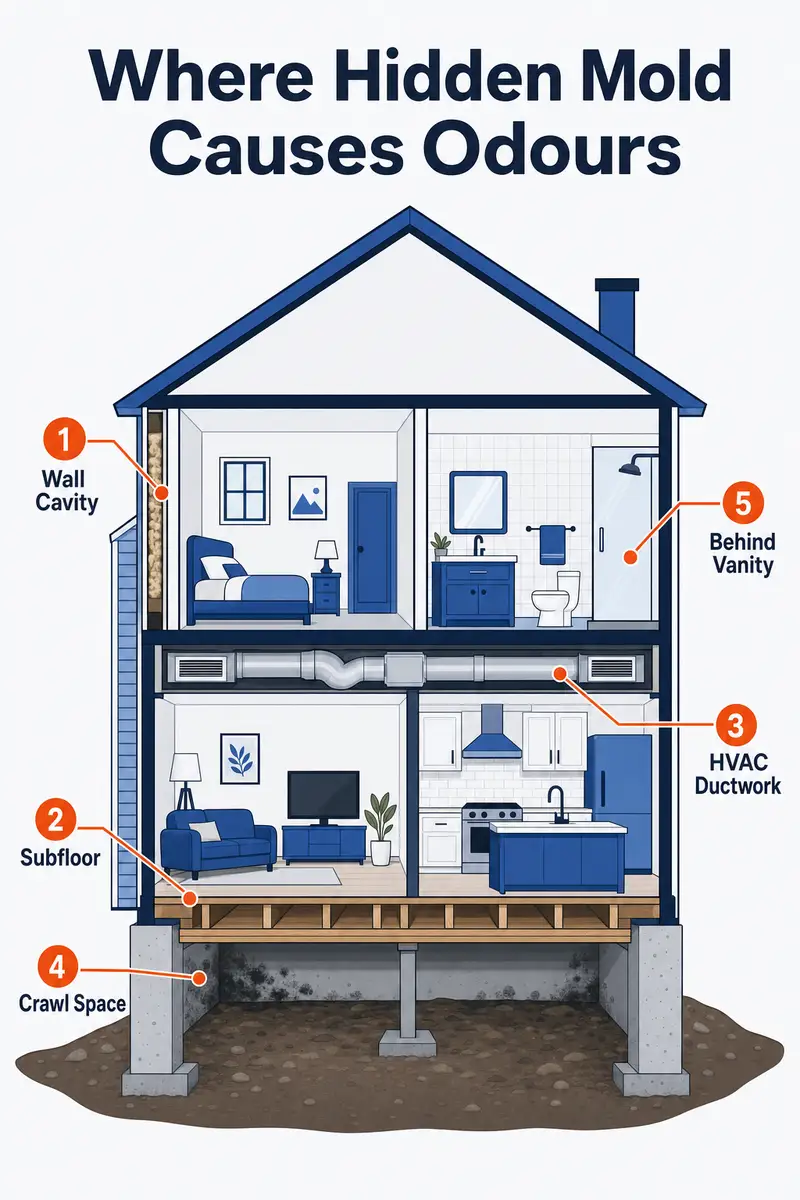
Because the growth is somewhere you can’t look. In our experience, hidden mold is more common than visible mold in odour complaints, and it usually sits in one of a handful of places.
Wall cavities are the usual suspect, especially on exterior walls or anywhere a plumbing line runs. A slow supply-line weep behind drywall can feed growth for months without ever showing a stain on the painted side. Subfloors are another, particularly under vinyl or laminate where a spill or appliance leak got trapped between layers.
Then there’s the HVAC system, which deserves special mention because it’s the one that fools people. If growth is established on a coil, in a drain pan, or inside ductwork, the system distributes those MVOCs through the whole house every time it runs. The homeowner smells it in three different rooms and concludes the problem is everywhere. It isn’t. It’s in one place, being broadcast.
Crawl spaces, the cavity under a bathtub, the back of a vanity, behind a finished basement stud wall. We’ve found growth in all of them. None were visible without opening something up, and that’s precisely why sampling the air is more reliable than trusting your eyes.
How Do We Find the Source?
We combine air sampling with a moisture-focused walkthrough. Air samples tell us what’s airborne and at what concentration. The walkthrough tells us where the conditions for growth exist.
Air sampling uses a spore trap, a cassette that draws a measured volume of air across an adhesive slide. That slide goes to an accredited laboratory, where an analyst counts and identifies what’s on it. Results come back as spores per cubic metre, and for culturable samples as CFU per cubic metre (colony forming units).
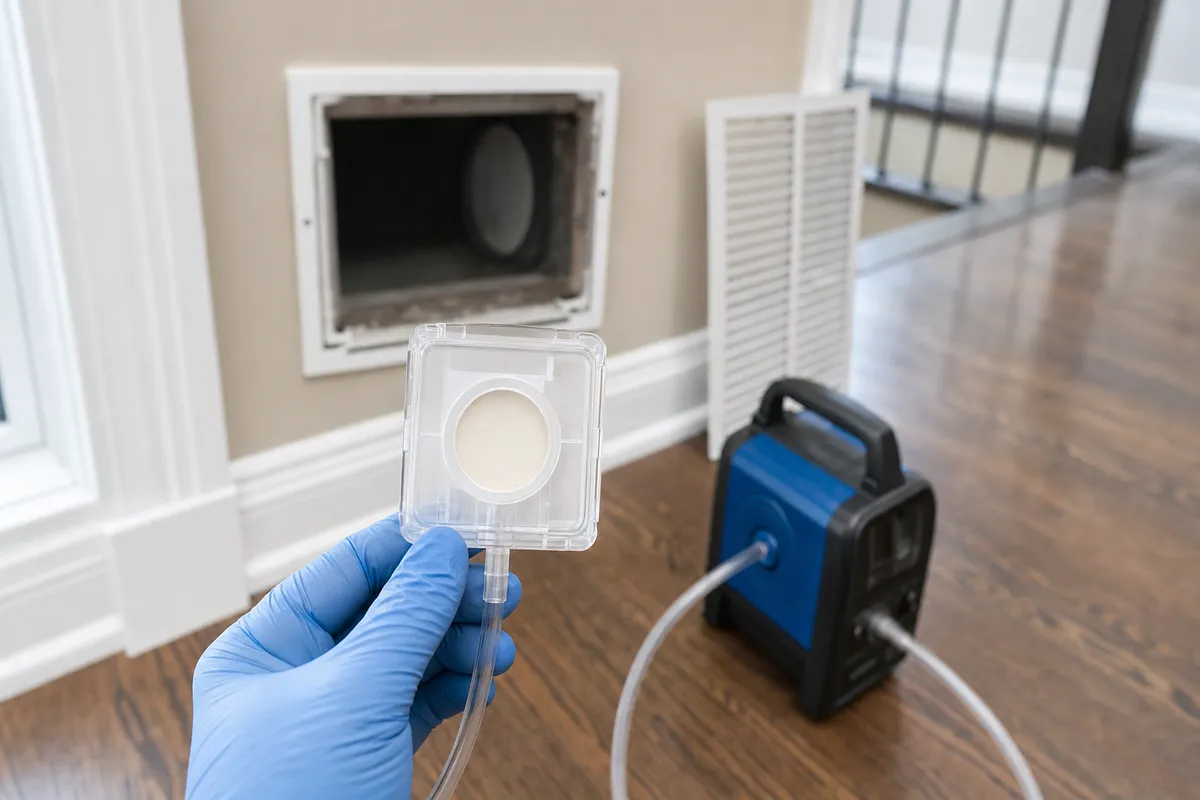
A single indoor number means very little on its own. That’s why we always collect an outdoor control sample on the same visit. Outdoor air contains mold spores everywhere, all the time, and that’s normal. What matters is whether the indoor count materially exceeds the outdoor baseline, and whether the species mix indoors looks different from outside. An indoor sample dominated by species that are scarce in the outdoor control is a much stronger signal than a raw number ever is.
Alongside sampling, our inspectors check relative humidity, look for temperature differentials that cause condensation, and use moisture meters on suspect surfaces. The sampling methods and lab standards behind all of this follow IICRC S520 and IAQA guidance, and our inspectors hold both certifications. Once the lab results come back, understanding what your air quality test results mean is its own subject, and we’ve written that up separately.
Is It Mold, or Mildew, or Something Else?
Mildew is a type of mold, so the distinction people draw between them is mostly about appearance rather than biology. Mildew usually grows flat, looks powdery, and shows up white or grey on damp surfaces like grout and window sills. What most people call “mold” is the fuzzier, darker, more established growth.
Both smell musty. Both need moisture. Mildew is generally easier to deal with because it sits on the surface where you can see and reach it, while the growth behind a wall is the one that needs sampling to confirm.
Not every musty smell turns out to be mold, though, and we’d rather say that plainly than let you assume otherwise. We’ve been called out to homes where the odour traced back to a floor drain that had dried out, a damp crawl space with no growth yet, old carpet underlay holding moisture, or a stagnant sump. Those are real findings and they’re worth knowing, because the fix is completely different and usually cheaper.
If our sampling comes back clean, that’s what the report says. A negative result is still a useful result. It rules out the expensive possibility and points you somewhere else.
When Should You Book an Odour Inspection?
Book one when a smell persists after cleaning and airing out the space, or when it keeps returning. A one-off odour that clears with ventilation usually isn’t worth testing. A recurring one is.
- The smell showed up after water damage, a leak, or spring flooding.
- Someone in the house has respiratory symptoms, congestion, or worsening allergies that ease when they leave the building.
- You’re buying the property and noticed it during a viewing.
- It’s concentrated in one room, which usually means the source is close by.
Seasonal timing matters more here than people expect. Across Ontario and Quebec, we see odour complaints cluster in a few predictable windows. Spring thaw drives groundwater up against foundations and basements start smelling in March and April. Summer humidity plus air conditioning creates condensation on cold surfaces. And when heating starts in the fall, warm dry air moving through the building pulls MVOCs out of cavities that had been quiet all summer.
If the smell is specifically musty and you already suspect the cause, mold testing may be the more direct route. Odour inspection is the better starting point when you genuinely don’t know what you’re dealing with.
What Do You Get in the Report?
You get a written report with your lab results, what they mean, where we found the source, and what we recommend doing about it. Same-day reporting is available.
The report includes the sampling locations and methods used, the laboratory analysis with indoor and outdoor comparisons, an interpretation in plain language rather than raw data you’d have to decode yourself, and specific recommendations. If there’s a moisture source driving the problem, it’s identified in the report, because fixing the growth without fixing the water just resets the clock.
We write these so they’re usable by someone who isn’t an air quality professional. If you’re a homeowner deciding what to do next, a landlord documenting a tenant complaint, or a buyer negotiating on a property, the report should be able to stand on its own. Buyers and sellers in particular find this matters, which is why we cover air quality testing for real estate transactions as its own topic.
Should the results point to mold that needs removing, we’ll tell you what the report supports. We don’t do remediation ourselves. If you want to understand what that work involves before you get quotes, there’s useful background on professional mould removal worth reading first.
How Much Does an Odour Inspection Cost?
Air quality testing in Canada generally runs between CAD 300 and CAD 1,500. Where a specific inspection lands depends on the size of the property, how many samples are needed, and how much investigation the situation calls for.
A single-room complaint in a condo needs fewer samples than a whole-house investigation in a century home with a fieldstone basement. Lab analysis is charged per sample, so sample count is the main driver of the number. Properties with multiple affected areas, or where the source isn’t obvious after the first walkthrough, sit at the higher end.
We’ll give you a price before we book, not after we’ve finished. If you want the full breakdown of what moves the number, we’ve written up what air quality testing costs in Canada with the variables laid out.
Where Do We Test?
We cover Ontario and Quebec, with inspectors working out of the Ottawa and Montreal regions.
Our regular service areas include Ottawa, Montreal, Gatineau, Kingston, Carleton Place, Brockville, Belleville, and Cornwall, along with the surrounding communities. If you’re outside those, call and ask. We travel further than the list suggests, and the answer depends on scheduling more than distance.
You can find your closest coverage area on our service area pages, each with local booking details.
Common Questions About Odour Inspections
Yes, and that’s the most common version of this job. Air sampling doesn’t depend on anything being visible. A spore trap measures what’s airborne, so hidden growth behind a wall or inside ductwork shows up in the results even when there’s nothing to see.
Most residential inspections take one to two hours on site. Larger properties or ones with several affected areas take longer. Laboratory turnaround for the samples is typically two to three business days, with same-day reporting available on the inspection findings.
No. Musty odours usually involve moisture, but the source can be a dried-out floor drain, damp materials without active growth, a stagnant sump, or old underlay holding water. Testing is what separates these, and we’ve had plenty of visits end with a clean result and a much simpler explanation.
Smelling mold means MVOCs are present, which indicates active growth somewhere. Health responses vary a lot between people. Some notice nothing, while others get congestion, irritated eyes and throat, or worsening asthma and allergy symptoms indoors that improve when they leave. If symptoms track with being in the building, that’s worth taking seriously and worth testing.
No. We test and report, we don’t remediate. That separation is deliberate, because an inspector who also sells the cleanup has an obvious incentive to find something. Our report goes to you, and you decide what happens next.
You can, and for some situations they’re reasonable. They’re much weaker at answering “where is it coming from,” because a settle plate tells you something is present without telling you the concentration, the species mix, or the location. We’ve compared the options for home air quality test kits if you want to weigh it up.
Book an Odour Inspection
If something in your home or building smells wrong and you can’t find why, that’s worth a call. Our inspectors are IICRC and IAQA certified, we’ve completed over 15,000 inspections since 2005, and we’ll tell you what we actually find.
Monday to Friday, 8:00 AM to 3:00 PM. Or book an inspection online and we’ll get back to you with available times.