A mold inspection in Ottawa starts with a certified inspector who finds the moisture, samples the air, and sends every sample to an accredited lab. We are an independent testing company. We test, we report, and we do not sell removal work, so the results you get are honest and unbiased. If you need mold inspection Ottawa residents rely on, you are in the right place.
For more than 20 years our inspectors have completed over 15,000 inspections across Ontario and Quebec. That experience matters in Ottawa, where freeze-thaw cycles, older housing stock, and spring flooding from the Ottawa River create hidden moisture problems that are easy to miss. This page explains exactly what a mold inspection and test involves, how we read your results, what it costs, and how to book one. If you already see or smell mold, you can call us now at 1-866-528-2897.
What is a mold inspection in Ottawa?
A mold inspection is a full visit by a certified inspector who looks for mold, finds the moisture feeding it, and collects samples for lab analysis. The inspection is the whole process. The test is the lab sampling that happens inside it.
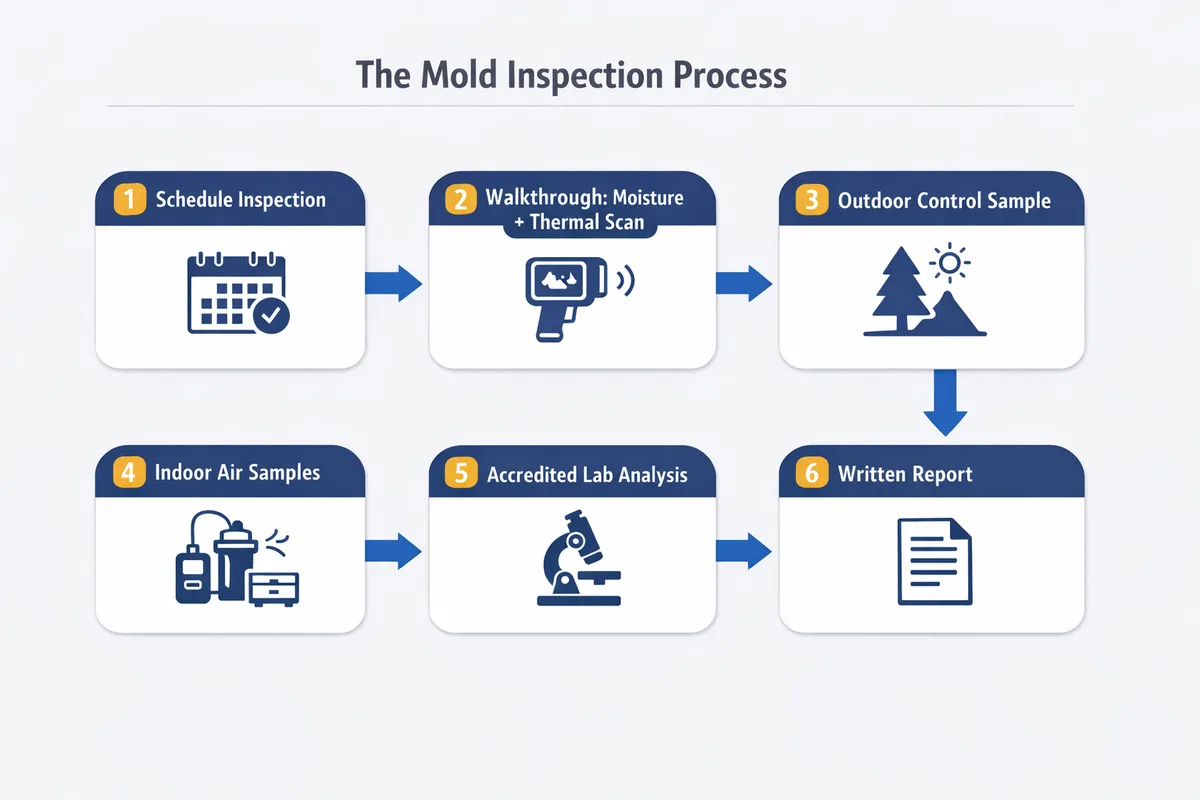
During an Ottawa mold inspection, our inspector walks the property and checks the spots where mold hides: basements, bathrooms, attics, behind baseboards, and around windows. We use a moisture meter to find damp materials and a thermal imaging camera to spot cold, wet areas behind walls. When we find a problem, or when you need proof of air quality, we collect samples and send them to an accredited lab.
We work as an independent third party. Because we do not do removal or remediation, we have no reason to find more mold than is really there. Many Ottawa companies test and remove, which creates a clear conflict of interest. Our only job is to tell you the truth about your air and your home.
Mold inspection vs. mold test: what’s the difference?
The inspection is the visit, and the test is the lab work done during it. You usually need both. A visual inspection alone can confirm visible mold, but it cannot measure airborne spores or identify which species you have. That requires a mold test, where we collect air or surface samples for lab analysis.
A good mold inspector in Ottawa does both together. We find the source, document the damage, and then test to confirm what is in the air. The result is a clear picture you can act on, whether you are a worried homeowner, a buyer, or a landlord.
When do you need a mold inspection in Ottawa?
You need a mold inspection when you can smell mold, see growth, or have had water damage. These three signs are the most common reasons Ottawa homeowners call us. Health symptoms and real estate deals are close behind.
Book a mold inspection if any of these apply to your home:
- A musty or earthy smell that will not go away, often the first sign of hidden mold
- Visible mold growth on walls, ceilings, grout, or window frames
- Recent water damage, a leaky roof, a burst pipe, or a flooded basement
- Worsening allergies, asthma, coughing, or congestion that improves when you leave the house
- Buying or selling a home and you want an unbiased assessment first
- Confirming a remediation job worked, known as post-remediation clearance testing
Why Ottawa homes face extra mold risk in spring
Ottawa homes face a higher mold risk every spring because of snowmelt, rising groundwater, and Ottawa River flooding. The spring freshet from March to May pushes water tables up and sends water into basements across the National Capital Region.
In our experience, the calls spike a few weeks after the snow melts. Water seeps into foundations, basements stay damp, and mold starts to grow in the dark, humid corners homeowners rarely check. Older Ottawa homes with stone or block foundations are especially prone to this. April showers and summer humidity then keep the moisture going. A spring mold inspection catches these problems before they spread behind finished walls.
Our mold testing methods explained
We use four main mold testing methods: air sampling, surface sampling, bulk sampling, and moisture mapping. We choose the right method for your situation rather than running every test by default. This keeps your cost down and your report focused.
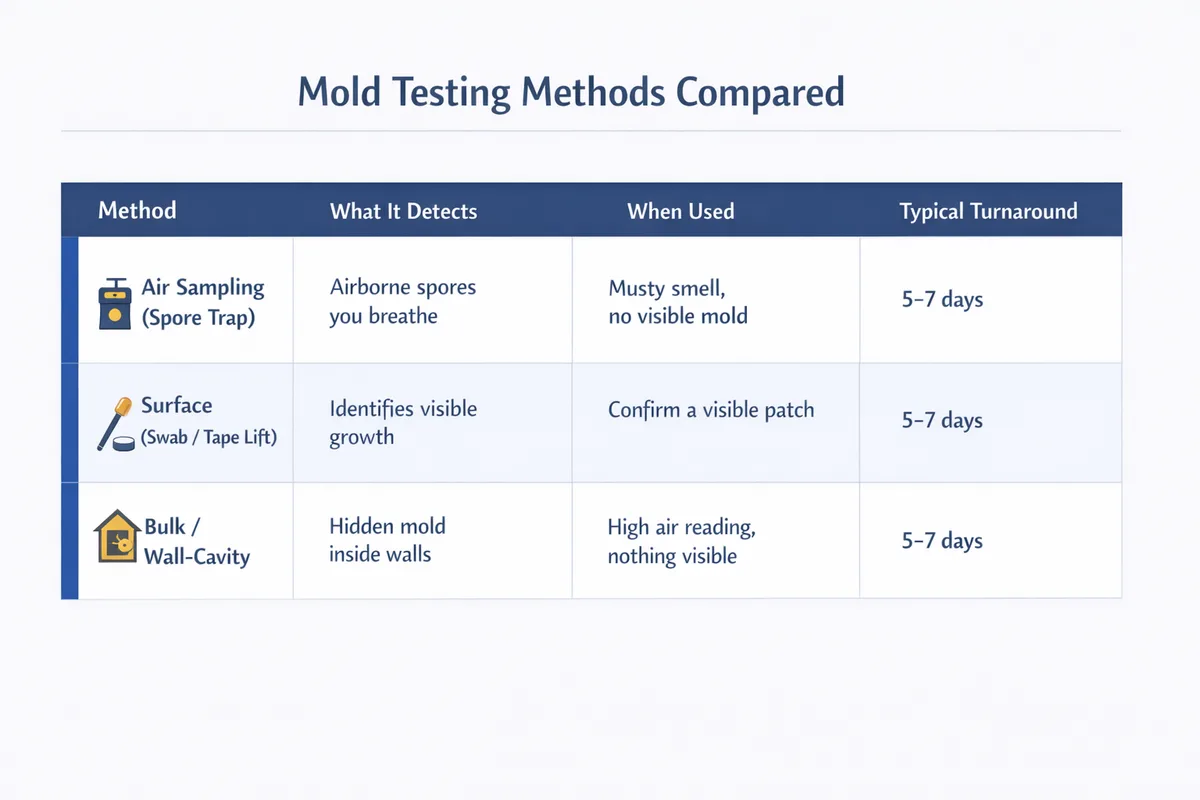
Each method answers a different question. Air sampling tells you what you are breathing. Surface sampling confirms what a visible patch actually is. Bulk and wall-cavity sampling find hidden growth. Together they give a complete answer.
Air sampling (spore trap)
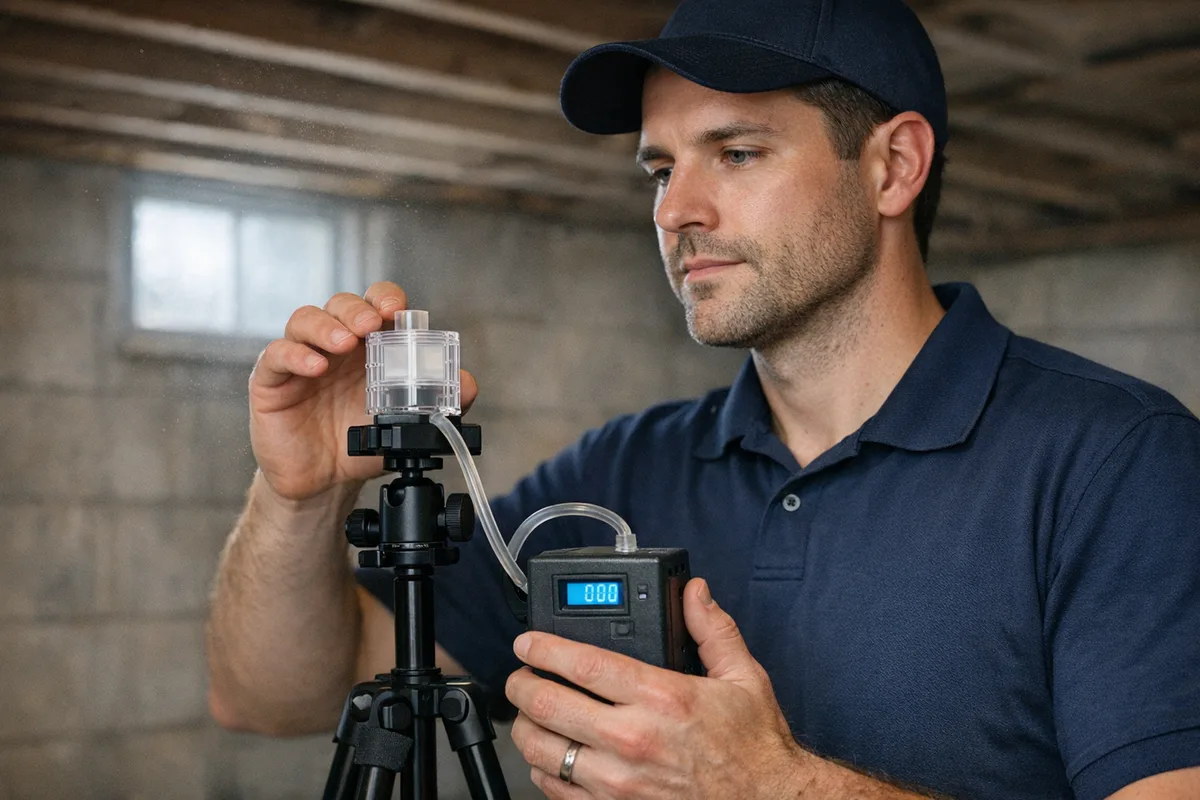
Air sampling uses a spore trap to measure how many mold spores are floating in your air. Our inspector runs a calibrated pump for about five minutes in each room, pulling air across a sticky slide that captures spores. The lab then counts and identifies them under a microscope.
The most important step is the outdoor control sample. We always take one outdoor air sample on the same visit. Mold spores are everywhere outdoors, so the only way to know if your indoor levels are abnormal is to compare them to the outdoor baseline. Any inspector who skips the outdoor sample cannot give you a reliable result. This is the core of professional mold testing done correctly.
Surface sampling: swab vs. tape lift
Surface sampling confirms whether a visible stain is actually mold and which type it is. We use two methods. A swab rubs a sterile tip across the surface. A tape lift presses clear tape onto the growth to capture spores without disturbing them.
Tape lift is the cleaner choice for delicate or visible growth because it preserves the spore structure for the lab. Swabs work well on rough or hard-to-reach surfaces. Both are quick and inexpensive, and we often bundle one or two surface samples with an air test for a fuller picture.
Bulk and wall-cavity sampling
Bulk and wall-cavity sampling find mold hidden inside walls, ceilings, or building materials. When the air reads high but nothing is visible, the mold is often hiding behind a finished surface. We use a low-flow needle probe to sample the air inside a wall cavity without tearing it open.
This method is one of the most useful tools we have for older Ottawa homes, where slow leaks can feed mold inside walls for years. It lets us confirm hidden growth before any demolition, so you only open up the walls that actually need it. We pair this with a full moisture and thermal scan to map exactly where the water is coming from.
How to read your mold lab report (CFU/m³)
Your mold lab report measures spore levels in CFU/m³, which means colony-forming units per cubic metre of air. The single most important number is not your indoor count on its own. It is how your indoor count compares to the outdoor baseline taken on the same day.
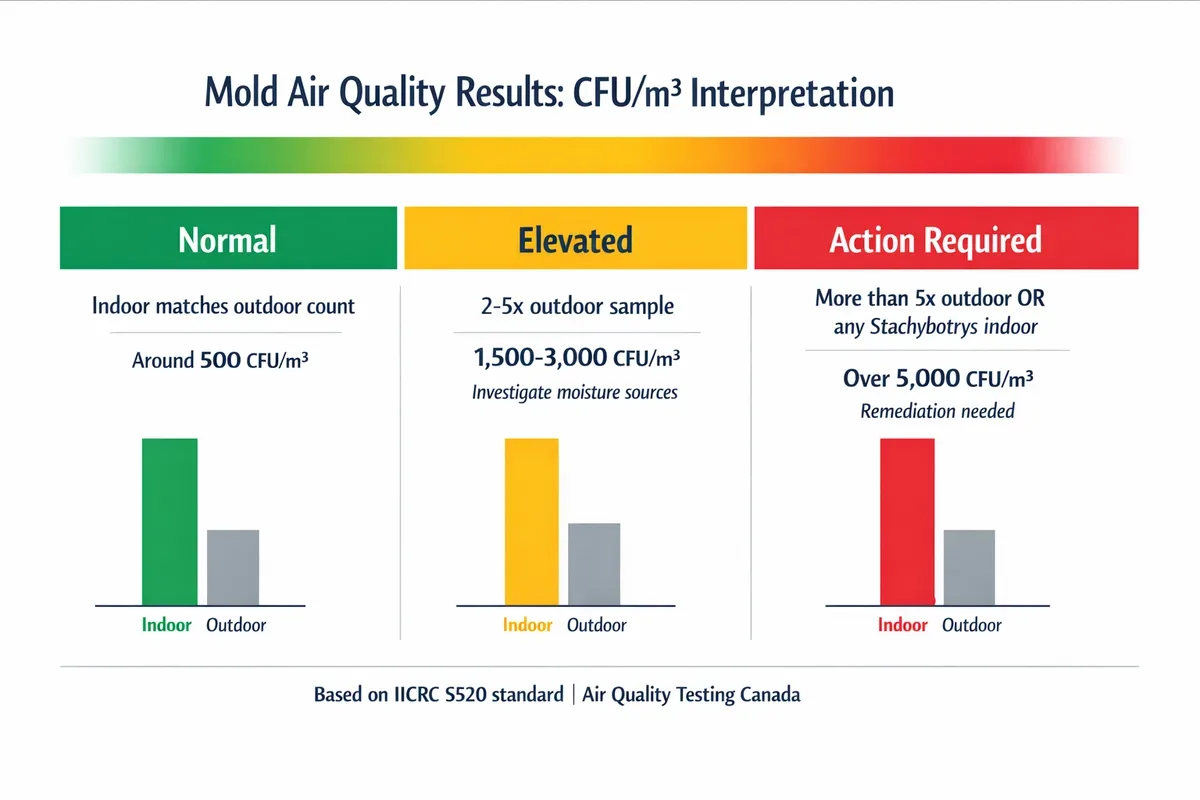
There is no single legal “safe” mold number in Canada. Health Canada does not set a numeric limit, because what matters is the comparison and the species present. Our reports interpret your numbers in plain language so you know exactly where you stand.
Normal
Indoor spore counts are similar to or lower than outdoor levels, with a similar mix of species. No action needed.
Elevated
Indoor counts are higher than outdoor, or you have indoor species not found outside. This points to an active indoor source worth investigating.
Action required
Indoor counts are much higher than outdoor, or we find water-damage species like Stachybotrys indoors. This signals a real problem that needs attention.
The species matter as much as the count. We commonly find Aspergillus, Penicillium, and Cladosporium in Ottawa homes. Stachybotrys, often called black mold, grows on materials that stay wet and is a strong sign of a chronic moisture problem. Our report names what we find and explains what it means for your health and your home. To go deeper, see our guide to understanding your air quality test results.
What does a mold inspection cost in Ottawa?
A mold inspection in Ottawa typically costs between $250 and $900, depending on how many areas you test and whether you need lab analysis. A simple visual inspection costs less than a full multi-zone air test with lab work. We give you a clear, flat-rate quote before we start, with no surprises.
| Scope | What it includes | Typical Ottawa cost |
|---|---|---|
| Visual mold inspection | Certified inspector visit, moisture sweep, thermal imaging, written summary; no lab sampling | $250–$400 |
| Inspection + air testing | Visual inspection plus one indoor spore-trap sample, one outdoor control, lab fee, written CFU/m³ report | $300–$500 |
| Whole-home 3-zone panel | Three indoor samples, one outdoor control, lab fees, full moisture and thermal survey, interpretation | $500–$900 |
| Post-remediation clearance | Two to three indoor samples, outdoor control, IICRC clearance protocol, clearance report | $400–$1,200 |
A few extras can change the price. A surface tape lift runs about $80 to $150 per sample and is often bundled in. Wall-cavity air sampling adds roughly $200 to $300 per cavity. A store-bought mail-in kit costs $60 to $120 but does not include professional interpretation, which is where the real value is. The biggest cost factors are the number of zones you test and whether hidden mold needs cavity sampling.
DIY mold test kit vs. professional inspection
A DIY mold test kit can tell you that mold exists, but it cannot tell you how much, where it comes from, or whether your levels are abnormal. Most kits use a settle plate, which simply collects whatever lands on it over time. A settle plate will almost always grow mold, because spores are in every home and every kit, so it tells you very little.
The two things DIY kits miss are the outdoor control sample and expert interpretation. Without comparing your indoor air to outdoor air, a result is just a number with no meaning. A professional inspection gives you a calibrated air sample, an accredited lab analysis, and a report you can hand to a doctor, an insurer, or a contractor.
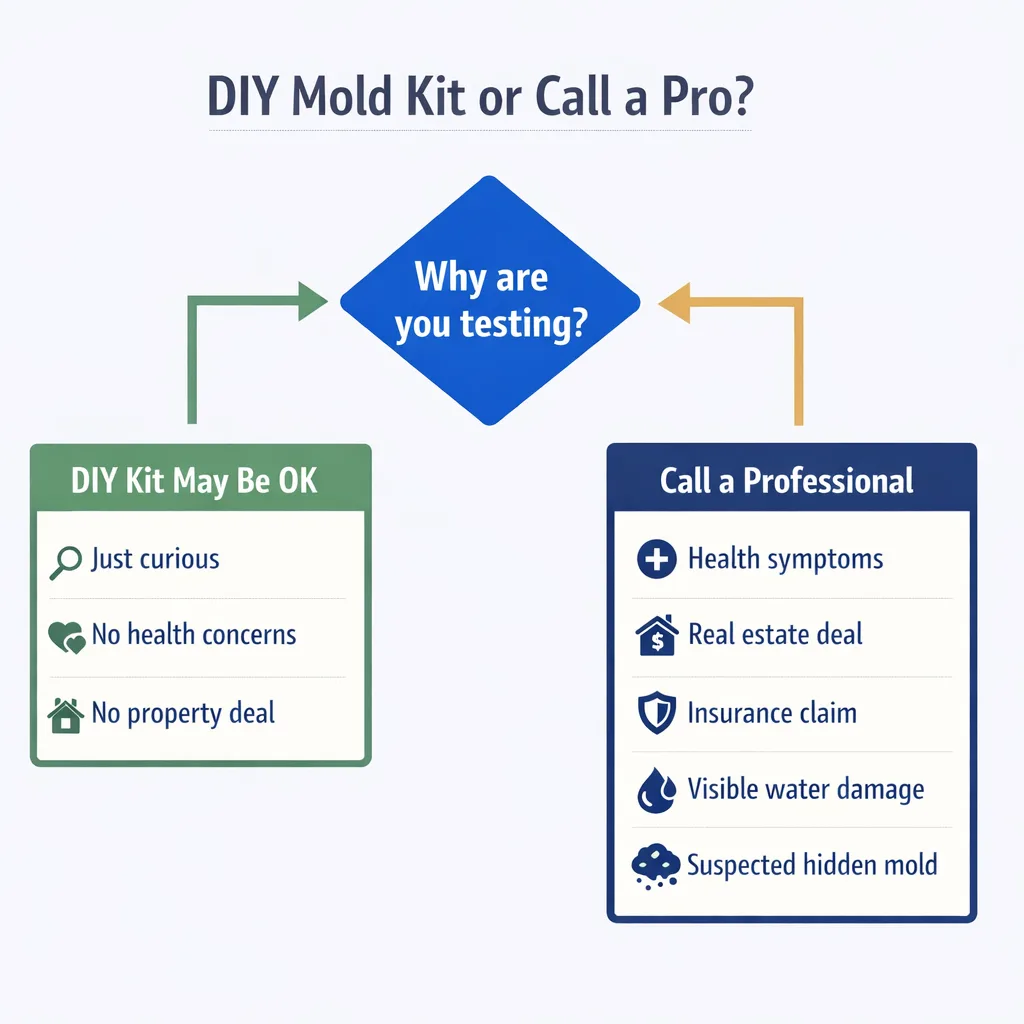
A DIY kit is fine if you are simply curious and have no health concerns or property deal at stake. Call a professional when you have health symptoms, a real estate transaction, an insurance claim, visible water damage, or suspected hidden mold. In those cases, the kit’s small savings can cost you far more in missed problems. For background on home test kits, see our review of air quality testing for mold and how kits compare.
Why choose us for mold inspection in Ottawa?
Choose us because we are an independent, certified testing company with no removal work to sell. After 15,000-plus inspections, our only product is the truth about your air. That independence is rare in Ottawa, where most companies both test and remediate.
Our inspectors are IICRC and IAQA certified and follow the IICRC S520 standard for mold assessment. We send every sample to an accredited Canadian lab and deliver a clear written report fast. That report is documentation you can use with a physician, an insurance company, a real estate lawyer, or a remediation contractor.
If your results confirm mold and you need it removed, we will point you to qualified help. You can review how to choose a mold removal company in Ottawa so you hire the right contractor. We stay in the testing role so your assessment and your removal are never done by the same hand. We also offer asbestos testing for older Ottawa homes facing renovation. Homeowners in nearby regions can also read about mold detection in Montreal homes.
Mold inspection service areas around Ottawa
We provide mold inspection and testing across Ottawa, Gatineau, and the wider National Capital Region. Our inspectors cover the city core and the surrounding communities, with same-week appointments in most areas.
Our service area includes Ottawa, Gatineau, Kingston, Carleton Place, Brockville, Belleville, and Cornwall. Whether you need mold inspection Ottawa wide, in Kanata, Orleans, Barrhaven, or the central core, we can usually book you within a few days. For a broader look at our local work, see our air quality testing in Ottawa page.
What Ottawa Homeowners Say
Real feedback from recent Ottawa-area mold inspections
“Our basement near the Ottawa River flooded during the spring thaw and started smelling musty. The inspector arrived on time, took an outdoor control sample, and had lab results in two days. Turned out to be Stachybotrys behind the drywall. Honest and thorough.”
“Bought an older home in the Glebe and wanted an unbiased mold assessment before closing. They air-sampled three rooms plus an outdoor control and explained the CFU numbers clearly. No upsell, just facts I could take to my lawyer.”
“Renovating a 1960s home in Kanata and needed asbestos testing on the popcorn ceiling and old vinyl tiles. Clear written report in 48 hours that saved us from a costly mistake during demolition. Will use them again.”
“After our remediation contractor finished, we wanted independent clearance testing so we knew the job was actually done. They followed the IICRC clearance protocol and gave us a report the contractor accepted. Worth every penny for peace of mind.”
Frequently asked questions
A mold inspection is the full visit, where a certified inspector looks for mold and finds the moisture causing it. A mold test is the lab sampling done during that visit, such as an air or surface sample. You usually need both: the inspection finds the source, and the test confirms what is in your air and which species you have.
A mold inspection in Ottawa typically costs between $250 and $900. A visual inspection runs $250 to $400, while an inspection with air testing and lab analysis runs $300 to $500 for a single zone. A whole-home multi-zone panel costs $500 to $900. We provide a flat-rate quote before any work begins.
The on-site inspection usually takes one to two hours, depending on the size of your home and the number of samples. Lab results for air and surface samples typically come back within five to seven business days. We then send you a written report that interprets your numbers in plain language.
There is no single normal mold spore count, because the result depends on comparing your indoor air to the outdoor air taken on the same day. Indoor levels that are similar to or lower than outdoor levels, with a similar species mix, are considered normal. Indoor counts much higher than outdoor, or water-damage species like Stachybotrys found indoors, signal a problem.
You can use a DIY mold test kit, but it has real limits. Most kits use a settle plate that grows mold from spores present in any home, and they lack an outdoor control sample and professional interpretation. For health concerns, real estate deals, insurance claims, or suspected hidden mold, a professional inspection gives you reliable, lab-confirmed results you can actually use.
Yes, a mold inspection is strongly recommended after any basement flooding or significant spring thaw. Ottawa’s spring freshet pushes groundwater into basements, and mold can begin growing within 24 to 48 hours of water exposure. An inspection a few weeks after the water recedes catches hidden growth before it spreads into finished walls and flooring.
Book a mold inspection in Ottawa today
Booking a mold inspection in Ottawa is simple. You get a certified, independent inspector, an accredited lab analysis, and a clear report you can act on. We serve Ottawa, Gatineau, Kingston, Carleton Place, Brockville, Belleville, Cornwall, and surrounding communities with same-week bookings. Do not wait for a small mold problem to spread behind your walls. We also offer asbestos testing if a related question comes up during the inspection.
📞 Call 1-866-528-2897 Request a callback
Monday to Friday, 8:00 AM to 3:00 PM ET · Quotes are always free