
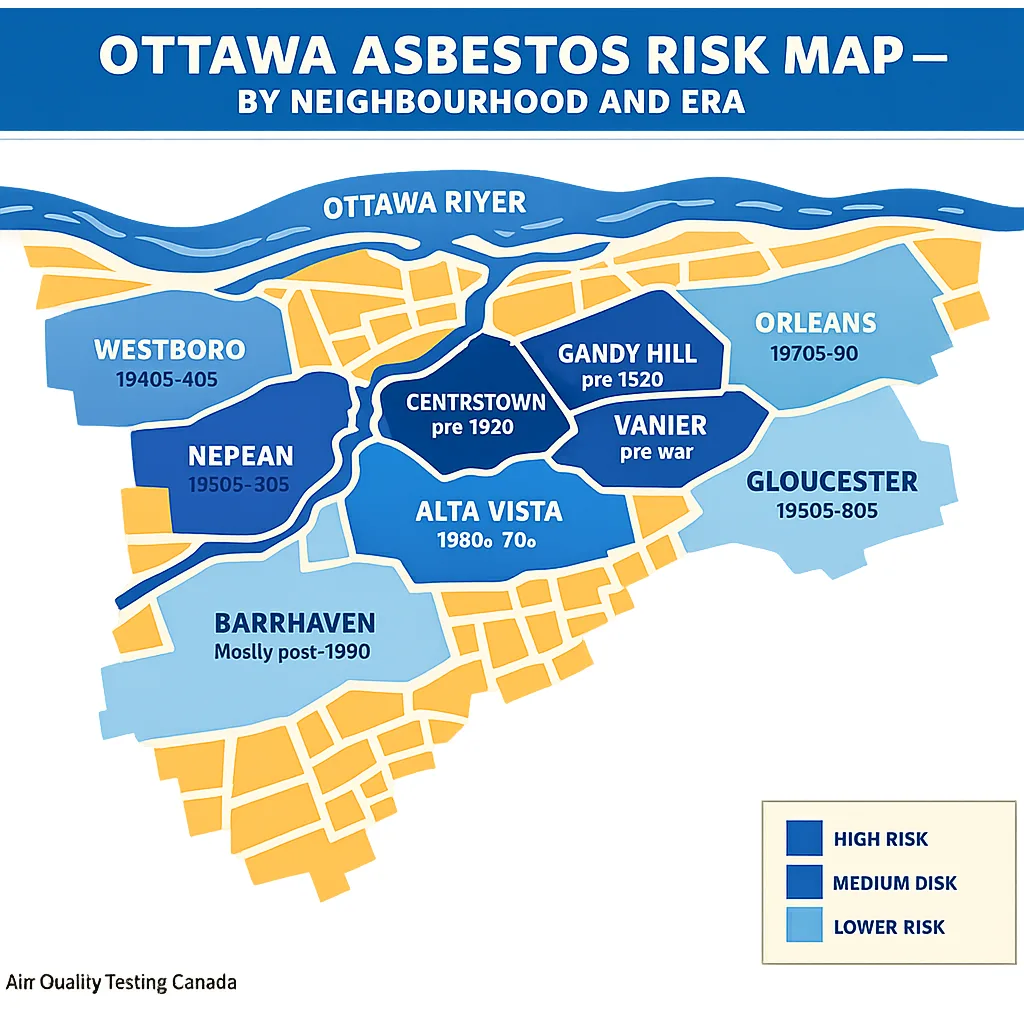
If you own a home or building in Ottawa that was built before 1990, there is a real chance asbestos is somewhere inside it. The Ottawa region’s housing stock spans more than a century: Centretown rowhouses from the 1900s, Vanier and Sandy Hill walk-ups from the inter-war years, Alta Vista and Gloucester subdivisions from the 1960s and 1970s, and 1980s tail-end builds in Kanata, Barrhaven and Orleans. Every one of those eras used materials that, in their day, contained asbestos.
Asbestos testing in Ottawa is the only way to know for sure. We sample, we send to an accredited lab, and we give you a defensible written report. No remediation upsell, no removal pitch, just independent results so you can make a decision about your home or project.
Air Quality Testing Canada has performed more than 15,000 inspections across Ontario and Quebec since 2010. IICRC-certified, IAQA-certified, and partnered with accredited labs for PLM and TEM fibre analysis. Call 1-866-528-2897 for same-week service in Ottawa, Kanata, Orleans, Nepean, Barrhaven, Gloucester, Vanier, Gatineau and the Outaouais.
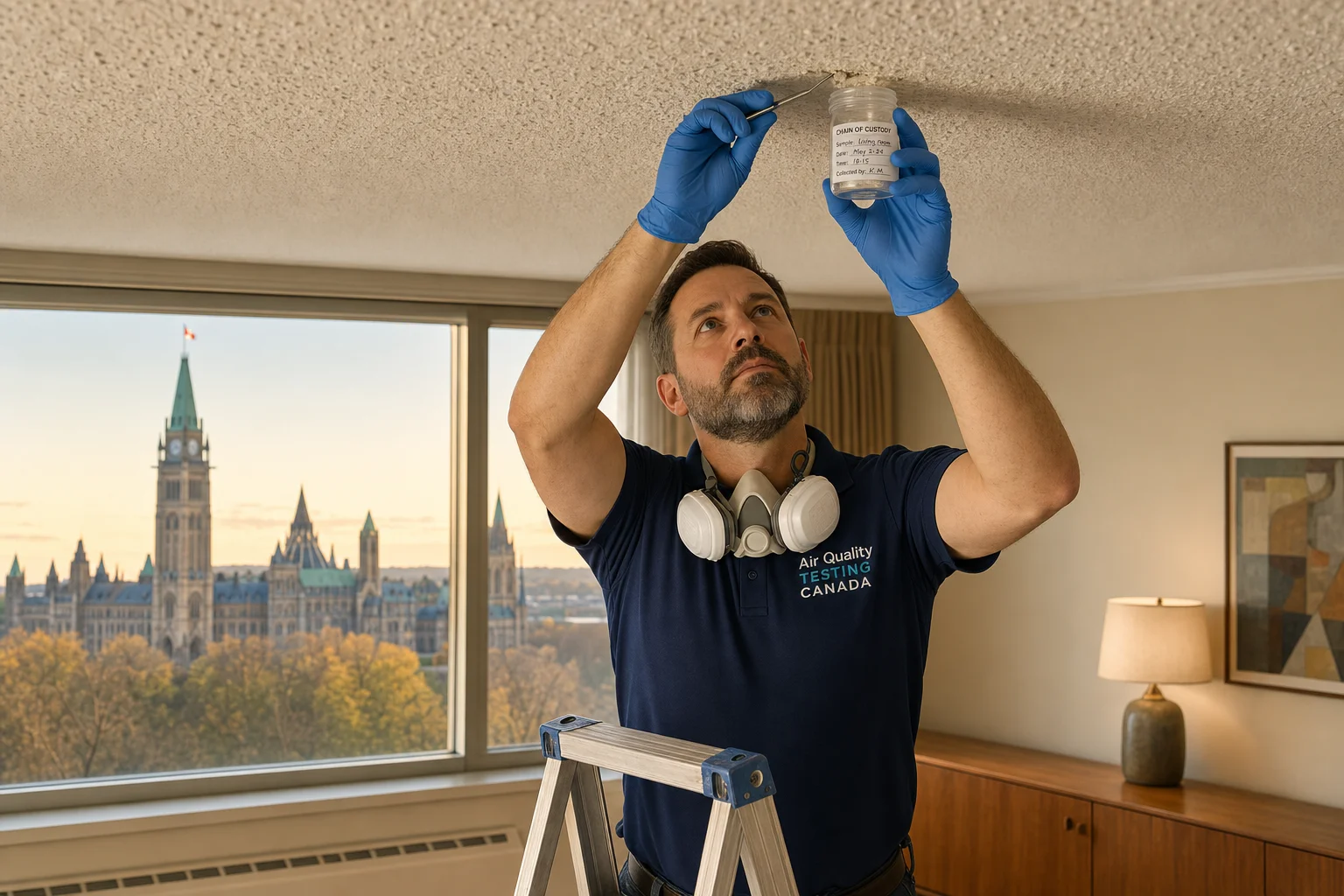
Why Ottawa homes and buildings need asbestos testing
Asbestos was used in Canadian construction from the early 1900s through the late 1980s, and in some products until 1990. It was fire-resistant, cheap, and a good thermal insulator, which made it ideal for everything from attic insulation to floor tiles to drywall joint compound. The trade-off, which the construction industry did not fully act on until decades later, is that disturbing asbestos releases microscopic fibres that lodge in lung tissue and cause mesothelioma, asbestosis and lung cancer 20 to 40 years later.
Ottawa’s pre-1990 housing stock is dense. According to the 2021 Census, roughly half of Ottawa’s private dwellings were built before 1980, the era when asbestos products were still in everyday use. That means most older homes in the city contain at least one asbestos-containing material somewhere, even if it is encapsulated and safe in its current state. The problem is renovation. As soon as you cut into a wall, sand a popcorn ceiling or pull up vinyl floor tiles, you risk releasing fibres into the air.
That is why an Ottawa asbestos test before any pre-1990 renovation is not optional under Ontario law. It is required by Ontario Regulation 278/05 for any project that disturbs material that might be asbestos-containing. The same logic applies to real-estate transactions, insurance claims, and post-flood demolition along the Ottawa River, Rideau River and Mississippi Mills watershed where basements take damage every spring.
Materials we test in Ottawa-area properties
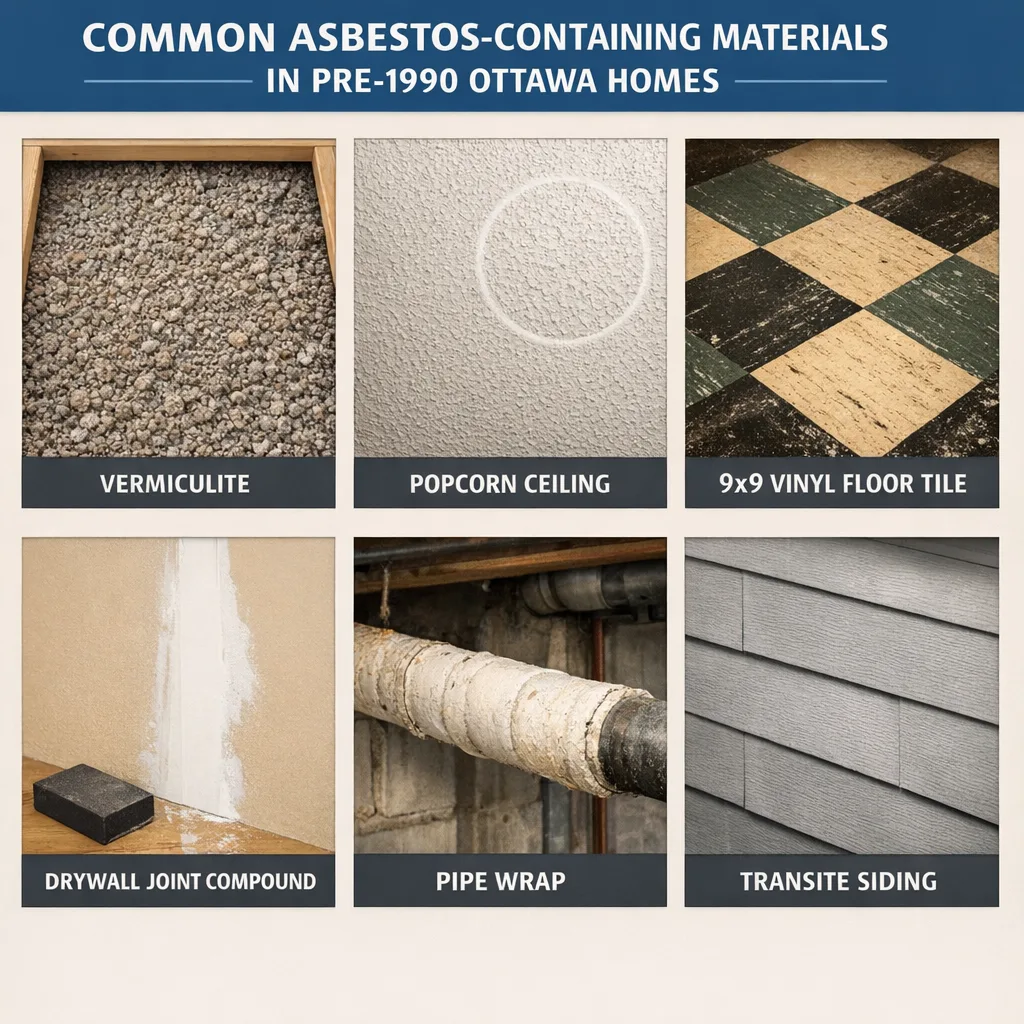
When we sample an Ottawa home or commercial building for asbestos, the materials we focus on are the ones that were most commonly used in pre-1990 Canadian construction:
- Vermiculite (Zonolite) attic insulation: a grey, pebbly, lightweight loose-fill insulation poured between attic joists from the 1920s through 1990. Most vermiculite sold in Canada in that era came from the Libby, Montana mine and is contaminated with tremolite asbestos. If your Ottawa attic has loose-fill insulation that looks like grey gravel, do not disturb it. Test first.
- Popcorn ceilings (textured spray ceilings): common in Ottawa homes built between 1955 and 1985, especially in basement rec rooms, bedrooms and rental finishes. Often contained chrysotile asbestos at 1 to 10% by weight.
- 9″ × 9″ vinyl floor tiles: distinctive small-format tiles installed throughout the 1950s, 1960s and 1970s, often in kitchens, basements and entryways. The tiles themselves and the black mastic adhesive underneath are both potential asbestos sources.
- Drywall joint compound (mud) and texture finishes: pre-1980 joint compound regularly contained chrysotile asbestos. Sanding a renovation wall in a 1960s Alta Vista bungalow can release more fibres than any other source in the home.
- Pipe and boiler wrap (Magnesia and air-cell insulation): common in older Centretown and Sandy Hill basements with original heating systems. White or grey wrap on steam and hot-water lines.
- Transite siding, soffit and roof shingles: cement-asbestos board used on the exterior of homes from the 1930s through 1970s.
- Window putty and caulking: pre-1980 glazing compound around original wood windows.
- HVAC duct seal and gaskets: older furnaces, especially oil-fired conversions in mid-century Ottawa homes, used asbestos-containing gaskets.
Visual identification is unreliable. A “popcorn” ceiling in one 1972 Gloucester bungalow may contain no asbestos, while an apparently identical ceiling in the house next door may be 5% chrysotile. The only way to know is bulk sample testing.
Asbestos testing Ottawa process: bulk and air sampling
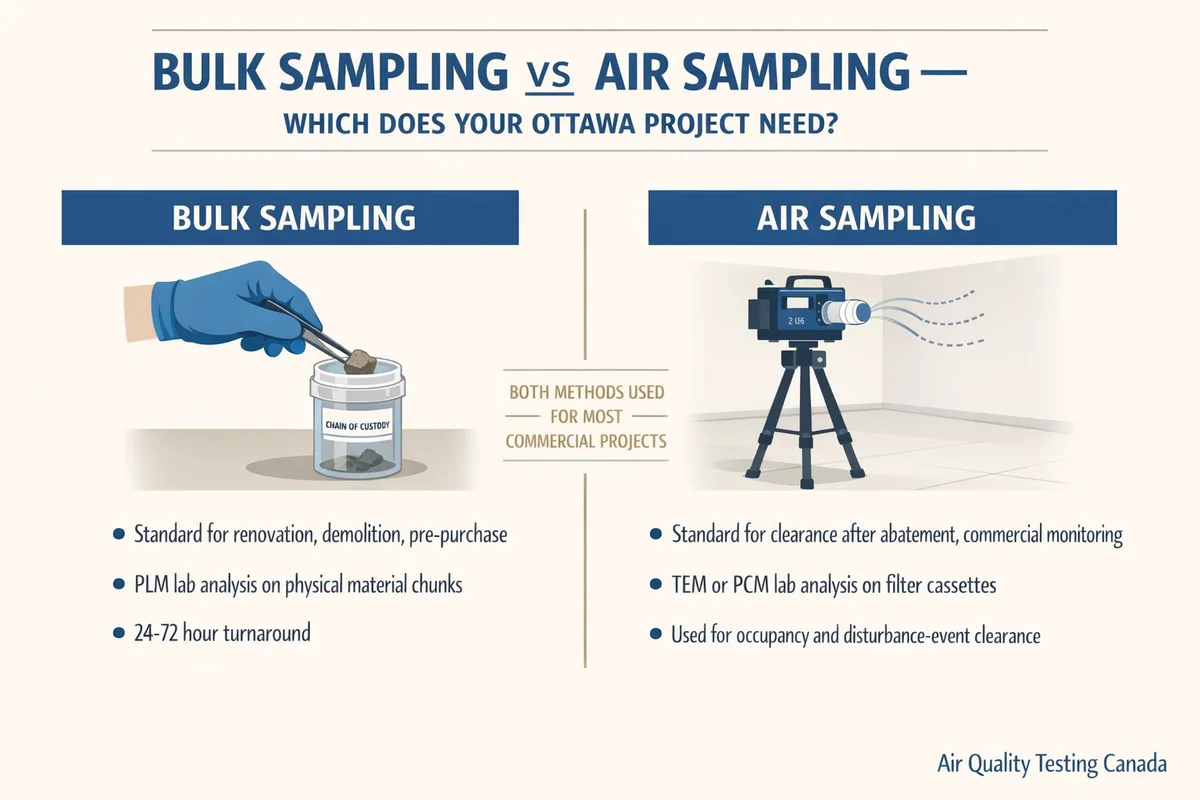
There are two complementary ways to test for asbestos in an Ottawa home, and most projects use both depending on scope.
Bulk sampling is the standard for renovation, demolition and pre-purchase work. We physically remove a small piece of the suspect material (a coin-sized chunk of popcorn ceiling, a 9″ × 9″ floor tile, a teaspoon of vermiculite from the attic), then seal it in a chain-of-custody container, and send it to an accredited lab for PLM (Polarized Light Microscopy) analysis. PLM is the standard EPA/Health Canada method for identifying asbestos in building materials. Results in 24 to 72 hours.
Air sampling measures airborne asbestos fibre concentration. We set up calibrated pumps with 25 mm mixed-cellulose-ester filter cassettes, run them for a known volume of air (typically 1,200 to 2,400 litres over 4 to 8 hours), and send the filters to a lab for TEM (Transmission Electron Microscopy) or PCM (Phase Contrast Microscopy) analysis. Air sampling is used for clearance testing after asbestos abatement, for occupancy monitoring in commercial buildings, and for confirming that a disturbance event has not contaminated adjacent rooms.
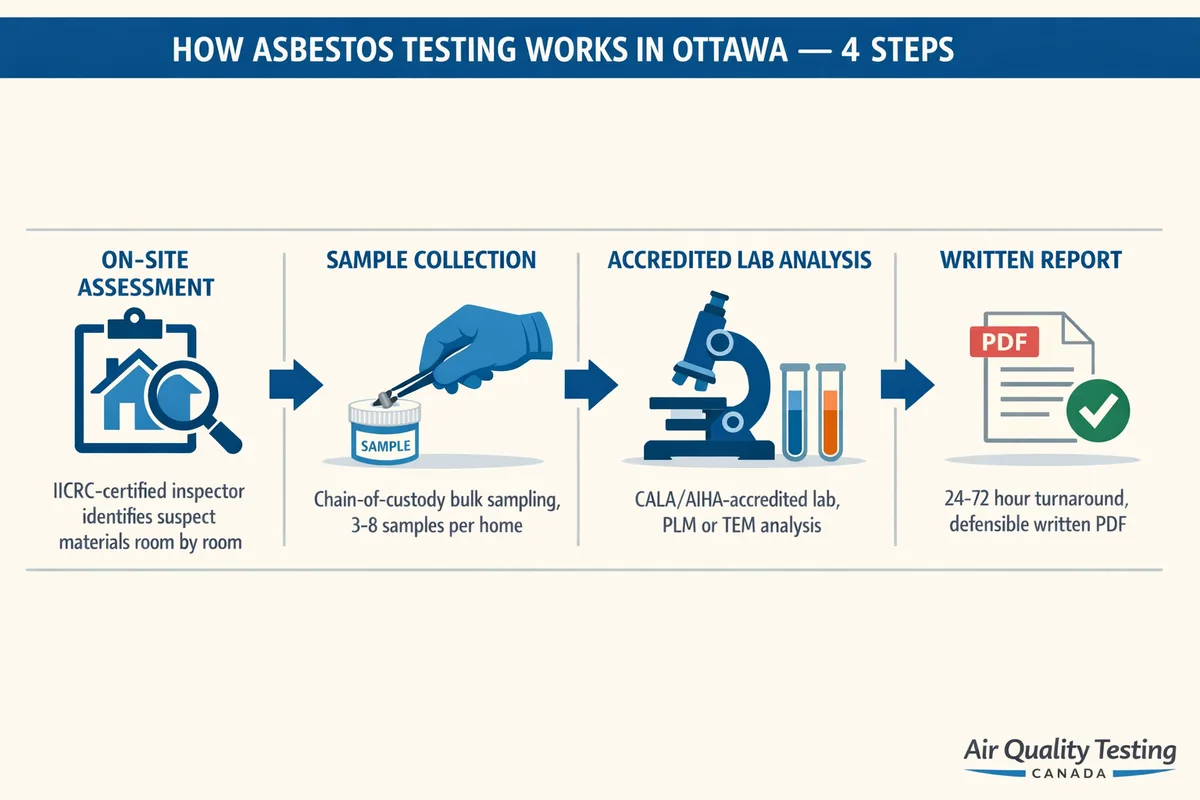
Our four-step Ottawa testing process:
- On-site assessment. Our IICRC- and IAQA-certified inspector walks the property, identifies suspect materials in every room and attic/crawlspace, photographs each one, and decides where to sample. For a typical pre-1990 Ottawa home we collect 3 to 8 bulk samples; commercial projects often need 20+.
- Sample collection. Using sealed bulk-sampling tools (scalpel, tweezers, mister to control dust), we collect coin-sized pieces into labelled containers. For air sampling, calibrated pumps run on-site for 4 to 8 hours. Every sample is chain-of-custody documented.
- Accredited lab analysis. Samples go to a CALA- or AIHA-accredited laboratory for PLM (bulk) or TEM/PCM (air). We use partner labs in Ottawa and Toronto for fastest turnaround.
- Written report. Within 24 to 72 hours of sample drop-off, you receive a written PDF report identifying every material tested, the asbestos fibre type (chrysotile, amosite/amphibole, crocidolite) and percentage, sample locations with photographs, and recommendations for what to do next.
Bulk sampling versus air sampling: which do you need?
This is the most common question Ottawa homeowners ask, and the answer depends on what you are trying to find out.
Choose bulk sampling when
- You are planning a renovation or demolition in a pre-1990 home and need to know if a specific material is asbestos before disturbing it. This is the Ontario Reg. 278/05 requirement.
- You are buying a pre-1990 home and want a defensible report on the highest-risk materials before closing.
- You see suspicious material (vermiculite in the attic, popcorn ceiling, old floor tile) and want a definitive yes/no answer on that specific material.
Choose air sampling when
- You need clearance after an asbestos abatement contractor has finished work, before re-occupancy. Independent third-party clearance is essential. The abatement contractor cannot clear their own work.
- You manage a commercial building and need ongoing fibre monitoring as part of an asbestos management plan.
- A disturbance event happened (accidental drilling into vermiculite, a worker sanded a popcorn ceiling without knowing) and you need to know if the air is still contaminated.
- You are concerned about a tenant complaint or workplace exposure.
For most Ottawa residential projects, bulk sampling answers the question. For commercial, institutional and post-abatement work, both are usually required.
Ottawa neighbourhoods we serve
We test across the entire Ottawa region. The neighbourhoods below are not an exclusive list. They are the areas where we most often see specific asbestos risks based on era-of-build and housing-stock patterns:
- Centretown, Sandy Hill, Glebe and Old Ottawa South: late-1800s and early-1900s rowhouses and detached homes. High likelihood of asbestos pipe wrap on original heating systems, plaster systems and transite siding.
- Vanier and Overbrook: pre-war and inter-war housing. Vinyl floor tiles, drywall compound, vermiculite attic top-ups common.
- Westboro, Civic Hospital, Hampton Park and Carlington: 1940s to 1960s housing. Popcorn ceilings, 9″ × 9″ floor tiles, drywall texture finishes.
- Alta Vista, Heron Park, Riverside Park and Hunt Club: 1960s and 1970s subdivisions. Vermiculite insulation, popcorn ceilings, drywall mud.
- Gloucester, Beacon Hill and Blackburn Hamlet: 1960s to 1980s suburban builds. Vermiculite, drywall, transite components.
- Nepean (Bells Corners, Bayshore, Centrepointe): 1960s to 1980s. Mix of vermiculite, vinyl tile and pipe wrap.
- Kanata (Beaverbrook, Glen Cairn, Bridlewood): late 1970s to 1990 tail-end builds. Drywall compound and some vinyl tile.
- Barrhaven, Stittsville and Riverside South: mostly post-1990, but pre-1990 rural farmhouses and conversions still warrant testing.
- Orleans (Convent Glen, Chapel Hill, Fallingbrook): 1970s to 1990 suburban housing.
- Rockcliffe Park, New Edinburgh and Manor Park: high-value older homes, original heating systems, often with multiple ACM categories.
- Gatineau, Hull, Aylmer and the Outaouais: same construction-era patterns apply; we test cross-river.
We also serve the broader Eastern Ontario corridor: Kemptville, Smiths Falls, Carleton Place, Almonte, Pakenham, Rockland, Embrun and Russell.
Vermiculite and Zonolite insulation in Ottawa attics
If we had to pick the single most common asbestos concern in Ottawa attics, it would be loose-fill vermiculite, usually sold under the brand name Zonolite. This is the grey, pebbly, lightweight insulation that looks like packing peanuts or aquarium gravel. It was poured into millions of attics across Canada from the 1920s through 1990 as a top-up insulation, often layered over existing fibreglass or mineral wool.
The problem is that about 70 percent of vermiculite sold in North America during that period came from a single mine in Libby, Montana, which was contaminated with tremolite, an amphibole asbestos fibre that is more carcinogenic than chrysotile. The Libby mine closed in 1990, but the vermiculite from it is still in attics across Ottawa today.
If you have loose-fill vermiculite in your Ottawa attic:
- Do not disturb it. Do not vacuum it. Do not push fibreglass batts in on top of it. Each disturbance releases fibres.
- Test before any renovation that involves the attic: adding insulation, running a new bathroom vent, installing pot lights, replacing ductwork, finishing the attic, or any work that goes through the ceiling below.
- Test before sale or purchase. Disclosing vermiculite is required under Ontario real-estate practice; a defensible test report tells the buyer exactly what is there.
- If a test confirms asbestos contamination, a licensed abatement contractor can remove it safely. Independent post-abatement air clearance testing is essential. We provide this as a separate service.
The federal Vermiculite Insulation Compensation Program closed in 2018, so there is no longer a federal subsidy. But knowing what is in your attic is still essential, both for safety and for property value.
Ontario Regulation 278/05: what Ottawa property owners must know
Ontario Reg. 278/05 (Designated Substance, Asbestos on Construction Projects and in Buildings and Repair Operations) is the law that governs how Ottawa property owners, contractors and building managers must handle asbestos.
The key requirements:
- A Designated Substances Survey (DSS) is required before any construction, renovation, demolition or repair project. The survey identifies all known and suspected asbestos-containing materials. For commercial buildings, the building owner must commission the DSS. For home renovations, the homeowner is responsible, but the contractor cannot legally begin work without it.
- Sampling must be done by a qualified person: typically an IAQA- or IICRC-certified inspector. Self-sampling is legal for personal-use diagnostic purposes but is not defensible for regulatory compliance.
- Three classifications drive the work plan:
- Type 1 (low risk): small-scale removal of intact material under controlled conditions.
- Type 2 (moderate risk): most residential abatement work, requires enclosure and respiratory protection.
- Type 3 (high risk): large-scale removal, requires full negative-pressure enclosure, decontamination units and continuous air monitoring.
- Air clearance testing is required at the end of Type 2 and Type 3 work before re-occupancy. The clearance test must be performed by a competent person independent of the abatement contractor.
Our role at Air Quality Testing Canada is the testing side: DSS surveys, bulk sampling, air clearance. We do not perform abatement, which keeps our results independent and defensible.
Our certifications and lab partners
Independence and credentials matter. Anyone with a $50 mail-in test kit can call themselves an asbestos tester. What you actually want is:
- IICRC certification (Institute of Inspection, Cleaning and Restoration Certification): the global benchmark for inspection competency. Every Air Quality Testing Canada inspector is IICRC-certified.
- IAQA certification (Indoor Air Quality Association): adds indoor environmental quality methodology and sampling protocol training.
- Indoor Air Quality Inspector and Indoor Air Consultant credentials.
- Accredited-lab partnerships for fibre analysis. We work with CALA- (Canadian Association for Laboratory Accreditation) and AIHA- (American Industrial Hygiene Association) accredited labs in Ottawa, Toronto and Montreal. Lab accreditation is the only guarantee that the PLM and TEM analysis is performed to ISO/IEC 17025 standards.
- Chain-of-custody documentation on every sample. Without chain-of-custody, lab results are not defensible in court, insurance, or real-estate disputes.
We have run more than 15,000 inspections across Ontario and Quebec since 2010. We do not sell remediation. The report is the deliverable. What you do next is your decision.
How much does asbestos testing Ottawa cost?
Asbestos testing Ottawa pricing typically runs between $300 and $1,500 CAD depending on scope.
| Service level | Price range | What’s included |
|---|---|---|
| Single-material bulk test | $300 to $450 | One material tested (e.g. one popcorn ceiling, one floor tile group, one vermiculite attic), 1 to 3 samples, PLM lab analysis, written report. |
| Standard residential survey | $500 to $800 | Whole-home walkthrough, 4 to 6 bulk samples across multiple materials, PLM analysis, photo-documented written report. The most common Ottawa residential service. |
| Pre-renovation Designated Substances Survey | $700 to $1,200 | Reg. 278/05-compliant survey, 6 to 12 samples, full documentation suitable for permitting and contractor handover. |
| Commercial / large-scale survey | $900 to $1,500+ | Industrial, institutional or multi-unit buildings, 12+ samples, often combined with air sampling. Custom quote. |
| Air clearance after abatement | $400 to $800 | Post-abatement clearance with calibrated air pumps, TEM or PCM lab analysis, defensible written report. |
All prices CAD, before HST, and include accredited-lab analysis plus a written report. We do not bundle remediation pricing into the testing fee.
Rush analysis is available. 24-hour turnaround is roughly a 30% surcharge over standard 48 to 72 hour service. Want the national picture before you book? Here is what asbestos testing costs across Canada, including the Ontario rules that affect your quote.
Ready to book? Call 1-866-528-2897. Hours are Monday to Friday, 8:00 AM to 3:00 PM.
Frequently asked questions
How much does asbestos testing cost in Ottawa?
How long do Ottawa asbestos lab results take?
My Ottawa attic has grey pebbly insulation, is it asbestos?
What materials commonly contain asbestos in Ottawa homes?
How many samples do I need for an Ottawa asbestos test?
Can you tell if it’s asbestos just by looking?
For mold inspection in the Ottawa region, see our Ottawa mold inspection and testing page. For the broader national asbestos testing service across Ontario and Quebec, see our asbestos testing service page. For the full multi-service Ottawa hub including mold and indoor air quality testing, see Ottawa air quality testing.
If you also need asbestos removal in Ottawa, our colleagues at Mold Busters handle abatement across Ontario and Quebec.
For more information about asbestos health risks, see the Health Canada asbestos overview and the Ontario Reg. 278/05 text on ontario.ca.