June 9, 2026
Asbestos Testing Cost in Canada
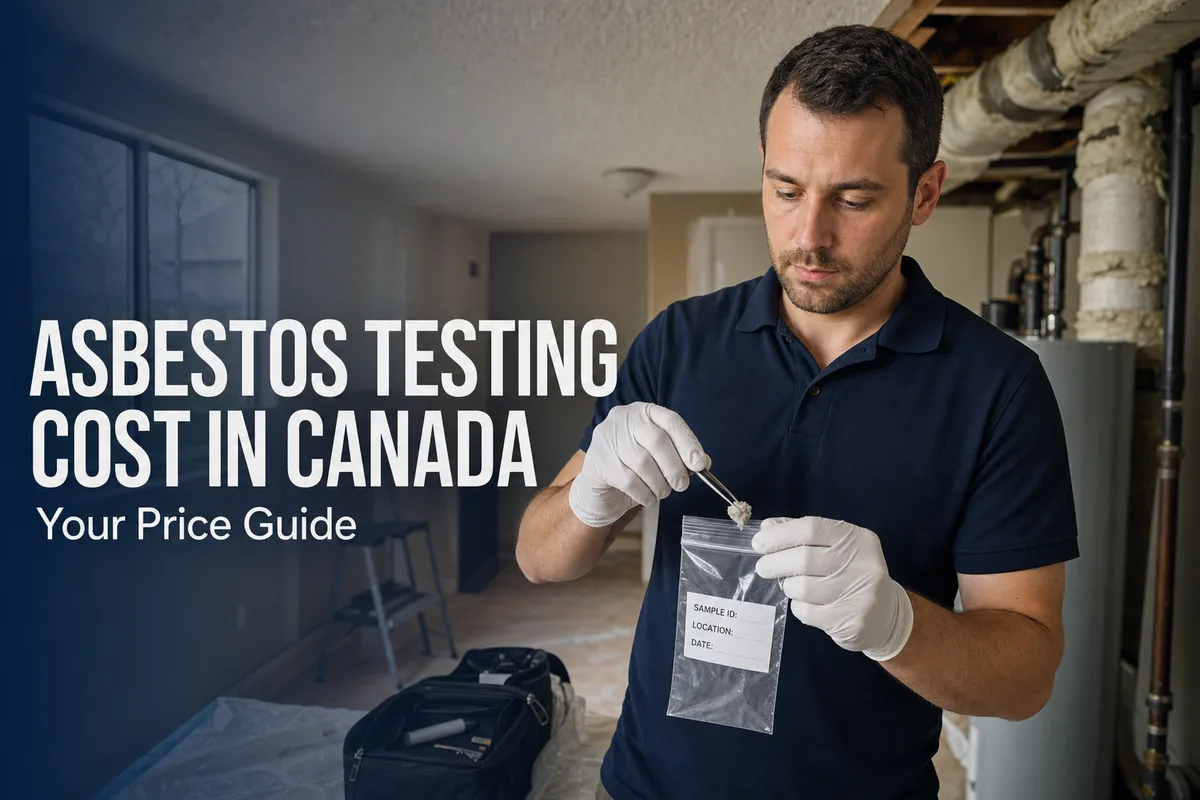
A homeowner in Ottawa called us last spring about a popcorn ceiling she wanted gone before listing the house. Her first question wasn’t whether it had asbestos. It was “what’s this going to cost me?” Fair question, and the honest answer is “it depends,” which nobody likes to hear. So let’s put real numbers on it.
Asbestos testing in Canada in 2026 runs anywhere from about $30 for a single DIY mail-in sample to $1,300 or more for a full pre-demolition survey. Most homeowners doing a normal renovation land somewhere in the middle: a few hundred dollars for a professional inspector to take a handful of samples and send them to an accredited lab. Below we break down every tier, what actually moves the price, and where Ontario and Quebec differ (they do, and it matters for your bill).
How much does asbestos testing cost in Canada in 2026?
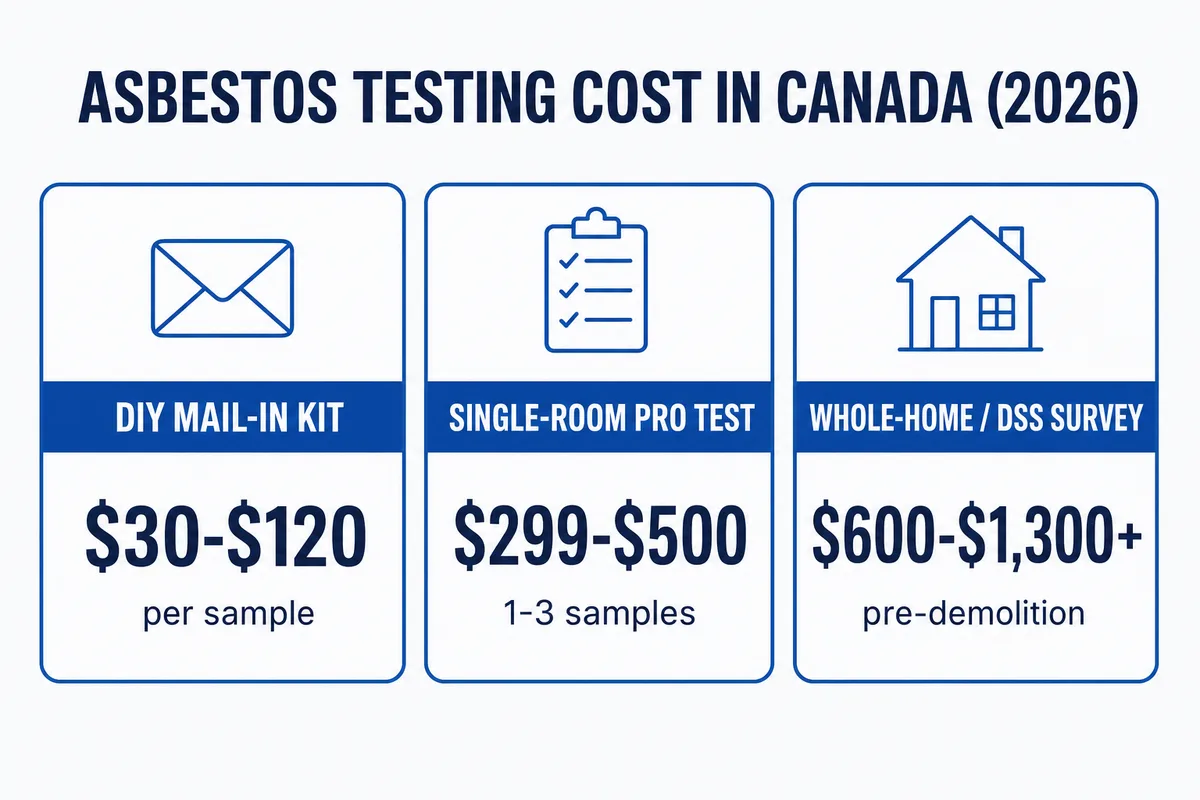
Professional asbestos testing in Canada typically costs $299 to $500 for a single-room inspection with one to three samples, while a DIY mail-in kit runs $30 to $120 per sample and a whole-home or designated substance survey runs $600 to $1,300+. The figure you’ll actually pay depends mostly on how many samples the lab has to analyze and how fast you need the results back.
Here’s how the three common tiers shake out:
| Tier | Typical cost (CAD) | What’s included | Best for |
|---|---|---|---|
| DIY mail-in kit | $30 to $120 per sample | Sampling bag, instructions, lab fee. You take the sample yourself. | One low-risk material you can safely reach, like a single floor tile |
| Single-room professional test | $299 to $500 | Certified inspector visit, 1 to 3 bulk samples, accredited PLM lab analysis, written report | A bathroom, kitchen, or basement reno; pipe wrap; a popcorn ceiling check |
| Whole-home or DSS survey | $600 to $1,300+ | Full property walk, multiple samples across material types, designated substance survey report | Pre-demolition, full gut renovations, real estate deals, workplace projects |
Quoted way over $1,300 for a standard house? Those ranges hold across most of Ontario and Quebec, where our inspectors work. If you’re not demolishing the whole thing and the number is far above this, get a second quote. We’ve seen some abatement-adjacent companies pad the testing line item to win the removal job later.
What affects the cost of asbestos testing?
Four things move the price more than anything else: the number of samples, the lab turnaround speed, how accessible the suspect material is, and whether you need air sampling on top of bulk samples. Get a handle on those and you can estimate your own bill within a hundred dollars or so.
Sample count is the big one. Each suspect material is its own homogeneous area, and the lab charges per sample analyzed (usually $40 to $80 each beyond what’s bundled into the base inspection fee). A single popcorn ceiling might be one sample. A 1960s home where the vinyl flooring, the ceiling texture, the pipe insulation, and the drywall joint compound all look suspect? That’s easily four or five.
Turnaround speed stacks on top. Standard lab analysis takes about three to five business days. Need it same-day because your contractor is standing in the driveway? Expect to pay roughly double the standard rate for a 24-hour rush. (Honestly, most renovations can absorb a three-day wait, and the standard rate saves real money.)
Then there’s access and travel. If our inspector has to pull a fixture, cut into a wall cavity, or work around finished surfaces to reach the material safely, that adds time. Distance from our Ottawa or Montreal base can factor in for rural properties too. And if your project needs air sampling for post-work clearance rather than just bulk material testing, that’s a separate line, typically $200 to $400 per area because it involves pumps, cassettes, and a different lab method.
Quick estimate: base single-room inspection ($299 to $500) + roughly $40 to $80 for each extra material beyond the first few + a rush multiplier if you can’t wait three to five business days. Air clearance, if needed, is a separate $200 to $400 per area.
Asbestos is one piece of a bigger picture. If you also want the broader numbers, see our guide to air quality testing cost in Canada.
DIY asbestos test kit vs professional testing: which is cheaper?
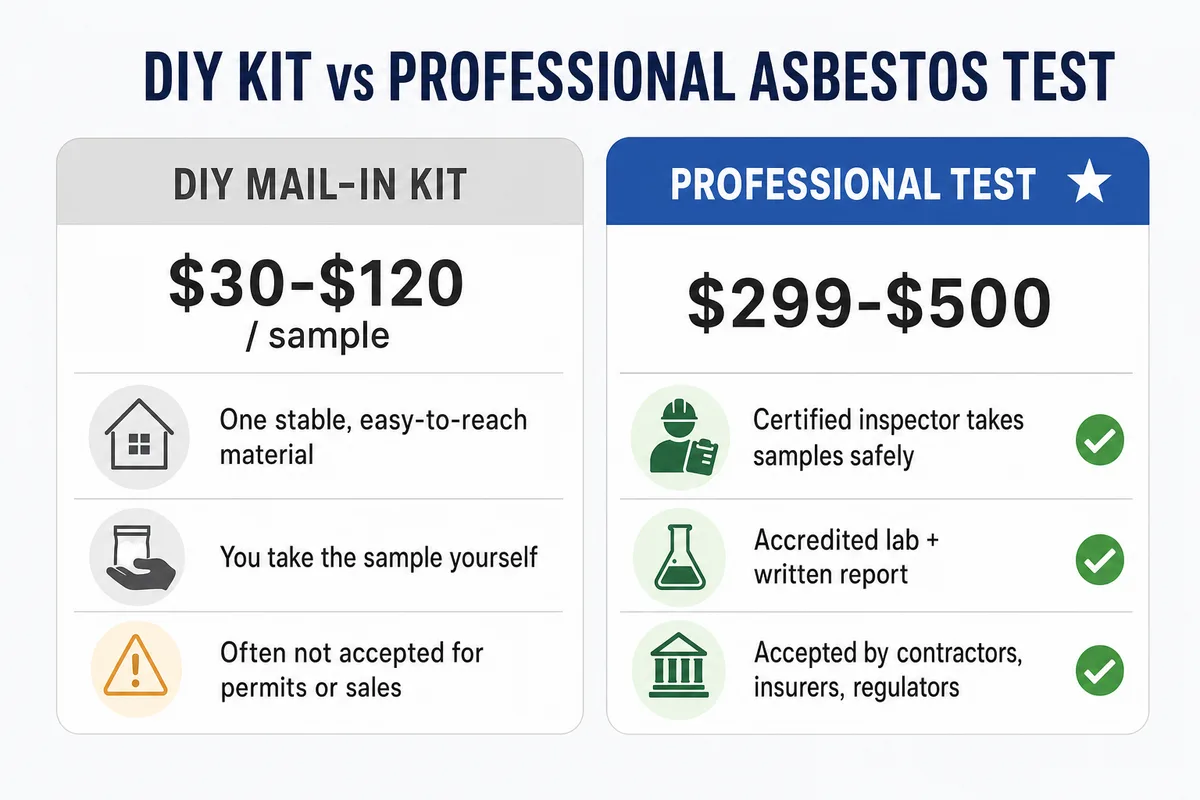
A DIY kit is cheaper upfront ($30 to $120 per sample versus $299+ for a pro), but it’s only the right call in a narrow set of situations, and choosing wrong can cost you far more than you saved. The kit covers the lab fee and a sampling bag. You do the actual sampling, which is exactly where it goes sideways.
🏠 DIY mail-in kit
$30 to $120 per sample. Fine for one stable, easy-to-reach material like a single floor tile. You take the sample and mail it to a lab.
The catch: a self-collected result often won’t be accepted by contractors, insurers, or regulators, because there’s no documented chain of custody and no certified sampler. And taking the sample means disturbing the material, which is how fibres get into the air.
🔬 Professional test
$299 to $500 for a single room. Certified inspector, safe sampling, accredited lab analysis, and a written report you can actually use for a permit, a sale, or an insurance claim.
For anything friable, anything overhead, or anything tied to a project, this is the cheaper path once you count the do-over you’d otherwise pay for.
Here’s the part most kit sellers won’t tell you. Snapping off a chunk of dry, friable pipe insulation in your basement with no containment, no respirator, and no wetting agent is genuinely riskier than leaving it alone. We’ve walked into homes where someone “just grabbed a piece” and unknowingly contaminated a room.
People search “asbestos test kit Canadian Tire” hoping for a quick fix, and for one stable, easy-to-reach floor tile, a kit can be fine. For anything friable, overhead, or tied to a permit or sale, a professional test is cheaper once you count the do-over. If you want a deeper read on what consumer kits can and can’t do, our guide to air quality testing kits lays it out.
Does asbestos testing cost more in Ontario or Quebec?
Base testing prices are similar across Ontario and Quebec, but the regulations differ enough to change which test you need, and that’s what actually shifts your total cost. The lab fee for a bulk sample is roughly the same in Ottawa as it is in Montreal. The difference shows up in the survey requirements and the paperwork.
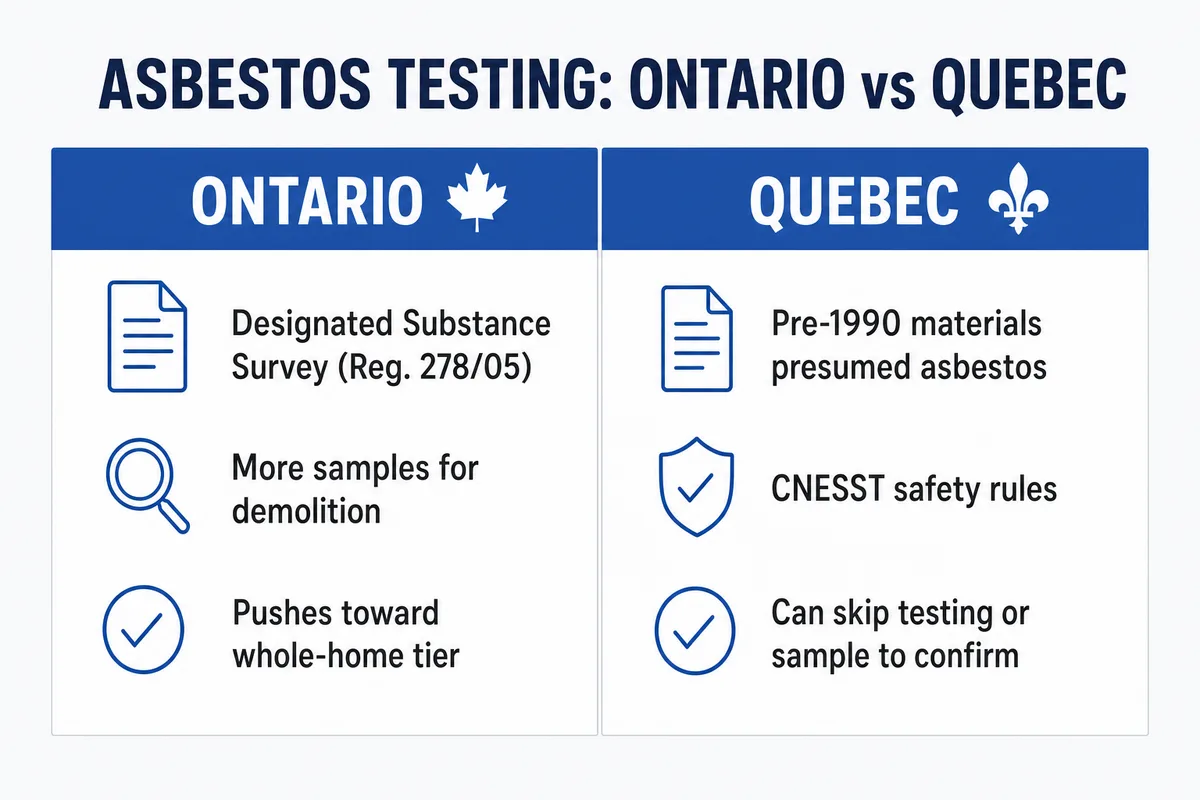
🏛️ Ontario
Pre-demolition and pre-renovation work on many properties triggers a designated substance survey under Ontario Regulation 278/05. That survey checks for asbestos across all the materials a project will disturb, which usually means more samples and a more detailed report, pushing you toward the $600 to $1,300+ tier rather than a quick single-room test.
Our Ottawa asbestos testing work runs into this constantly with older Centretown and Glebe homes.
⚜️ Quebec
Under the province’s safety regime (the Loi sur la santé et la sécurité du travail and CNESST rules), many materials in buildings from before 1990 are treated as presumed to contain asbestos unless testing proves otherwise. That presumption can save money in some cases, because a contractor may just handle the material as asbestos rather than pay to test it.
But to confirm before spending on abatement, you’re back to bulk sampling. Our Montreal asbestos testing page covers the Quebec rules and the West Island and South Shore areas we serve.
Either province, the smart move is a flat-rate quote up front so the regulatory layer doesn’t surprise you at invoice time.
What is the 3-5-7 rule for asbestos sampling?
The 3-5-7 rule is a sampling-count guideline that tells the inspector how many samples to collect from each material type so the lab result is statistically reliable, and it directly affects your cost because more required samples means a higher lab bill. It comes out of standard asbestos survey protocols, and most homeowners have never heard of it even though it shapes their quote.
3️⃣ Surfacing materials
At least 3 samples per homogeneous area. Think sprayed-on ceiling texture or popcorn ceilings.
5️⃣ Thermal system insulation
At least 5 samples. Pipe and boiler wrap, duct lagging, and similar insulation.
7️⃣ Miscellaneous materials
At least 7 samples for larger areas. Floor tile, drywall, and roofing materials.
A small, uniform area won’t always hit the upper counts, and a good inspector uses judgment rather than blindly maxing out every category. But this is why a house with several suspect material types can need a dozen or more samples, and why “just test the ceiling for thirty bucks” rarely reflects what a defensible survey actually requires. If you want to understand the lab side of this, our overview of different types of air quality samplers covers the equipment behind the counts.
Is asbestos testing worth the cost?
For homes built before 1990 where you’re about to renovate, sell, or demolish, yes, testing is almost always worth it, because the cost of testing is trivial next to the cost of an asbestos exposure or a stop-work order mid-project. A few hundred dollars now versus a contaminated job site later isn’t a close call.
A large share of Canadian homes built between roughly 1950 and 1990 contain at least one asbestos-containing material, and asbestos exposure is still linked to hundreds of deaths a year in this country. That’s not a scare tactic, it’s the reason the rules exist. The practical risk for most homeowners isn’t dramatic, though. It’s the renovation that gets halted because a contractor spots suspect material and won’t touch it without a clearance report, or the sale that stalls because a buyer’s inspector flags an untested popcorn ceiling.
Testing before you start turns an unknown into a line item you can plan around. If you’re weighing a broader assessment, it’s worth understanding why indoor air quality testing matters and how asbestos fits into the bigger picture of what’s in your air.
What’s included in a professional asbestos test, and how long does it take?
A professional asbestos test includes an on-site visit by a certified inspector, careful sampling of suspect materials, accredited lab analysis (usually PLM), and a written report you can hand to a contractor, insurer, or regulator. The on-site portion for a single room typically takes 30 to 60 minutes; the lab results follow in three to five business days unless you’ve paid for a rush.
- On-site visit by an IICRC and IAQA certified inspector
- Safe bulk sampling following regulatory protocols
- Accredited lab analysis (polarized light microscopy)
- Written report with location, condition, and your options
- Same-day reporting available when the timeline is tight
What you’re really paying for, beyond the lab number, is the chain of custody and the interpretation. Across 15,000-plus inspections we’ve learned that the report matters as much as the result. A bare lab sheet saying “chrysotile detected” doesn’t tell you what to do next. A proper report identifies where the material is, whether it’s friable, what condition it’s in, and what your options are, so you can decide between encapsulation, abatement, or simply leaving an intact material alone.
“That last option surprises people. Intact, undisturbed asbestos is often safest left in place. After 20 years and more than 15,000 inspections, we’d rather tell a homeowner to leave a sealed floor alone than sell them a removal they don’t need.”
Air Quality Testing Canada, IICRC and IAQA Certified Inspectors
If you want the full service breakdown and to book, the asbestos testing page has it, and you can see where we test across Ontario and Quebec.
Asbestos testing cost vs asbestos removal cost: what’s the difference?
Testing and removal are two separate jobs with very different price tags, and people searching “asbestos cost” often conflate them. Testing confirms whether asbestos is present and runs from $30 to about $1,300 as covered above. Removal, also called abatement, is the controlled work of taking the material out, and it costs far more.
Testing: $30 to $1,300+ (the decision-making purchase).
Removal / abatement: varies widely; attic vermiculite removal commonly runs $5,000 to $12,000+ depending on volume and access. Project-specific, quoted by the abatement contractor.
We don’t quote removal pricing here because it’s genuinely project-specific, but the key point is that testing is the cheap, smart first step. You test to find out whether you even need removal. Skipping the test and assuming the worst can mean paying for abatement you didn’t need; skipping it and assuming the best can mean a contaminated demolition. Either way, the few hundred dollars for testing is the decision-making purchase, not the expensive one.
How do I get an accurate asbestos testing quote?
The fastest way to a reliable price is a flat-rate phone quote based on your specific property, the year it was built, and what you’re planning to disturb. Call us at 1-866-528-2897, Monday to Friday, 8:00 AM to 3:00 PM, and we’ll give you a number before anyone schedules a visit.
A good quote starts with a few questions: how old is the building, what’s the project (a single bathroom or a full gut), which materials look suspect, and how fast you need results. From there we can tell you whether you’re looking at a single-room test or a designated substance survey, roughly how many samples it’ll take, and what the all-in cost will be. We serve Ottawa, Montreal, Gatineau, Kingston, and the surrounding regions, with same-day reporting available when the timeline is tight. No guesswork, no surprise line items at the end. Just a clear number and a written report you can actually use.
Asbestos testing cost: frequently asked questions
Checking for asbestos costs about $30 to $120 per sample with a DIY mail-in kit, $299 to $500 for a single-room professional inspection (1 to 3 samples), or $600 to $1,300+ for a whole-home or designated substance survey. The number of samples and the lab turnaround speed are the biggest factors.
It’s a guideline for how many samples to take from each material type: at least 3 for surfacing materials (like popcorn ceilings), 5 for thermal system insulation (pipe and boiler wrap), and 7 for miscellaneous materials (floor tile, drywall, roofing) in larger areas. More required samples means a higher lab bill.
For one stable, easy-to-reach material like a single floor tile, a kit can be fine. For anything friable, overhead, or tied to a permit, sale, or insurance claim, it usually isn’t, because self-collected results often aren’t accepted without a certified sampler and chain of custody, and taking the sample yourself can release fibres into the air.
Base lab fees are similar, but the rules differ. Ontario projects often trigger a designated substance survey (Reg. 278/05) that needs more samples. Quebec treats many pre-1990 materials as presumed asbestos under CNESST rules, which can change whether you test at all. Both shift your total cost more than the per-sample price does.
No. Testing confirms whether asbestos is present ($30 to $1,300+) and is the smart first step. Removal, or abatement, is the controlled work of taking the material out and costs far more (attic vermiculite removal alone commonly runs $5,000 to $12,000+). You test first to find out whether removal is even necessary.
The on-site visit for a single room takes about 30 to 60 minutes. Standard lab analysis returns in three to five business days, with same-day or 24-hour rush available for roughly double the standard rate.