
Different Types of Air Quality Samplers: Which One Answers Your Question?
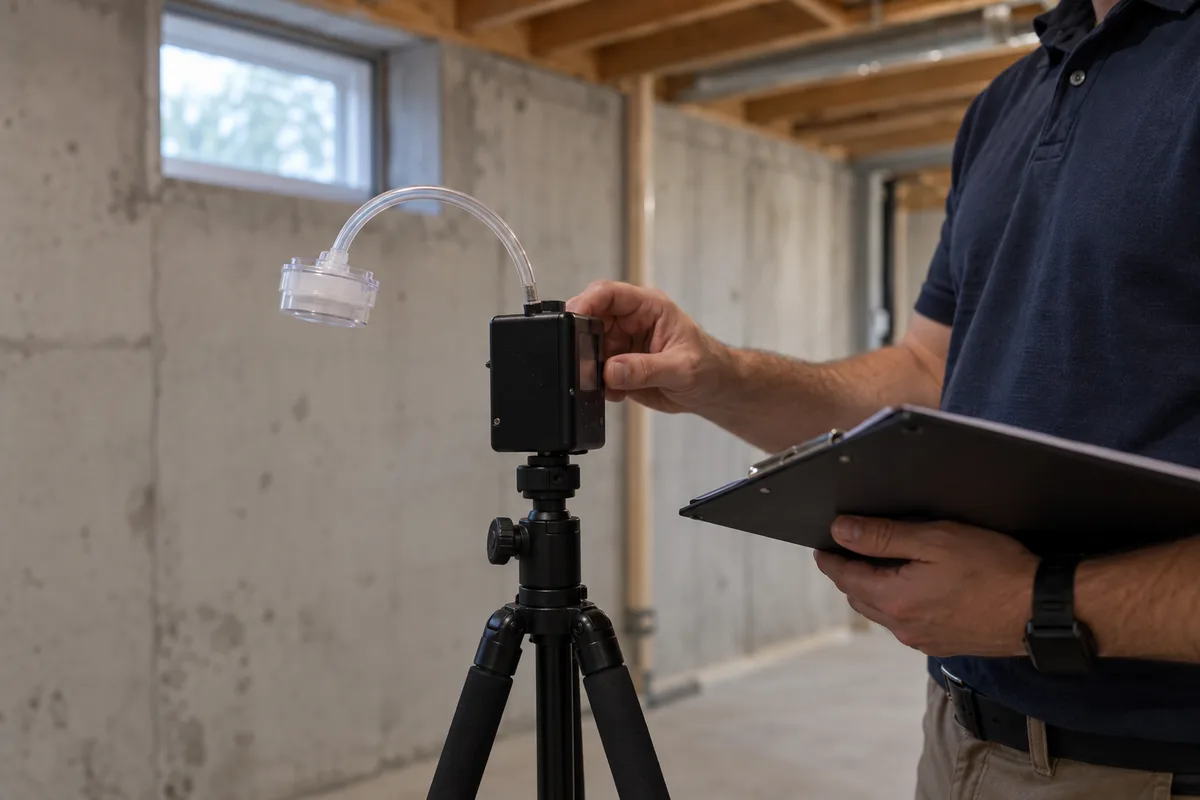
The main air quality samplers are spore traps, culture plate impactors, filter cassettes, sorbent tubes and passive samplers such as settle plates and diffusion badges. Each one answers a different question, and none of them answers all of them. If you've got a musty smell or a stain and someone has offered you "an air test", you're probably picturing one machine that reads everything.
That machine doesn't exist. The sampler decides what a test can prove, so the useful first step is working out what you need to know. Our plan on a visit is short: match the method to the question, collect a measured sample, take an outdoor control for mould work, and send it all to an accredited lab.
| Sampler | How it collects | What you get back | What it can't tell you |
|---|---|---|---|
| Spore trap | A pump pulls a measured volume of air across a sticky slide | Spores per cubic metre, counted under a microscope | Whether those spores were alive |
| Culture plate (impactor) | A pump pushes air onto a growth plate | Colony-forming units per cubic metre (CFU/m3), down to species | Anything dead, or anything that won't grow on that plate |
| Filter cassette | A pump draws air through a fine filter | A fibre count (PCM) or identified asbestos fibres (TEM) | PCM alone can't separate asbestos from other fibres |
| Sorbent tube | A pump draws air through a tube of absorbent material | Named chemicals, measured by the lab | Anything the lab wasn't asked to look for |
| Settle plate | An open dish catches whatever falls on it | Colonies on a dish | How much mould is in a given volume of air |
| Diffusion badge | No pump; a gas drifts onto a collector over hours or days | An average for one target chemical | Short spikes during that time |
| Direct-reading monitor | A built-in sensor, with no lab involved | A live number on a screen | What the particle or gas actually is |
What's the difference between active and passive air sampling?
Active samplers use a pump to pull a known volume of air, so the lab can report a concentration. Passive samplers wait for particles or gases to reach them, so time and air movement shape the result too.
A common spore trap cassette, the Air-O-Cell, runs at 15 litres per minute. Ten minutes on that pump is 150 litres of air, about what a shallow bath holds. Because the lab knows that figure, it can turn a slide count into spores per cubic metre.
Passive sampler
Waits for the air to come to it
- Needs no pump or power
- Diffusion badges suit one known chemical over hours or days
- Settle plates have no air volume to work from
Active sampler
Measures a known amount of air
- A calibrated pump sets the volume
- Minutes of sampling, not days, for most mould work
- The lab can report a concentration you can compare
Our take: for a mould or asbestos question in a building, an active sample is what gives you a number you can put next to something else.
Why would a spore trap count mould that a culture plate misses?
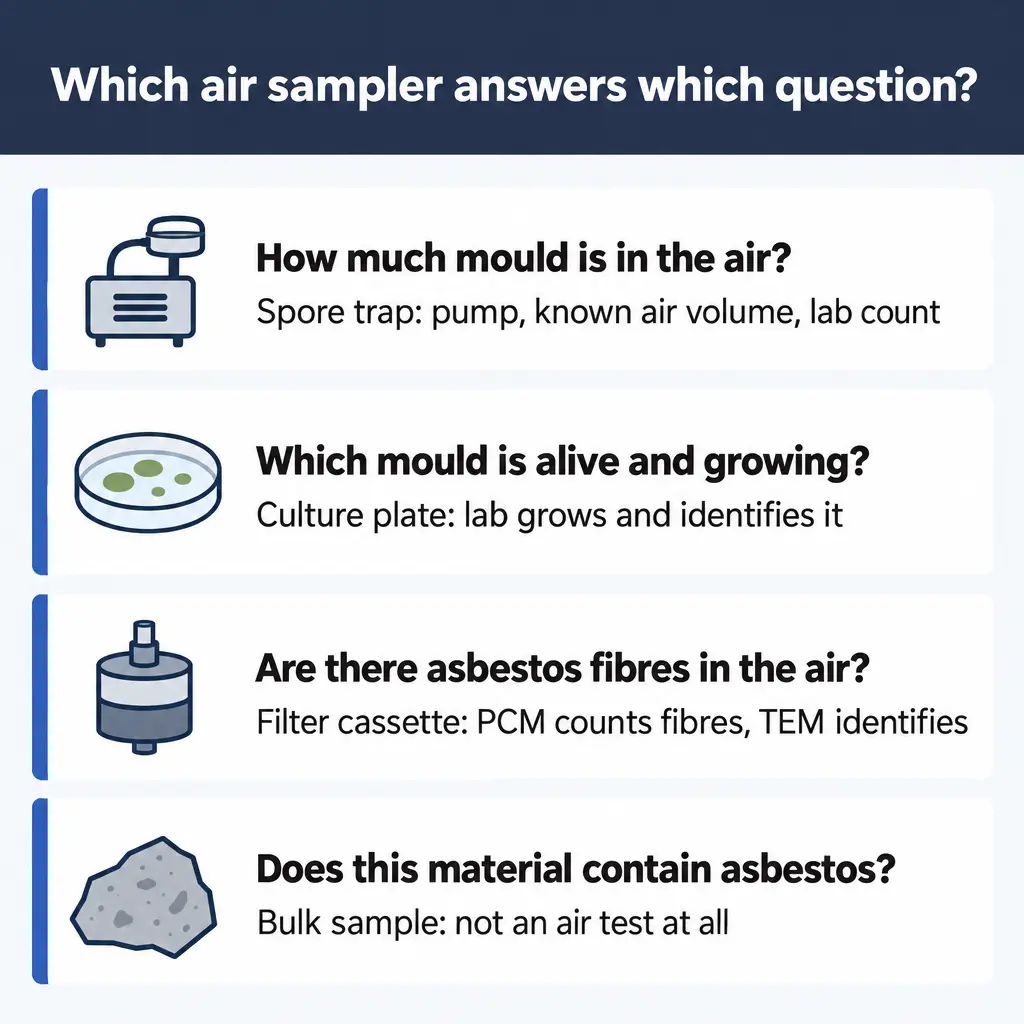
A spore trap counts every spore on the slide, dead or alive. A culture plate only shows what grows, so dead spores never appear on it. A spore trap can't assess viability, so it can't say whether a spore was alive.
So each one earns its place. The spore trap is our everyday tool for airborne mould because it gives a fast total count. Culture sampling comes out when you need to know which mould is present, right down to the species. Our inspection process explains how those samples fit into a visit.
But neither number means much alone. Outdoor air is full of spores, so the indoor count only makes sense next to an outdoor control taken the same day. When the indoor count is clearly higher than outdoors, or the mix of types looks different, we flag it. Our guide to reading air quality test results walks through that comparison.
So why can't a hardware-store petri dish do the same job?
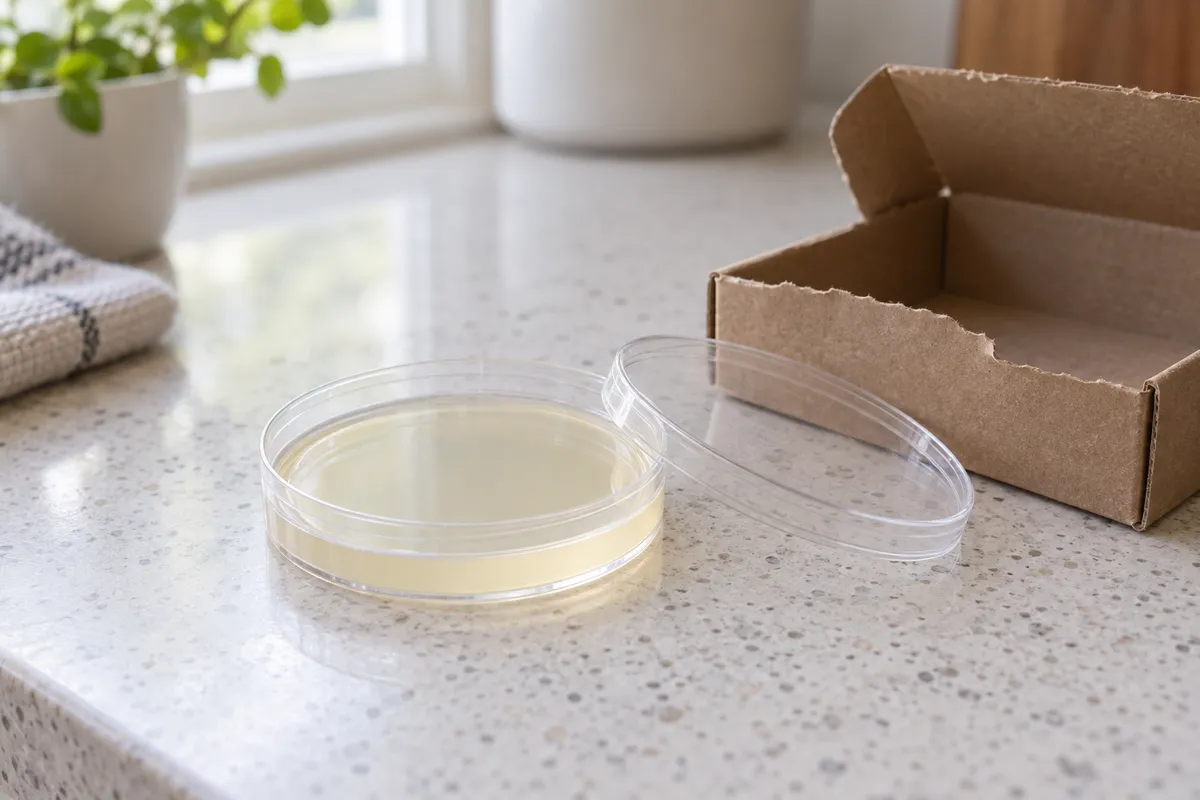
A petri dish kit is a settle plate, and a settle plate has no pump, so nobody knows how much air it sampled. The colonies depend on how long you left it open, where you put it and how the air moved that day. Lighter spores can also stay aloft while heavier ones drop into the dish.
Honestly, a dish that grows something tells you spores exist, which was never in doubt. Settle plates do have a use where staff compare plates over time under the same conditions, but a single dish on a kitchen counter has nothing to compare against. Our review of air quality test kits covers which consumer products are worth the money.
Myth Mould grew on my test dish, so my house has a mould problem.
Fact Spores are normal in indoor air. Growth on a dish shows they landed there. It says nothing about whether the amount is unusual.
Myth An air test is always the right first step.
Fact Health Canada says that in most situations it does not recommend testing the air for mould. If you can see the growth and you know where the water came from, fix the water first. An air sample earns its cost when the source is hidden or unexplained.
Which sampler is used for asbestos in the air?
A filter cassette is the air sampler for asbestos. A pump draws air through a fine filter and a lab examines what it caught, using one of two methods.
PCM counts fibres
Phase contrast microscopy gives a fibre count. NIOSH Method 7400 can't tell asbestos apart from other fibres, such as fibreglass.
TEM identifies them
Transmission electron microscopy, under NIOSH Method 7402, is the confirming step when you need to know whether the fibres counted are asbestos.
But an air sampler usually isn't where an asbestos question starts. If you want to know whether a ceiling, a floor tile or a pipe wrap contains asbestos, the lab needs a small piece of that material, and that's a bulk sample. Air sampling is more often the check after asbestos work, to confirm the space is ready to use again. Our asbestos testing service covers both.
Where do sorbent tubes and diffusion badges fit?
Sorbent tubes and diffusion badges sample chemical vapours, not particles. A tube needs a pump and goes to a lab for analysis. A badge needs no power and gets worn or hung for hours or days, which is why it shows up in workplace exposure studies.
Those are specialist tools, and a mould or asbestos inspection in a house rarely needs them. If a smell is what's bothering you, start by finding its source. Our odour inspection traces where a lingering smell is coming from before anyone reaches for a sampler.
Can a direct-reading monitor replace a lab sample?
No. A direct-reading monitor gives you a number from a sensor, and a number can't name the mould, the fibre or the chemical behind it. Monitors are good at showing change: humidity climbing in a basement, or particles rising while someone sands a wall.
We take humidity readings on every walkthrough for that reason, and we won't pretend a handheld number is a diagnosis. For the equipment itself, see our guides to particle counters and data loggers versus consumer monitors.
What any sample can't do: an air sample is a short look at one spot on one day. A clean result doesn't clear a wall nobody sampled, and more samples aren't automatically better if they don't answer your question.
How do our inspectors choose the sampler on a real visit?
Our inspectors choose the sampler after the walkthrough, because the building usually narrows the question. We've done this more than 15,000 times since 2005, working to the IICRC S520 standard for mould assessment and sending samples to an accredited third-party lab.
-
1
Before the visit
You tell us what you're trying to find out
A smell, a stain, a renovation or a home purchase each point to a different sample.
-
2
On site
We walk the building and take moisture readings first
That tells us where a sample will say something useful. A typical home takes about one to two hours.
-
3
On site
We collect the samples the question calls for
For mould air work, that includes an outdoor control the same day. Suspect materials get a bulk sample instead.
-
4
Usually the same day
You get a written report on what we found on site
It covers the walkthrough, the readings and where each sample came from.
-
5
3 to 5 business days for mould and asbestos bulk
The lab results come back with what they mean
Every result sits next to its location and its comparison, with recommendations in order of priority.
Frequently asked questions about air samplers
A spore trap often runs about 5 to 10 minutes indoors at 15 litres per minute, and less in a dusty room so the slide doesn't overload. The whole home visit takes about one to two hours, because the walkthrough decides where samples go. See our inspection process.
A non-viable sample, such as a spore trap, counts every spore, dead or alive. A viable sample grows what's alive on a plate, so the lab can name the species but misses anything dead. Neither result means much without an outdoor control. See how our mould testing works.
Settle plates give a simple fallout check, usually in controlled places where staff compare plates over time under the same conditions. In a house there's no baseline and no measured air volume, so one dish can't tell you whether the amount is unusual. Read how to choose a test kit.
Yes, when the questions differ. A spore trap and a culture plate can answer separate parts of a mould question on the same visit, and suspect building materials get a bulk sample as well. More samples only help if each one answers something you need to know. See our residential air quality testing.
Know what you're asking before anyone runs a pump
Tell us what's worrying you. We'll say which sample answers it, or whether you need one at all. Call 1-866-528-2897, any time, 24/7. Inspections run Monday to Friday, 8 AM to 5 PM.