June 18, 2026
How Much Does Air Quality Testing Cost in Canada?
A couple in Kanata called us in March after their toddler’s cough wouldn’t quit through the winter. They’d already bought a $250 monitor that kept flashing red, and they wanted to know the same thing almost everyone asks first: what’s a real air quality test going to run us? Fair question. The honest answer starts with “it depends,” which nobody loves to hear, so let’s put actual numbers on it.
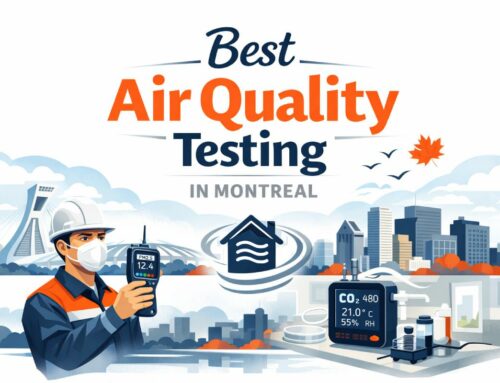
Professional air quality testing in Canada usually lands between $300 and $700 for a home, with a single-room spot check on the lower end and a whole-home assessment toward the top. A consumer monitor or DIY mail-in kit costs far less, $30 to $400, but it answers a different question than a professional test does. Below we break down every tier, what actually moves the number on your invoice, how Ontario and Quebec compare, and when paying for a test is genuinely worth it versus when a cheap sensor will do.
How much does air quality testing cost in Canada?
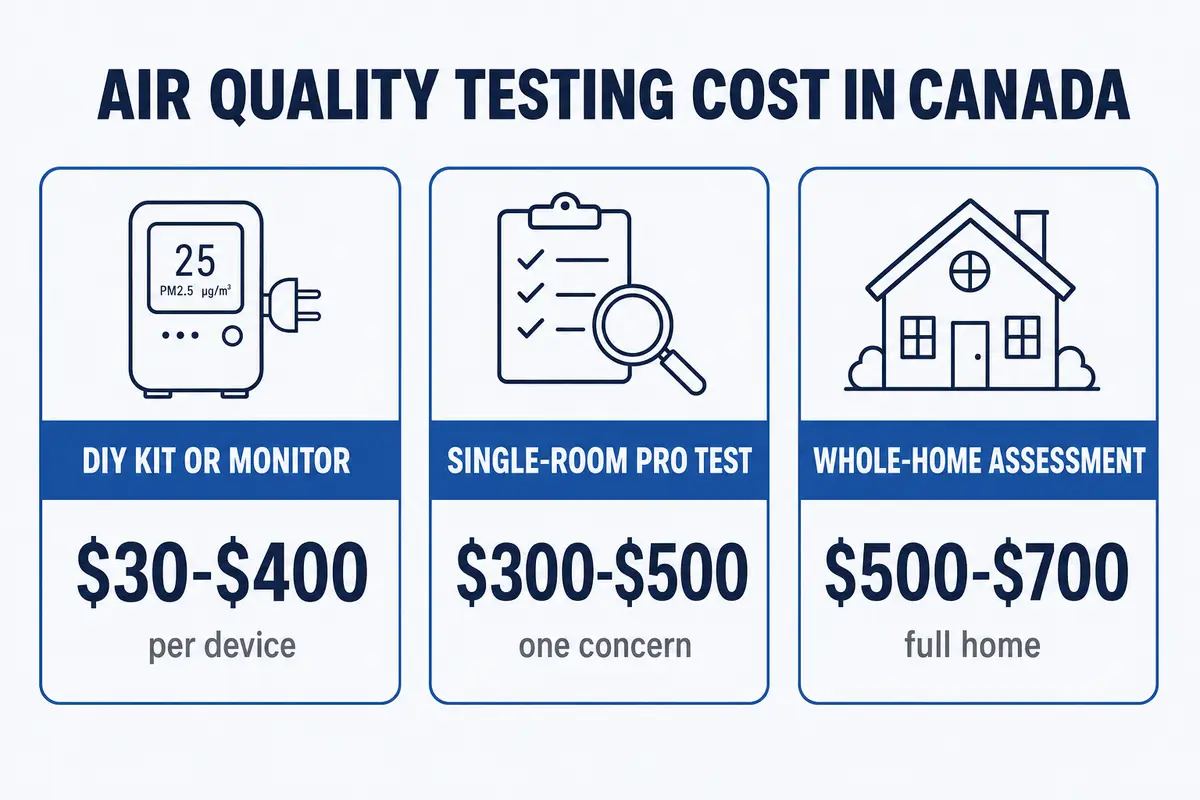
Professional indoor air quality testing in Canada typically costs $300 to $700 for a home, depending on how many rooms and contaminants you need checked. A single-room or single-issue test sits at the $300 to $500 end, a full whole-home assessment runs toward $700, and a DIY kit or consumer monitor costs $30 to $400. What you actually pay comes down mostly to how many samples the lab has to analyze and how fast you need the results.
Here’s how the common tiers shake out:
| Tier | Typical cost (CAD) | What’s included | Best for |
|---|---|---|---|
| DIY kit or consumer monitor | $30 to $400 | A mail-in lab sample, or a plug-in monitor you keep (Airthings, uHoo, Awair) | Tracking humidity and trends over time, a quick one-room reading |
| Single-room or single-issue test | $300 to $500 | Certified inspector visit, sampling for one concern, accredited lab analysis, written report | One problem room, a post-leak spot check, a musty smell you can’t place |
| Whole-home assessment | $500 to $700 | Full walk-through, multiple samples across the home, lab analysis, detailed report | Real estate deals, post-flood checks, multi-room or recurring symptoms |
Quoted well over $700 for a standard house? Those ranges hold across most of Ontario and Quebec, where our inspectors work. Ask what’s driving it. Sometimes it’s a legitimate multi-contaminant panel, and sometimes it’s padding. We’ve seen a few remediation-first companies inflate the testing line to lock in the cleanup job later.
What affects the cost of an air quality test?
Four things move the price more than anything else: the number of samples, the lab turnaround speed, the size and layout of the property, and whether you’re chasing one specific problem or a broad panel. Get a feel for those and you can estimate your own bill within about a hundred dollars.
Sample count is the big lever. Each contaminant the lab analyzes is its own line, and bulk or air samples usually run $40 to $80 each beyond what’s bundled into the base inspection fee. Testing a single basement for mold after a leak might mean one or two samples. A whole house where you want mold, plus particulate, plus a general air panel? That’s easily four or five, and the total climbs with each one.
Turnaround stacks on top. Standard lab analysis takes about three to seven business days. Need it back same-day because a closing date is bearing down? Expect to pay roughly double for a rush. Honestly, most situations can absorb a few days’ wait, and the standard rate saves real money.
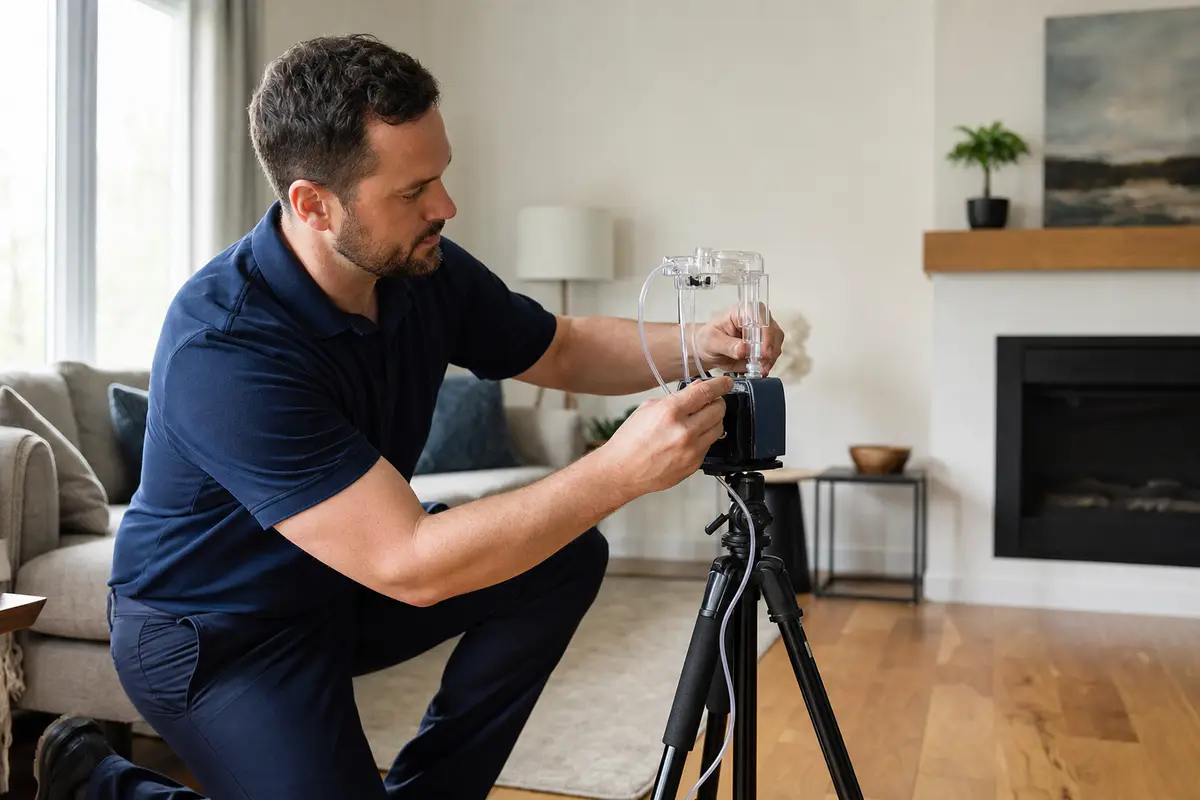
Then there’s the property itself. A 900 square foot condo with one concern is quick. A 3,000 square foot home with a finished basement, multiple HVAC zones, and a crawlspace takes longer to walk, sample, and write up, so it costs more. Access matters too. If our inspector has to pull a vent cover or work around finished surfaces to sample properly, that’s time on the clock. For a sense of what tools actually go into a visit, our overview of the different types of air quality samplers shows why a thorough test isn’t just one gadget waved around a room.
Quick estimate: base single-room test ($300 to $500) + roughly $40 to $80 for each extra contaminant or room beyond the first + a rush multiplier if you can’t wait three to seven business days. A full whole-home panel lands toward $700.
DIY air quality test kit vs professional testing: which is cheaper?
A DIY kit or consumer monitor is cheaper upfront ($30 to $400 versus $300+ for a pro test), but it answers a narrower question, and treating it as a full test is where people get burned. The cheap option is great for one job and weak at another, so the real question isn’t price, it’s what you actually need to know.
🏠 DIY kit or consumer monitor
$30 to $400. Great for tracking humidity, particulate, and trends in your own home around the clock. Units like Airthings or Awair have genuinely improved.
The catch: the sensors drift over time, and there’s no certified sampler, no chain of custody, and no signed report. It can’t tell you what species of mold is behind the drywall.
🔬 Professional test
$300 to $700. Certified inspector, sampling matched to your concern, accredited lab analysis, and a written report you can use for a sale, a claim, or a health complaint.
For anything tied to a transaction, an insurer, or hidden mold, this is the cheaper path once you count the do-over you’d otherwise pay for.
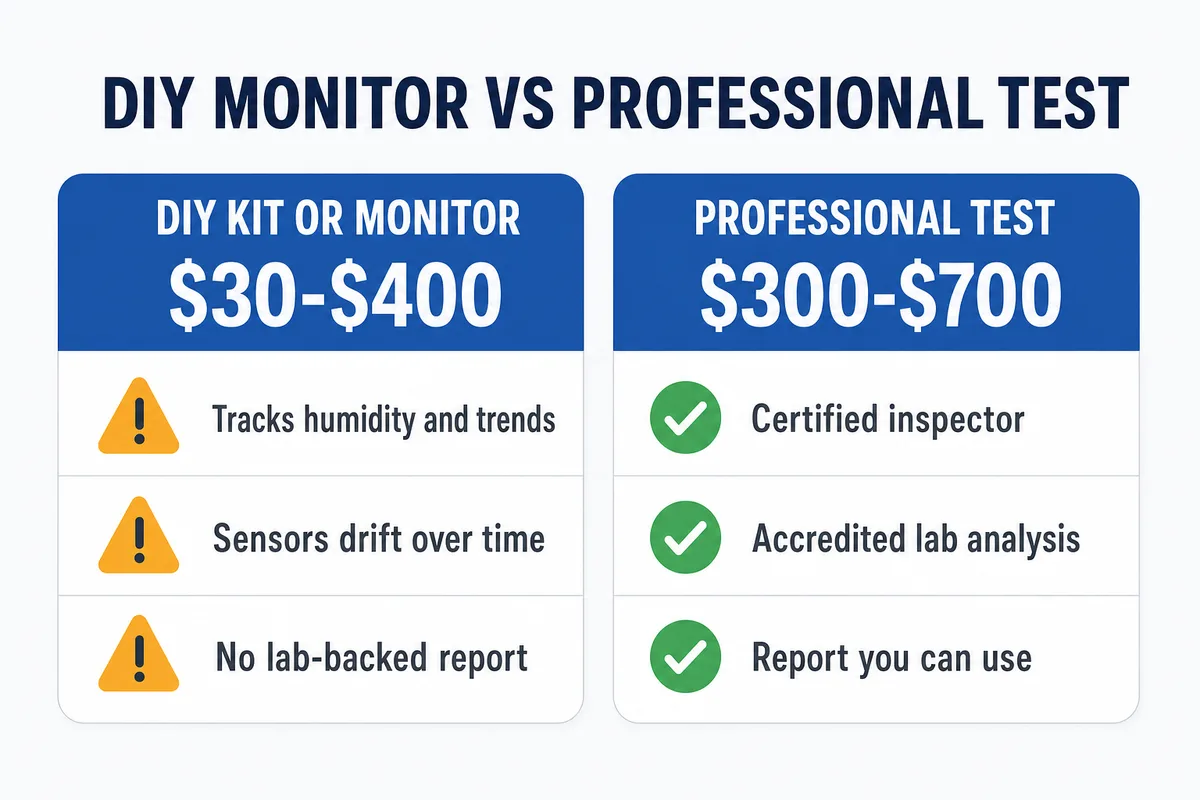
For ongoing daily readings in your own home, a $200 to $400 monitor is usually worth it. For anything tied to a sale, a claim, a health complaint, or hidden mold, a professional test is the cheaper path once you count the do-over. Our guide to the best air quality testing kits walks through which consumer tools are worth buying and which aren’t.
Does air quality testing cost more in Ontario or Quebec?
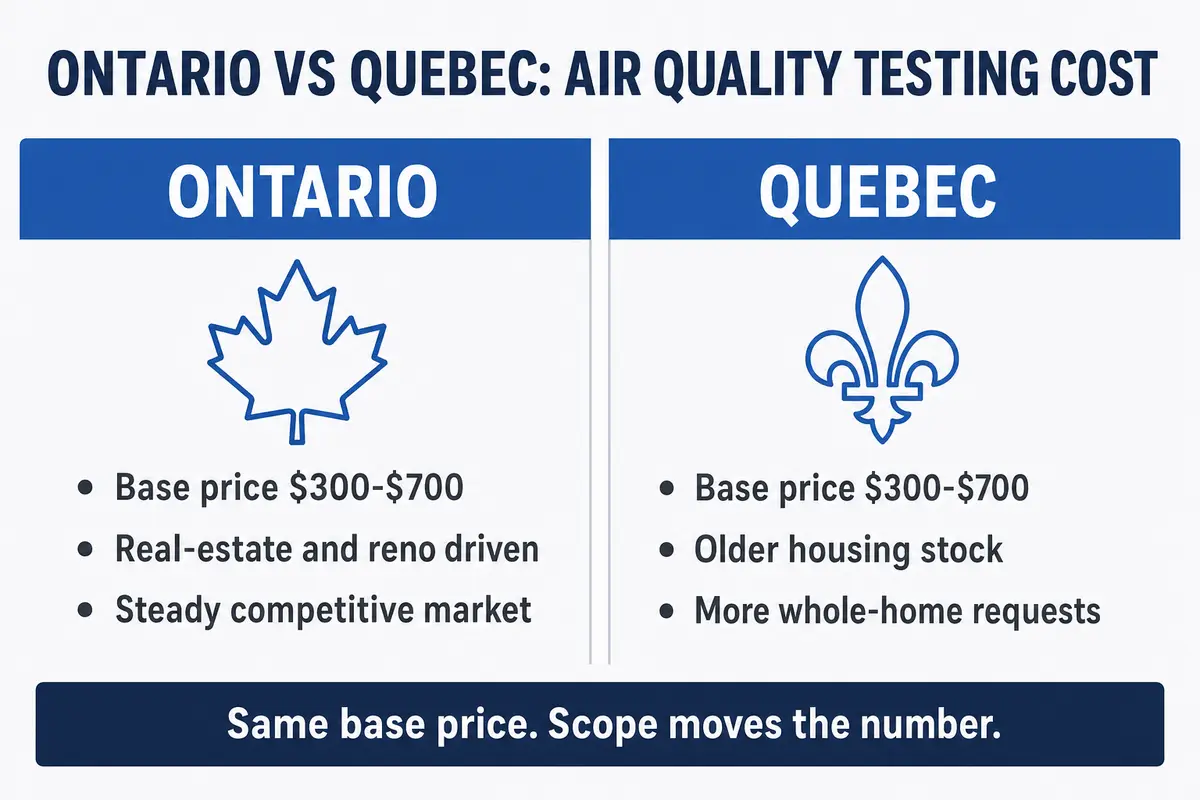
The base price of an air quality test is roughly the same in Ontario and Quebec, usually that $300 to $700 band, but the surrounding context can shift your total. Province lines don’t change what a lab charges to analyze a sample. What changes is the kind of project that tends to trigger a test, and how local rules and market rates shape the quote.
🏛️ Ontario
A lot of testing rides alongside real estate and renovation work, especially in the Ottawa and Kingston markets we serve. Demand is steady, the inspector pool is competitive, and a straightforward residential test stays in the typical range.
Our Ottawa air quality testing work sees a lot of pre-purchase and post-reno checks.
⚜️ Quebec
Around Montreal and Gatineau, older housing stock and a busier renovation scene mean more whole-home and multi-contaminant requests, which sit at the higher end simply because there’s more to sample.
Our Montreal air quality testing page covers the neighbourhoods and the West Island areas we serve.
So if you’re comparing a quote in Ottawa against one in Montreal, don’t assume a higher Montreal number means someone’s overcharging. It often means a bigger scope. Ask both inspectors to list exactly what they’re sampling and how many lab analyses are included, then compare line for line.
How much does mold testing or inspection cost?
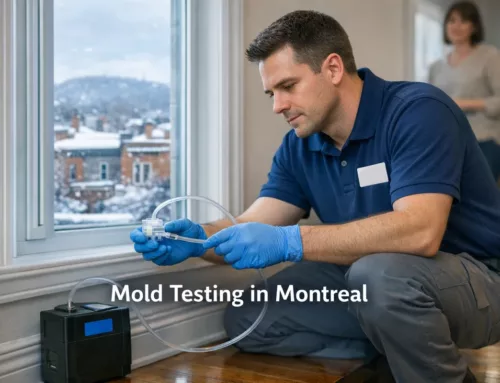
Mold testing in Canada usually runs $300 to $600 or more, with a basic inspection on the lower end and lab-confirmed air or surface sampling pushing it up. A visual mold inspection alone is the cheapest step. The moment you add lab samples, whether air spore traps or surface swabs, you’re paying per sample on top of the inspection fee, and that’s what moves a mold job from a few hundred dollars toward the higher end.
Most homeowners call us about mold after they smell something musty, spot a stain, or finish cleaning up a leak and want to be sure it’s actually gone. A single-room mold check with one air sample lands near the bottom of the range. A whole-home assessment after a basement flood, with samples in several rooms plus an outdoor control, costs more because there’s simply more to analyze. The lab fee per sample is the same line item that drives every other kind of air quality test.
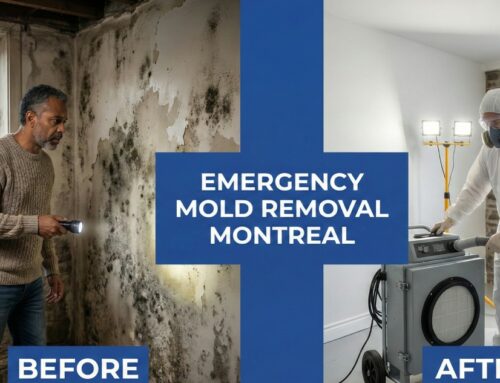
Testing is not removal. A mold test tells you whether you have a problem and how bad it is. It doesn’t clean anything up, anywhere. We’ve had callers assume the test price included removal, and it doesn’t. Testing is the diagnostic step that tells a remediation crew exactly what to target, which usually saves money on the removal because nobody’s guessing.
If mold is your main worry, our mold testing page covers how a visit works and what the report tells you.
What about asbestos testing cost?
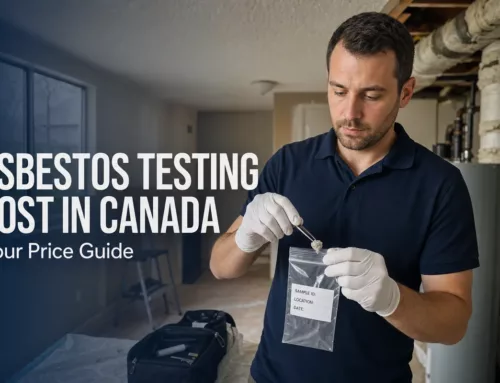
Asbestos testing is priced separately from a general air quality test, and it follows its own logic because the sampling and lab method are different. It commonly runs from about $30 for a single DIY mail-in sample up to $1,300 or more for a full pre-demolition survey, with most renovation-driven tests landing in the few-hundred-dollar middle.
If you’re planning a reno on an older home, especially anything involving popcorn ceilings, old floor tile, or pipe insulation, asbestos is worth ruling out before the demo starts. Rather than repeat all of it here, we’ve put the full breakdown, including the Ontario versus Quebec rules and the sampling-count math, in our dedicated guide to asbestos testing cost in Canada.
Is air quality testing worth the cost?
Air quality testing is worth the cost when you have a specific reason to test, like symptoms, a real estate deal, a recent flood, or a smell you can’t track down. It’s not worth several hundred dollars if you’re just curious and feeling fine, where a $40 to $200 monitor will tell you plenty. The value isn’t in the test itself, it’s in the decision it lets you make.
Think about where a lab-backed result actually changes something. A family with a kid whose asthma flares only at home, and never at school, has a real question worth answering. A buyer about to spend half a million dollars on a house with a finished basement has a reason to know what’s in the air before closing. Someone who just dried out a flooded rec room wants proof the mold didn’t take hold. In those cases, $300 to $700 is cheap next to the cost of guessing wrong. We’ve laid out the full case in our piece on why you should get indoor air quality testing.
Now the contrarian bit, because not every situation needs us. If you have no symptoms, no moisture history, and no transaction on the table, and you just want peace of mind, a good consumer monitor is the smarter buy. It runs around the clock for the price of a single professional sample. Spending hundreds on a one-time professional test to confirm what a $150 monitor would tell you for months is, in our honest opinion, money you don’t need to spend yet.
What’s included in a professional air quality test, and how long does it take?
A professional air quality test includes an on-site inspection, sampling for the contaminants in scope, accredited lab analysis, and a written report you can act on, all for that typical $300 to $700. The on-site portion takes roughly 30 to 90 minutes depending on the size of the home, and lab results come back in three to seven business days, with a rush option if you’re against a deadline.
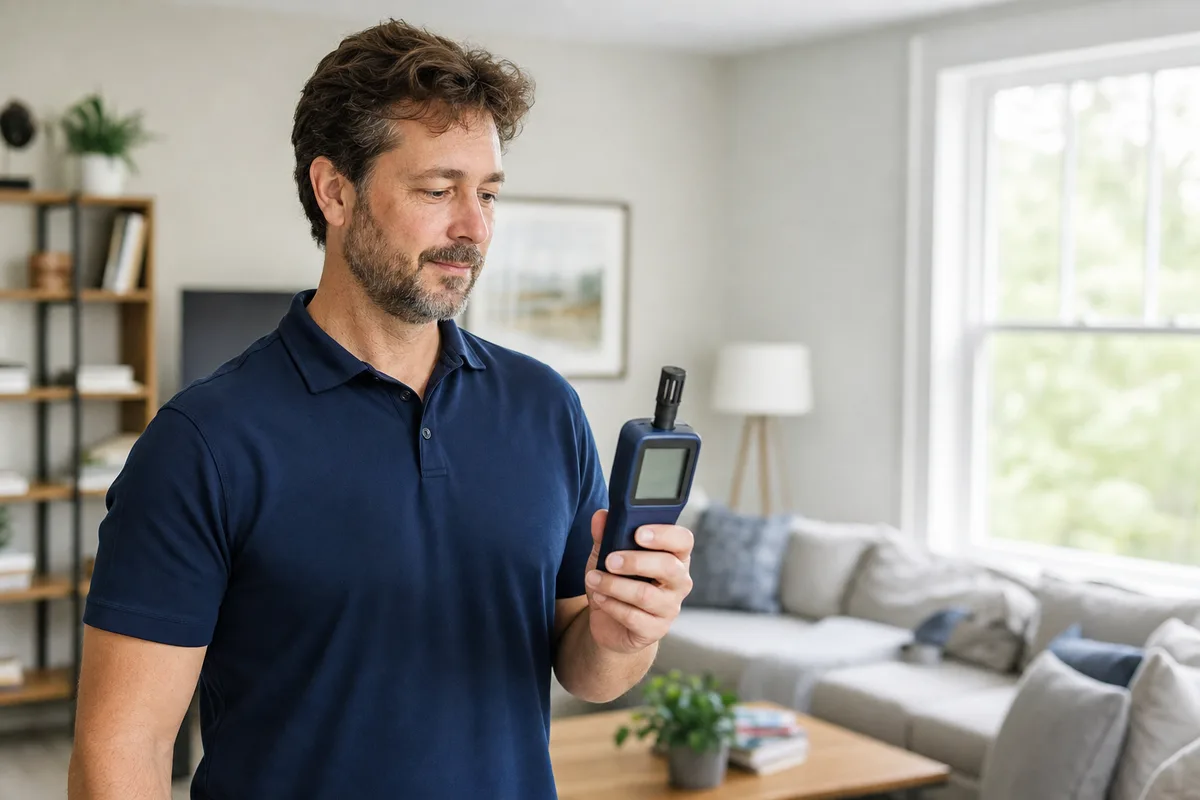
When our inspector arrives, the visit starts with a walk-through and a conversation about what prompted the call. Then comes the sampling, which might be air spore traps, surface swabs, particulate readings, or a combination, chosen to match your actual concern rather than a one-size template. Every sample is logged with a documented chain of custody and sent to an accredited lab, which is exactly what makes the result usable for a claim or a sale. After 20 years and more than 15,000 inspections, our crews have learned that the report is where the money is: a clear, plain-language document that says what we found, what it means, and what to do next.
That report is the deliverable you’re really paying for. A pile of raw numbers helps nobody. An IICRC and IAQA certified inspector reading those numbers in the context of your home, your symptoms, and the season is what turns a lab printout into a decision. That’s the same standard whether we’re testing a single room or a whole house.
Does commercial air quality testing cost more than residential?
Commercial air quality testing usually costs more than a residential test, typically $300 to $1,500 per visit, because commercial spaces are bigger, have more zones, and often carry compliance requirements a home doesn’t. A small single-floor office checking one or two concerns lands near $300 to $500, close to a residential job. A multi-floor building needing a full contaminant panel runs $900 to $1,500.
The jump isn’t arbitrary. A 1,200 square foot office with one mold worry is barely different from testing a house. But a three-storey building with multiple HVAC systems, dozens of occupants, and a landlord-tenant dispute in the background means more sampling points, more lab analyses, and sometimes after-hours scheduling so we’re not disrupting the workday. Compliance adds scope too, since a workplace complaint or an insurance file usually needs documentation a casual home test wouldn’t bother with.
If you’re weighing a quote for a business, the math is the same as a home, just scaled up: count the sampling points and the lab analyses, and the price follows. Our commercial air quality testing page breaks down how we handle offices, retail, and industrial sites, and the residential air quality testing page covers the home side.
How do I get an accurate air quality testing quote?
The fastest way to get an accurate quote is to call us at 1-866-528-2897 and describe what’s going on, because a real number depends on details a web form can’t capture. Tell us the size of the space, what prompted the test, and whether anything’s tied to a sale, a claim, or a health complaint, and we’ll give you a flat-rate quote with no surprises on the invoice.
We test across Ontario and Quebec, including Montreal, Ottawa, Gatineau, Kingston, Carleton Place, Brockville, Belleville, and Cornwall. Our office hours are Monday to Friday, 8:00 AM to 3:00 PM, and our inspectors carry IICRC and IAQA certification, the same standards we’ve held across more than 15,000 inspections. Ask us exactly what’s included before you book. A good inspector will happily walk you through every line, and if one won’t, that tells you something on its own.
Frequently asked questions about air quality testing cost
Professional indoor air quality testing in Canada usually costs $300 to $700 for a home. A single-room or single-issue test runs $300 to $500, a whole-home assessment runs toward $700, and a DIY kit or consumer monitor costs $30 to $400. The final number depends mainly on how many samples the lab analyzes and how fast you need results.
The main cost drivers are the number of samples analyzed (usually $40 to $80 each beyond the base fee), the lab turnaround speed, the size and layout of the property, and whether you’re testing for one specific issue or a broad panel. More samples and faster turnaround both raise the total.
A DIY kit or consumer monitor ($30 to $400) is worth it for tracking humidity and air trends in your own home over time. It’s not a substitute for a professional test when you need a lab-backed result for a sale, an insurance claim, a health complaint, or hidden mold, because it has no certified sampler and no documented chain of custody.
The base price is roughly the same in both provinces, around $300 to $700 for a home. Quotes can differ because of project scope and local market rates, not the province itself. A higher Montreal quote often reflects a larger sampling scope rather than overcharging, so compare what’s actually being sampled line for line.
Mold testing in Canada usually runs $300 to $600 or more. A basic visual inspection is the cheapest step, and adding lab samples (air spore traps or surface swabs) raises the price per sample. Testing tells you whether you have a problem and how bad it is; it does not include removal.
Air quality testing is worth the cost when you have a specific reason: ongoing symptoms, a real estate transaction, a recent flood, or a smell you can’t identify. If you have no symptoms and no transaction pending, a $40 to $200 consumer monitor usually gives you enough information for far less money.