June 17, 2026
Air Quality Testing for Real Estate

A buyer called us once, three days before her closing date, because the basement of the house she was about to own “smelled like a wet cottage.” Her home inspector had signed off. The seller hadn’t mentioned a thing. We pulled an air sample, found elevated spore counts behind the finished drywall, and that report changed the whole conversation at the lawyer’s office. She didn’t walk away. She closed for $9,000 less and had us back for clearance testing after the seller remediated.
That’s the part of a real estate deal nobody puts in the listing. Mold, asbestos, and indoor air problems don’t show up in photos, and they rarely show up in a standard home inspection either. So if you’re buying or selling a home in Ontario or Quebec, here’s what air quality testing actually does for the transaction, what it costs, and how a result can move (or save) a deal.
Do You Need Air Quality Testing When Buying or Selling a Home?
You need air quality testing in a real estate transaction whenever there’s a sign of moisture, a musty smell, older building materials, or simply a buyer who wants certainty before committing several hundred thousand dollars. It isn’t legally required to buy or sell. It’s a due-diligence tool, and a smart one in the right situation.
We’ll be honest about something the industry doesn’t always say out loud: not every house needs an air quality test. A 2018 build with a dry basement and no odor probably doesn’t. But older homes across Ottawa, Montreal, Kingston, and Gatineau? Different story. Freeze-thaw cycles, spring flooding, and decades-old basements create exactly the hidden moisture that feeds mold. The homes that look fine are often the ones worth checking, because the obvious problems already got priced in.
For sellers, testing before you list is a quieter advantage. You find issues on your own timeline instead of during a tense conditional period, and a clean report becomes a selling point you can hand a nervous buyer. For buyers, it’s bargaining power and protection rolled into one. Either way, you can learn why indoor air quality testing matters before you decide, and if you’re early in the process our guide on air quality testing for home buyers is a good starting point.
What Does a Pre-Purchase Air Quality Test Actually Check?
A pre-purchase air quality test checks for airborne and surface contaminants that affect health and habitability, mainly mold spores, with asbestos and odor sources assessed as needed. It looks at what you breathe, not just what you see.
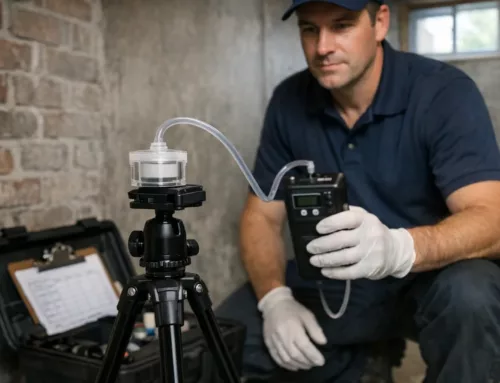
Our inspectors usually start with the things that cause the most deals to fall apart. Mold is number one. We take air samples (spore traps) and surface samples where there’s visible growth or staining, then send them to a lab for spore counts and species. That side of the work is what our mold testing service is built around. A musty smell with no visible source gets an odor inspection to trace it back to the cause, which is often hidden moisture or a failed building envelope. In older housing stock, especially homes built before the 1990s, we flag suspect materials for asbestos testing, since buyers planning renovations need to know what’s behind that popcorn ceiling or under the vinyl tile.
What’s in a pre-purchase assessment:
- Mold air sampling (spore traps) plus surface samples where there’s visible growth
- Asbestos material testing in pre-1990s homes, especially before a renovation
- Odor source tracing when there’s a smell but no obvious cause
- Moisture meter and thermal imaging walkthrough to find wet spots a camera never would
The full visit covers the same ground as a proper residential air quality assessment, just timed to your offer instead of a problem you’ve already discovered. The report tells you what’s there, how bad it is, and what it’ll take to fix. That last part is what your real estate lawyer actually cares about.
Is Mold Testing Part of a Standard Home Inspection?
No. A standard home inspection does not include lab-based mold or asbestos testing, and that surprises most buyers. General home inspectors are trained to spot visual and structural issues. They’ll note a water stain, but they won’t sample the air or send anything to a lab, and most aren’t certified to.
The gap that catches buyers: a home inspection can read “satisfactory” while mold sits behind finished walls. The inspector wasn’t wrong, mold testing simply wasn’t in their scope. Treat the two as a pair, not a substitute.
This is the gap we get called into constantly. A buyer gets a home inspection, everything reads “satisfactory,” and then someone notices a smell or a soft spot two weeks after moving in. It’s a separate, specialized service performed by IICRC and IAQA certified inspectors who do this all day. (For what it’s worth, a thorough home inspector will tell you when something’s outside their wheelhouse and recommend air sampling. The good ones do it routinely.)
The home inspection covers the bones of the house. Air quality testing covers what’s living in it. If you want to understand how the lab side works, our guide on understanding air quality test results breaks down what those spore counts mean in plain language.
How Much Does Air Quality Testing Cost in a Real Estate Deal?
Air quality testing for a real estate transaction in Canada typically runs from about $300 to $1,200, depending on the property and how many samples are needed. A focused mold air sample sits at the lower end. A larger home with multiple sample points, asbestos materials to assess, and a full written report lands higher.
Here’s roughly how it breaks down. These are ranges, not quotes, because square footage, the number of samples, and lab turnaround all move the number.
| Service | Typical range | Notes |
|---|---|---|
| Mold air sampling (typical home) | $300 to $650 | Each extra lab sample adds $80 to $120 |
| Asbestos material testing | Priced per sample | Usually a few hundred dollars for a small set |
| Combined transaction assessment | Upper end of range | Mold plus asbestos plus a full written report |
Put that against the stakes. Mold remediation alone can run anywhere from $3,000 to $20,000 or more once it’s behind walls or under flooring. A few hundred dollars of testing during your conditional period is cheap insurance against inheriting a five-figure problem.
We offer same-day reporting and flexible financing, and you can book testing through our team to fit a tight closing window. Keep the exact pricing conversation for the phone, since every property is different.
How Do You Make Air Quality Testing a Condition of Your Offer?
You make air quality testing a condition by writing it into your offer as an inspection-related condition, with a set number of days to complete testing and review results before the deal becomes firm. Your real estate agent and lawyer draft the wording. Don’t try to freehand this part.

Where air quality testing fits inside a typical home-purchase conditional period.
In Ontario, this rides alongside the inspection condition in the Agreement of Purchase and Sale, and the window is usually short, often 5 to 10 business days. Inside that window you order the test, get the lab results back, and decide. The condition lets you do one of a few things if a problem turns up: ask the seller to remediate before closing, negotiate a price reduction, request a closing credit so you handle it yourself, or, if it’s bad enough and the seller won’t move, walk away with your deposit intact. In Quebec, the same logic applies through a condition in the promise to purchase.
Timing is unforgiving. Lab turnaround eats into your window, so order testing early in the conditional period, not on day eight of ten. And know the difference between a condition you resolve before closing and a latent defect claim you’d have to chase afterward. The first is clean and contractual. The second is a lawsuit nobody wants.
If testing finds something during your condition, you’ve still got control. After closing, that control mostly depends on which province you’re in, which is the next thing worth understanding.
What Are the Disclosure Rules in Ontario vs Quebec?
Ontario and Quebec treat seller disclosure very differently, and it changes how much protection a buyer has after closing. Ontario leans on “buyer beware.” Quebec gives buyers a built-in legal warranty. If you’re moving between provinces or buying near the border around Ottawa and Gatineau, this distinction is one of the most important things on this page.

Ontario relies on buyer beware; Quebec gives buyers a legal warranty against latent defects.
Ontario: buyer beware
There’s no law forcing a seller to fill out a written disclosure of defects. Many use a voluntary Seller Property Information Statement (SPIS), but it’s optional. The principle is caveat emptor, buyer beware.
A seller can be held liable for a hidden defect they knew about and actively concealed, or for a dangerous defect they knew about and hid, but proving that after the fact is hard. This is exactly why pre-purchase testing carries so much weight in Ontario: the contract condition is your real protection, not the disclosure form.
Quebec: legal warranty
The Civil Code gives every buyer a legal warranty against latent defects, the vices cachés regime. A serious hidden problem like concealed mold, one a careful buyer couldn’t have spotted and that reduces the home’s usefulness, can give you recourse against the seller even after closing: cancellation, a price reduction, or repair costs.
There are limits. You generally have to give written notice and act within a reasonable time, tied to when you discovered the defect. And sellers can sometimes sell “without legal warranty, at the buyer’s risk and peril,” which strips that protection away, so read the promise to purchase carefully.
A dated pre-purchase air quality report becomes powerful evidence either way, because it documents the home’s condition at a specific moment. None of this replaces legal advice. Talk to a real estate lawyer in your province before you rely on any of it.
How Do Air Quality Results Affect the Deal?
Air quality results affect a deal by giving whoever holds the report room to renegotiate, delay, or cancel. A clean result builds confidence and keeps things moving. A bad result almost always changes the price, the timeline, or both.
We’ve watched the same handful of outcomes play out across thousands of inspections.
Seller remediates
The seller fixes it before closing and provides clearance testing to prove the work is done.
Price reduction
The price drops to reflect the repair cost, sometimes by far more than remediation actually runs, because buyers price in the hassle and the unknown.
Closing credit
Money is left on the table at closing so the buyer handles the fix their own way, on their own contractor’s schedule.
Buyer walks away
If testing was a condition and the problem is serious, the buyer can leave with their deposit intact. It’s their right.
There’s a financing angle people forget, too. Lenders and home insurers don’t love unresolved environmental findings, and a significant mold or asbestos issue can stall a mortgage approval or push a closing date. So a result isn’t only about buyer and seller. It can pull the bank into the conversation. Clearance testing after remediation is what closes the loop, the documented proof that the problem is gone, which is often what a lender, an insurer, or a cautious buyer needs to sign off.
What About Commercial Property Transactions?
Commercial property transactions raise the same air quality questions with higher stakes and more people who care about the answer. Investors, tenants, lenders, and property managers all have reason to want documented indoor air conditions before money changes hands. The due-diligence bar is simply higher.
For an office, a retail unit, a restaurant, or an industrial space, indoor air problems aren’t just a health concern, they’re a liability and an operating-cost issue. A mold problem in a leased building affects tenants and can trigger disputes. Older commercial buildings frequently contain asbestos in insulation, flooring, and fireproofing, which matters enormously for any buyer planning a fit-out or renovation. We handle these through commercial air quality testing, scaled to the building and the deal. The reporting tends to be more detailed because more parties rely on it. If you’re acquiring or leasing commercial space in Ontario or Quebec, testing during due diligence protects you the same way it does a homebuyer, just with more zeros attached.
Why Choose Air Quality Testing Canada for Your Transaction?
Air Quality Testing Canada brings 20 years and more than 15,000 inspections to the table, which matters when a report has to stand up at a lawyer’s office or in a renegotiation. We’re IICRC and IAQA certified, we use accredited labs for analysis, and we know both the Ontario and Quebec sides of these deals because we work in both provinces every week.
“We get called in during conditional periods all the time. The buyers who test before they sign are the ones who never call us in a panic after they’ve moved in.”
Air Quality Testing Canada, IICRC + IAQA certified inspectors
Speed is the other thing that counts during a transaction. Conditional periods are short, so we offer same-day reporting and we schedule around your closing timeline, not the other way around. Our reports are written to be useful, plain enough for a buyer to understand and specific enough for a lawyer or remediation contractor to act on. We test, we document, and we tell you straight what we found, including when the answer is “this house is fine and you don’t need to worry.” That honesty is part of why buyers, sellers, and agents across Montreal, Ottawa, Gatineau, and Kingston keep calling us back. When you’re ready, our Montreal team and Ottawa-Gatineau area inspectors can get out fast.
Frequently Asked Questions
Yes, but only if air quality testing was written into your offer as a condition. With a proper inspection or testing condition in place, a serious finding lets you walk away with your deposit, renegotiate the price, or ask the seller to remediate. Without that condition, your options after the deal goes firm shrink dramatically, especially in Ontario. This is the single best reason to make testing a condition rather than an afterthought.
The buyer usually pays for testing they order during their conditional period, and the seller can pay for testing they choose to do before listing. Remediation is negotiable. Common outcomes are the seller fixing it before closing, a price reduction, or a closing credit that lets the buyer handle repairs. Who ultimately pays for remediation depends entirely on how the negotiation goes once the report is in hand.
It depends on the province. In Ontario there’s no mandatory written disclosure, and the rule is buyer beware, though a seller can be liable for concealing a known, dangerous defect. In Quebec, the Civil Code’s legal warranty against latent defects (vices cachés) gives buyers recourse for serious hidden problems even after closing, unless the home was sold without legal warranty. Always confirm your specific situation with a real estate lawyer.
The on-site visit usually takes one to three hours depending on the size of the property and the number of samples. Lab analysis adds time on top of that, which is why turnaround matters during a short conditional period. We offer same-day reporting on the inspection side and work to get lab results back fast, so order testing early in your window rather than near the deadline.
Before. Testing before you buy gives you bargaining power and protection that mostly disappears once you own the home. During the conditional period, a finding can change the price or cancel the deal. After closing, fixing the same problem is on you, and recovering costs from the seller is difficult in Ontario and a legal process in Quebec. Front-loading the test is almost always the cheaper, less stressful path.