

Asbestos Testing in Toronto
Asbestos testing in Toronto means our inspector takes a small sample of each material you plan to disturb, and an accredited lab tells you in writing whether it contains asbestos. You can't see asbestos, so the ceiling you're about to scrape is a guess until a lab reads it.
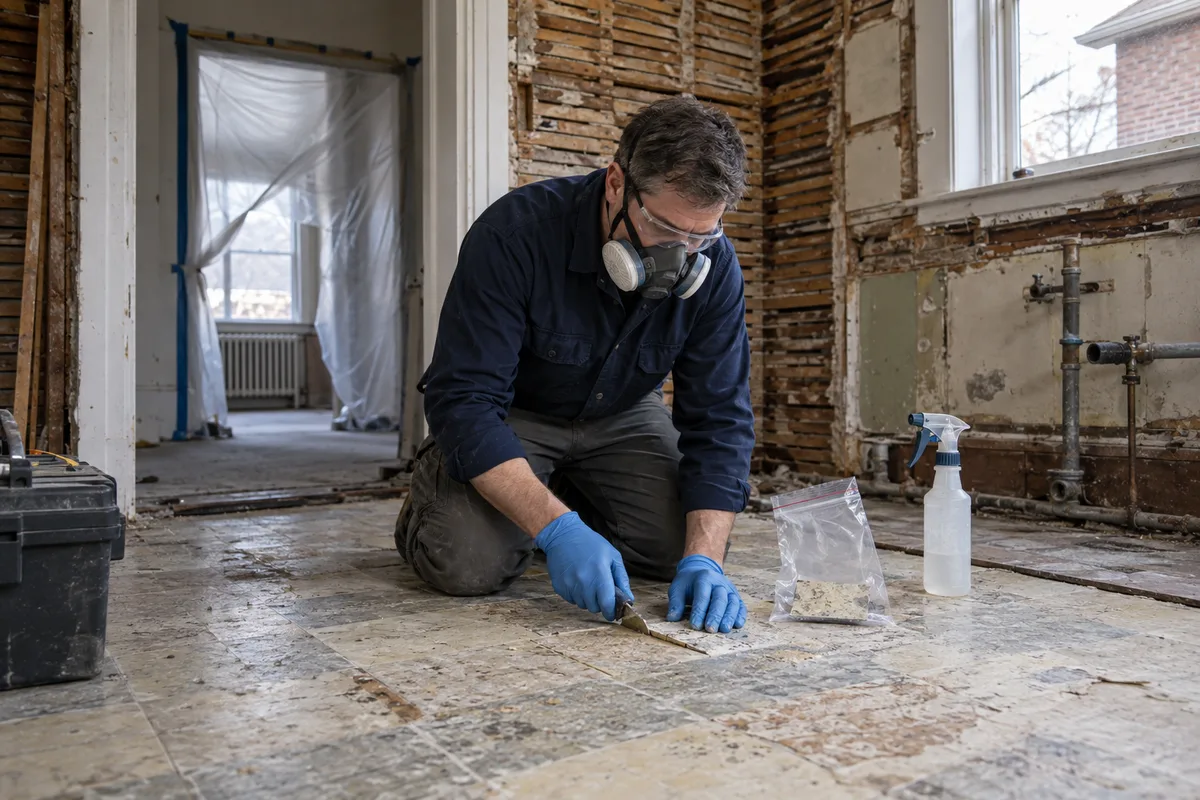
Accredited lab analysis
We don't do asbestos removal
Book your Toronto asbestos test
Tell us what you’re seeing. We’ll come back to you with a flat-rate quote.
Toronto Asbestos Testing at a Glance
| Phone | (647) 692-5969 |
|---|---|
| Hours | Customer service 24/7. Inspections Monday to Friday, 8 AM to 5 PM |
| Price | CAD 430 plus tax for the first material, CAD 250 for each extra material, one sample each |
| Travel fee | None in the GTA |
| What we sample | Ceiling texture, floor tile and glue, plaster, drywall joint compound, pipe and duct wrap, cement board and siding |
| Results | Written inspection report within 1 business day of the visit. Lab results in 3 to 4 business days, rush available for an added fee |
| What we don't do | Asbestos abatement or removal. We test, so the answer doesn't depend on selling you a removal job |
| Serving | All of Toronto, plus York Region, Durham, Mississauga and Brampton |
Full price list: asbestos testing cost in Canada.
We test Toronto homes, rentals, condos and commercial buildings for asbestos before renovation, demolition or purchase. Our own inspector samples each suspect material, an accredited lab analyzes it under a microscope, and you get a written yes or no for every material, with its asbestos type and percentage. The first material is CAD 430 plus tax and each extra one is CAD 250.
Most people call us at the same moment: a contractor has asked what's in the ceiling, or the drywall is coming down next week. That's the right time to ask. Everything about our asbestos testing service is built around one question, which is whether the material you're about to cut is safe to cut.
Last updated: 6 November 2026
Most Toronto homes went up while asbestos was still going into walls, floors and pipes
Toronto's housing is old by Canadian standards. In the 2021 census, 58.1% of the city's 1.16 million homes were built before 1981 and 67.5% before 1991. Put another way, if you pick any two homes on a Toronto block, odds are at least one of them was finished while asbestos products were still on store shelves.
The dates matter because different materials stopped at different times. Ontario's Ministry of Labour guide says asbestos was widely used in sprayed-on material and in pipe and boiler insulation until 1973, and that many other asbestos products continued until the mid 1980s. Health Canada uses 1990 as its line, and asbestos products have been banned in Canada since 2018. The bans don't reach back into walls that were closed up decades ago.
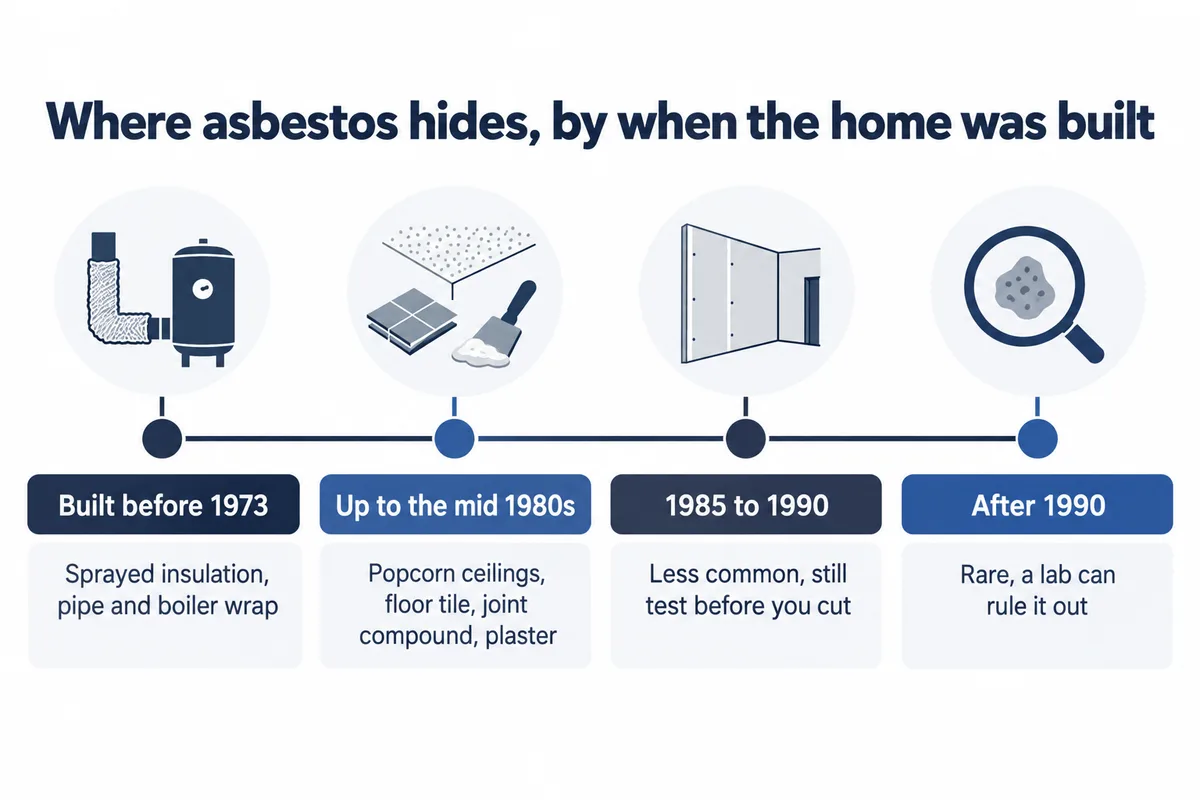
Sources: City of Toronto neighbourhood profiles, 2021 census (city totals are our own sum of the 158 neighbourhoods); Ontario Regulation 278/05 for the 0.5% definition.
But you can't tell asbestos by looking, so a lab result is the only real answer
The Canadian Centre for Occupational Health and Safety says it plainly: you can't tell if a product contains asbestos by looking at it, and the only way to know is a lab test. Two popcorn ceilings from the same year, on the same street, can come back different, which is why each one gets its own sample.
That cuts both ways, honestly. An old material isn't automatically dangerous, and a newer-looking one isn't automatically clean. Health Canada says asbestos poses no significant health risk when it's left undisturbed, sealed behind walls or floorboards, or tightly bound and in good condition. The risk starts when someone drills, sands, scrapes or breaks it.
Don't open it up before the result comes back. No scraping, sanding, drilling or demolition on a suspect material until the lab has answered. If it's already been disturbed, keep people out of the area, close the door and call us.
So we sample the materials a Toronto renovation is actually about to disturb
We don't test a whole house by default. We test what the work will touch. A kitchen reno usually means floor tile, the glue under it and the drywall joint compound. Finishing a basement can add a ceiling texture, plaster and the old wrap on furnace ducts. Here's where each material tends to show up in Toronto:
| Material | Where we find it in Toronto | Typical era |
|---|---|---|
| Pipe and boiler insulation | Basements of pre-war semis and row houses, old boiler rooms in walk-ups | Widely used until 1973 |
| Sprayed-on fireproofing and insulation | Mechanical rooms, parking garages and ceilings of 1960s and 70s towers | Widely used until 1973 |
| Plaster, including textured and acoustic plaster | Walls and ceilings of older houses, hallways of older apartment buildings | Into the 1980s |
| Stipple (popcorn) ceilings | Bungalows and suburban houses in Scarborough, North York and Etobicoke, apartment suites | Common before 1984 |
| Vinyl and asphalt floor tile, sheet flooring and mastic | Kitchens, basements, hallways, often under newer flooring | To the mid 1980s |
| Drywall joint compound | Any drywall from before the mid 1980s, including old basement finishes | Common before 1984 |
| Duct insulation and flexible duct connectors | Older forced-air furnaces and their ducts | To the mid 1980s |
| Cement pipe, siding and board | Exterior siding, soffits, old flue pipes | To the mid 1980s |
Sources: Ontario Ministry of Labour guide to O. Reg. 278/05, Appendix 2 (sample list of suspect materials and dates); Canadian Bar Association, Asbestos in the condominium (drywall compound, stippled ceilings and acoustic tile before 1984).
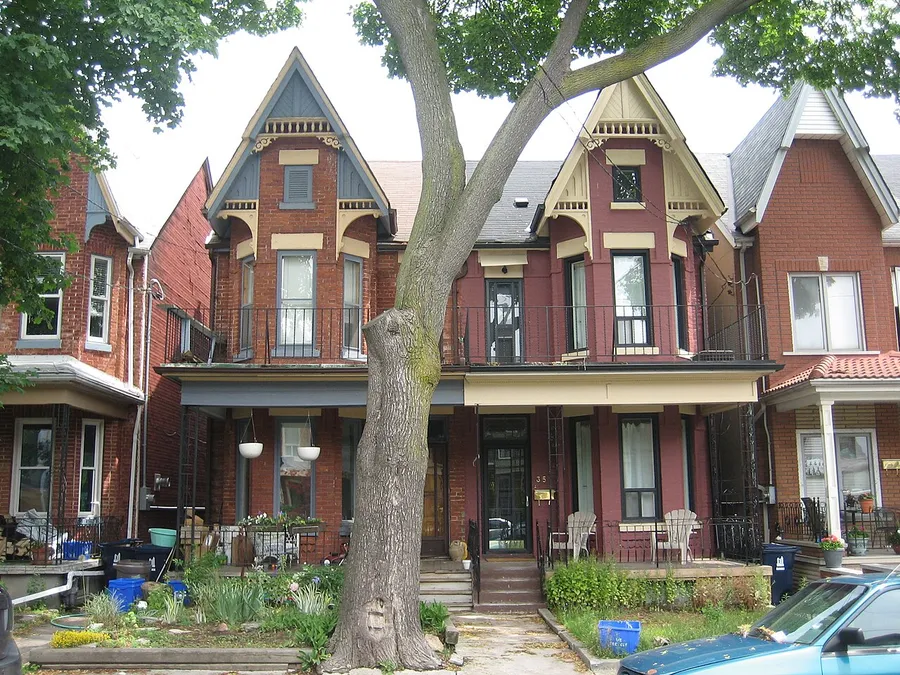
Pre-war brick semis and row houses
Plaster on lath, pipe wrap on old heating lines, and floors laid over floors. Anything in the basement near the original boiler deserves a sample before it comes out.
1950s to 1980s bungalows and suburban houses
Stipple ceilings, vinyl floor tile, drywall compound and furnace duct wrap. This is the stock we sample most often before kitchens and basements are redone.
1960s and 70s towers and walk-ups
Ceiling texture and floor tile inside units, plus fireproofing and pipe insulation in the common areas. Inside a suite, the unit owner tests. The building itself is the owner's job.
Who has to test depends on whether you live there, rent it out, run the building or do the work
Ontario's rules are in Ontario Regulation 278/05, and they treat four kinds of people differently. We're inspectors, not lawyers, so read this as a plain-language map and get advice if your case is close.
You own and live in the home
Section 2(4) exempts the owner of a private home that they or their family live in, and a building of up to four units with one lived in by the registered owner or family. But the Ministry of Labour's guide says the regulation still applies to the contractors and workers on your job. Expect a careful contractor to ask for a result before quoting.
You rent a unit or house to someone outside your family
The same guide answers this one directly: yes, the regulation applies to you. Before you ask for tenders or arrange a repair, section 10 says the material likely to be disturbed has to be examined and a report given to the contractor.
You sit on a condo board or manage a building
Once an owner knows or ought to know asbestos was used, section 8 requires a record kept on site, written notice to occupiers and hired trades, regular inspections and a yearly update. Some corporations also require board approval before a unit owner renovates. Building-wide work is covered on our commercial air quality testing page.
You're the contractor
What you're allowed to do depends on the result. The regulation sorts work into Type 1, 2 and 3 operations by how much fibre it can release, and a Type 3 job needs notice to a Ministry inspector first. If you find a suspect material that isn't in the owner's report, the work that would disturb it stops until it's tested.
Toronto demolition permits. Under Chapter 363 of the Toronto Municipal Code, a permit application that includes demolition must say whether there's a list of designated substances, including asbestos, as the Occupational Health and Safety Act requires. A house is the exception. So a semi or bungalow teardown skips that question at the permit counter, while a walk-up, a store or an office doesn't. We sample asbestos for that list, not the other designated substances.
Therefore the visit is short, and who you are decides how many samples each material needs
-
1
Before the visit
You tell us what's coming out
Call or send the form with the rooms and materials the work will touch. You get a flat-rate quote by material.
-
2
Visit day
We sample with as little dust as possible
The inspector cuts a small piece with clean tools, wets it to limit dust and seals it in a labelled container. Each sample is photographed and logged by location.
-
3
Within 1 business day of the visit
You get the written inspection report
What we sampled, where, and why, with photos of each spot.
-
4
3 to 4 business days
The accredited lab returns its results
Asbestos type and percentage for each sample. Rush analysis is available for an added fee.
The sample count is where owners get confused. A homeowner who just wants to know before opening a ceiling usually needs one sample per material. An owner covered by the regulation has to meet its minimums in Table 1: three samples for most materials, and three, five or seven for sprayed or trowelled surfacing depending on its area (the Toronto air quality testing page has that full "3-5-7" table). The minimum is set by the material and its area, not by how big your house is. We'll tell you which case you're in when we quote.
The first thing I ask on an asbestos call is what's coming out and when. A kitchen floor and a basement ceiling are two different materials, so they're two samples. I'd rather sample the three things you're actually removing than the whole house you're not touching.
 Luka Markovic
Senior Indoor Environmental Inspector and Engineer · Certified Mold Inspector (CMI) · More than 1,700 on-site and virtual inspections
You can read more about what happens during an inspection before you book.
A mail-in kit costs less, but it makes you the person disturbing the material
Yes, you can buy a kit, cut your own piece and mail it to a lab. For a homeowner in their own house that's legal, and the lab result itself can be perfectly accurate. We won't pretend otherwise.
The trouble is everything around the result. CCOHS advises homeowners not to remove or disturb suspect material themselves, and cutting a sample is disturbing it. A kit won't tell you which areas count as one material, how many samples a contractor or condo board will expect, or what to do when the drywall in the basement isn't the same drywall as upstairs. And a single result in an envelope isn't the location-by-location written report your contractor needs to plan the work.
Myth One sample from one room clears the whole house.
Fact A sample speaks for one material. The ceiling in the living room and the patch in the hallway can be different products from different decades.
Myth If it's asbestos, it has to come out right away.
Fact Not if you're leaving it alone. Health Canada says undisturbed material in good condition poses no significant risk.
A material sample answers the renovation question, and an air sample answers the cleanup question
Lots of pages online mix these up. They're two different tests for two different moments.
Material (bulk) sample
Does this ceiling, tile or wrap contain asbestos? Taken before a renovation, a demolition or a purchase. The result is a percentage of asbestos in the material. This is the test almost every Toronto homeowner needs.
Air sample
Are there fibres in the air now? Taken after removal work, to confirm the area is clear, or after an accident like a cracked ceiling. The result is fibres per cubic centimetre of air. It's CAD 450 plus tax for the first sample and CAD 330 for each extra, on request.
An air test before a renovation can't tell you what's inside a ceiling that hasn't been touched yet. That's why we almost always start with the material.
Buying a pre-1980 Toronto house? Test what you plan to open up, not every room
A home inspector will often write "possible asbestos" next to a ceiling or a furnace wrap. That's a flag, not an answer. If you're planning a renovation after closing, sample the materials that renovation will touch: the kitchen floor, the basement ceiling you want to drywall over, the duct wrap if the furnace is going.
Timing is the catch. The written report comes within 1 business day of the visit and lab results in 3 to 4 business days, so it fits inside a conditional period only if the seller gives access early. Our air quality testing for home buyers guide covers what else is worth checking before you firm up.
The lab report gives a type, a percentage and a location, and one positive covers the whole area
Each sample comes back with the asbestos type, if any, and its percentage. Under Ontario's regulation, a material with 0.5% or more asbestos by dry weight is asbestos-containing, and one positive result makes the whole area of that material asbestos-containing. The lab can stop analyzing the rest of that set once it finds one.
A positive result is a planning fact, not an emergency. If you're not renovating, the material can often stay exactly where it is. If you are, a qualified abatement contractor removes it before the rest of the work, using the procedures the regulation sets for that type of job. We don't do asbestos abatement or removal. Our report goes to whichever contractor you hire, and we can come back for the clearance air test when they're done.
One practical Toronto detail: the City's drop-off depots don't accept asbestos. Disposal is a job for a private company, which is one more reason it belongs with your abatement contractor and not in your car trunk.
What asbestos testing costs in Toronto, where the number of materials sets the total
Toronto prices are the same as everywhere else we work, with no travel fee in the GTA. All prices are in Canadian dollars, plus tax.
| Service | Price | What you get |
|---|---|---|
| First material | $430 | Inspector's visit, sampling, accredited lab analysis and written report |
| Each extra material | $250 | Another material sampled in the same visit and analyzed |
| Asbestos air test | $450 | First sample, on request, for clearance after removal. Each extra sample is $330 |
Slow down here, because the material count is what moves the bill. A few typical Toronto jobs, sampled once per material:
- A 1970s Scarborough kitchen with floor tile and drywall compound coming out: two materials, $680.
- Finishing the basement of a 1960s Etobicoke bungalow, touching the stipple ceiling, floor tile, plaster and furnace duct wrap: four materials, $1,180.
- Gutting a pre-war Leslieville semi, with plaster, floor tile, pipe wrap, ceiling texture and drywall compound: five materials, $1,430.
You'll see lower Toronto prices online, some starting around $199. Before comparing, ask whether that price includes someone coming to your home, safe sampling, the lab analysis and a written report with locations. Those are what your contractor actually needs. Owners covered by the regulation need more samples per material, and we'll price that up front. Our asbestos testing cost guide goes deeper.
We test for asbestos across Toronto and the GTA, and the older the street, the more often the answer is yes
Our own inspectors cover the whole city. We don't have a Toronto street address to list yet, so everything books by phone or through the form.
- Old Toronto and East York: the Annex, Little Italy, Cabbagetown, Riverdale, Leslieville, the Danforth, Leaside, the Beaches
- Etobicoke: Mimico, Long Branch, the Kingsway, Islington, Rexdale
- North York: Willowdale, Don Mills, Lawrence Park, Downsview, Weston
- Scarborough: Bendale, Cliffside, Agincourt, West Hill, Scarborough Village
- Around the city: York Region, Durham, Mississauga and Brampton
Worried about mould in the same basement? We can run mold testing during the same visit. West of the city, our Mississauga air quality testing page covers Peel, and the service areas page lists everywhere else.
- Since 2005 testing homes in Ontario and Quebec
- 15,000+ inspections
- IICRC Certified
- IAC2 Certified
- Certified Indoor Air Quality Inspector
- Certified Professional Inspector
- Indoor Air Quality Association (IAQA) corporate member
Toronto asbestos testing questions
Asbestos testing is CAD 430 plus tax for the first material and CAD 250 for each extra one, including the visit, sampling, lab analysis and written report. Two materials come to CAD 680 and four to CAD 1,180. There's no travel fee anywhere in the GTA. Our asbestos testing cost guide has the details.
A homeowner testing before a renovation usually needs one sample per material the work will disturb. Owners covered by Ontario Regulation 278/05, such as landlords and condo corporations, must meet its Table 1 minimums: three samples for most materials, and three, five or seven for sprayed or trowelled surfacing depending on area. We'll tell you which applies when we quote.
If you own and live in the home, Ontario's asbestos regulation exempts you as the owner. Your contractor and their workers are still covered, so they'll usually want a result before cutting into anything built before 1990. Testing first also protects your family from dust you can't see. See our asbestos testing service.
A landlord renting to someone outside their family is covered by Ontario Regulation 278/05. Before arranging repairs that could disturb a suspect material, they must have it examined and give the report to the contractor. If you're a tenant worried about work in your unit, ask your landlord for that report first. For property standards problems, Toronto tenants can contact 311.
Some corporations require board approval before a unit renovation, and a board that knows asbestos was used in the building has its own record and notice duties under the regulation. Ask your property manager what they need before work starts. A written lab report for the materials in your unit usually answers it. Building-wide surveys are covered by our commercial testing.
It might. Stippled ceilings were commonly made with asbestos before 1984, but plenty weren't, and you can't tell by looking. One sample of the ceiling texture, analyzed by an accredited lab, settles it before you scrape. Don't wet-scrape or sand it to "check". Our asbestos testing page explains the sampling.
A homeowner can legally mail a sample to a lab, and the lab result can be accurate. But cutting the sample means disturbing the material, which CCOHS advises homeowners not to do, and a kit won't give your contractor a written report with locations and sample counts. For a renovation, a professional sample is usually worth the difference.
No. We don't do asbestos abatement or removal. We test, so our answer doesn't depend on selling you a removal job. If a material comes back positive and the work has to go ahead, a qualified abatement contractor removes it, and we can return afterward for a clearance air test. Book through the form or call (647) 692-5969.
Get the Lab Result Before the First Cut
The ceiling, the tile and the wrap are guesses until a lab reads them. Book a visit and you'll have a written answer for every material your Toronto renovation will touch.
Customer service 24/7 · Inspections Monday to Friday, 8 AM to 5 PM · Flat-rate quotes