
Air Quality Data Logger vs Consumer Monitor: Which One Do You Need?
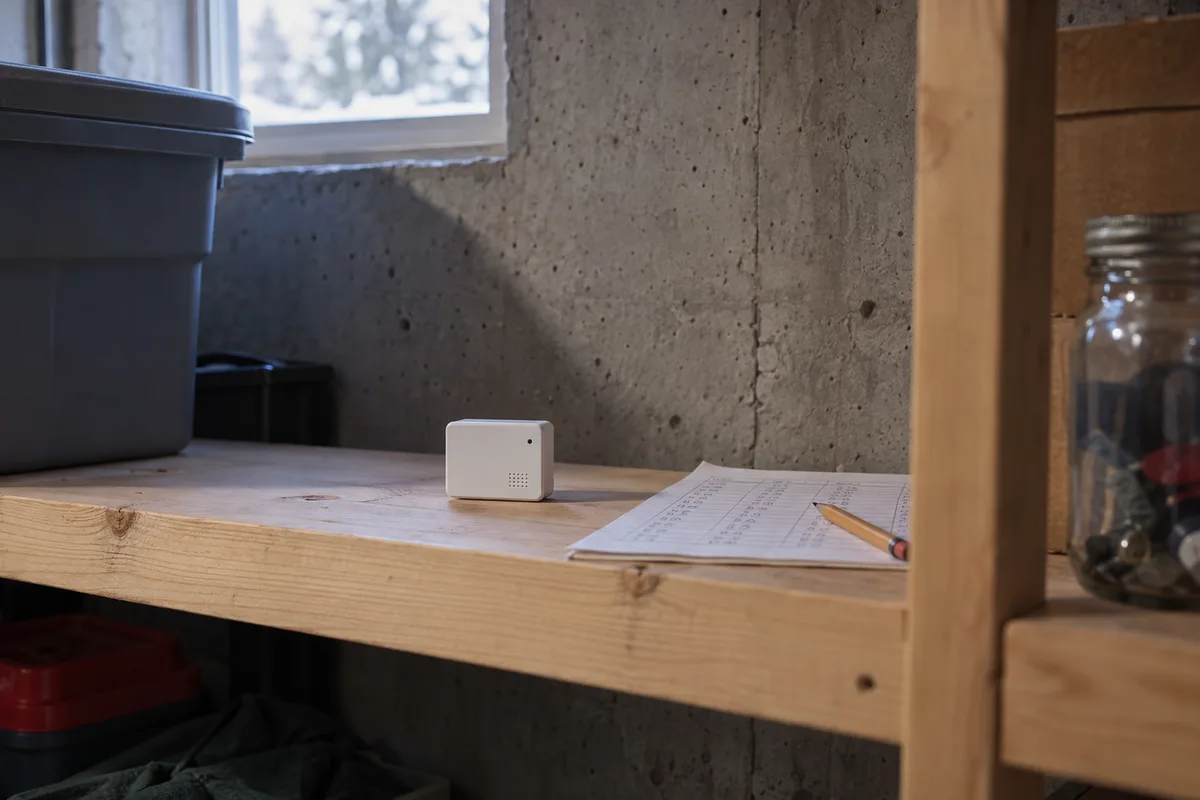
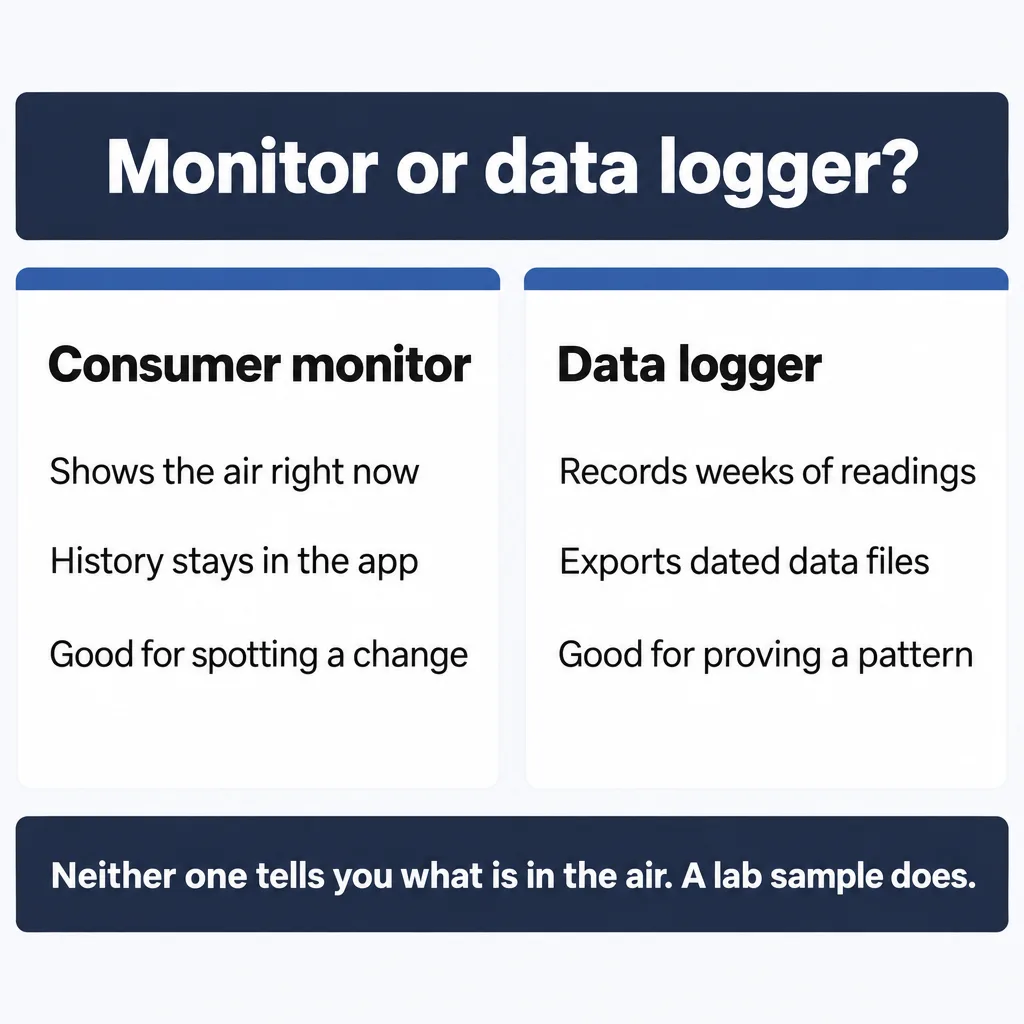
A consumer air quality monitor shows you what the air is doing right now. A data logger records readings for weeks and lets you export them, so you can show a pattern to someone else. If you're shopping for one, you've probably got a damp basement, a stuffy office or a number on a screen that's started to bother you.
A number on a screen is a clue, not a result. So pick the tool by what you need to do with the reading: react to it today, or prove something next month. And if you need to know what's actually in the air, neither one will tell you, and that's when a sample goes to an accredited lab.
What's the real difference between a data logger and a consumer monitor?
The real difference is what happens to the reading afterwards. A monitor is built around the live display and the app. A logger is built around the record: timestamped readings you can download and hand to a landlord, a contractor or an inspector.
| Consumer monitor | Data logger | |
|---|---|---|
| Best at | Showing a change as it happens | Showing a pattern over weeks |
| The reading lives | On a screen or in the maker's app | In a dated file you can export |
| Usually measures | Several things at once, such as PM2.5, CO2, tVOC and humidity | Often just one to three things, measured for a purpose |
| Accuracy paperwork | Rarely offered | Published specifications, with calibration certificates on some models |
| Rough price | About $100 to $400 | About US$165 for temperature and humidity, about US$635 with CO2 (one maker's models at a US retailer, November 2026) |
Those logger prices come from Onset's HOBO MX110 series, as an example and not a recommendation. Canadian prices will differ, so check with a local supplier. If you're mostly choosing a monitor for the house, our smart home monitor buying guide goes through them by budget.
But is a data logger more accurate than a monitor?
Not automatically. A logger with a cheap sensor just stores more of the same error, so check the specification and the calibration date rather than the word "logger" on the box.
Consumer monitors have known weak spots too. Optical PM2.5 sensors can read high in damp air, which is awkward in a basement, and we cover why in how humidity affects monitor accuracy. A tVOC reading is a total, so it won't name the chemical. Airthings says so plainly about its own sensors: they don't differentiate between individual gases.
Before you buy for documentation: if an employer, an insurer or a tribunal may read the data, ask them what instrument and calibration record they'd accept before you spend the money.
So which readings are worth logging?
Humidity and CO2 are the most useful readings to log, because Health Canada gives a clear reference for each and both change slowly enough to show a pattern. The others are better treated as trend lines.
| Reading | Reference point | What a log can show |
|---|---|---|
| Relative humidity | 30% to 50% (Health Canada) | Which rooms stay damp, and for how long |
| CO2 | 1,000 ppm, 24-hour average (Health Canada) | Whether a room gets enough fresh air while it's occupied |
| Temperature | None for this purpose | Cold spots, when read alongside humidity |
| PM2.5 | Use it as a trend | When particles rise, such as cooking or wildfire smoke days |
| tVOC | Use it as a trend | That something changed, without saying what |
Myth My bedroom hit 1,400 ppm of CO2 this morning, so it's over the Health Canada limit.
Fact The 1,000 ppm figure is a 24-hour average. A closed bedroom can peak at dawn and still average lower. That's why a log tells you more here than a single glance at a screen.
Myth A humidity log showing 65% means I have mould.
Fact It means the room is above Health Canada's range and conditions favour mould. Whether any is growing is a separate question.
When is a data logger worth it over a monitor?
A data logger is worth it when you'll need to show the record to someone or when the problem comes and goes. For quick feedback, like checking an air purifier, a monitor is fine and cheaper to live with.
A basement that's damp some weeks
A temperature and humidity logger across a rainy stretch shows when it climbs. If you're also weighing portable and stationary monitors, this is a job for something that stays put.
A dispute over a rental
Dated exports hold up better in a conversation than a screenshot of an app. A log can't prove the cause, but it does prove the conditions.
An office that feels stuffy by 3 PM
A CO2 log across a full work week shows the daily climb. If the building has a mold or asbestos question, see our commercial air quality testing.
Checking if the purifier does anything
Stick with a monitor. You want to watch particles fall in real time, and nobody needs to read the file afterwards.
How to get a log someone can use
- 1
Decide the question first
"Is this basement damp all week or only after rain?" tells you what to log and for how long.
- 2
Put it where people or problems are
Keep it away from vents, exterior doors and direct sun, unless one of those is what you're studying.
- 3
Run it for at least two weeks
Two weeks catches weekdays, weekends and some weather. A logger left running for one good day proves very little.
- 4
Write down what happened
Note the rainstorm, the houseguests and the day the dehumidifier ran. A spike with a note beside it is worth ten without.
But neither one can tell you what's in the air
Neither a monitor nor a logger can identify mould or asbestos. They measure conditions and totals. Naming what's there takes a physical sample and a lab, which is the whole reason different types of air samplers exist.
That doesn't make your log useless. It's a good thing to have at the door when an inspector arrives, because a month of humidity data points at the room worth sampling. Our inspectors take their own moisture readings too, and the mould test that follows goes to an independent accredited lab, with an outdoor control for comparison. You'd usually get a written report the same day as the visit, and mould lab results 3 to 5 business days after sampling.
Frequently asked questions about air quality data loggers
An air quality data logger records readings at set intervals and stores them with the date and time, usually for humidity, temperature or CO2. You download the file later and read the pattern. It doesn't identify mould or asbestos. See how air quality sensors work.
Run a data logger for at least two weeks, so it catches weekdays, weekends and some weather. A humidity question in a basement is better across a rainy spell, and a seasonal question may need a reading in both winter and summer. Keep notes on anything unusual. Read how humidity affects readings.
No. A monitor or logger can show humidity that favours mould, but it can't detect mould itself. Finding out what's growing takes a sample, an outdoor comparison and an accredited lab. A log is still useful, because it helps show where to sample. See how our mould testing works.
It depends on who will read the data. A log with a current calibration certificate can support a conversation about ventilation, but it won't replace an assessment if someone needs a formal finding. Ask your employer or regulator what they'll accept before you buy. See our commercial air quality testing.
You've got the pattern. Now find out what's behind it.
Bring us your log, or just the question. We'll tell you whether a sample would answer it. Call 1-866-528-2897, any time, 24/7. Inspections run Monday to Friday, 8 AM to 5 PM.